Awakening Cooperative Lab · Library
Talk report: Yi-Guang (Tim) Chen, “Protecting students’ right to learn and parents’ right to educational choice through democratic processes in Taiwan” (KASpaces Taiwan National Seminar, 2021)
This talk report traces Yi-Guang (Tim) Chen’s account of educational choice in Taiwan, showing how democratisation and multi-stakeholder cooperation expanded homeschooling and experimental education.
- Event
- KASpaces National Seminar — Decoding the DNA of Taiwan Education: Where Do We See Progress and Equality?
- Date
- 2021-10-24
- Author
- Lab report (machine draft, unreviewed)
- First published
- The speaker’s recorded talk for the seminar
- Copy taken
- 2026-11-22
- Event
- KASpaces National Seminar — Decoding the DNA of Taiwan Education: Where Do We See Progress and Equality?
- Date
- 2021-10-24
- Author
- Lab report (machine draft, unreviewed)
- First published
- The speaker’s recorded talk for the seminar
- Copy taken
- 2026-11-22
Contents
Yi-Guang (Tim) Chen, founder of Taiwan Homeschool Advocates, delivered a pre-recorded talk during Session 3 of the KASpaces National Seminar on Accelerating Progress and Equity in Education, held online on 23–24 October 2021. Chen’s central claim was that Taiwan’s expansion of educational choice developed alongside democratization through sustained cooperation among students, parents, schools, and government, rather than through a solely top-down reform.
Educational choice and participation
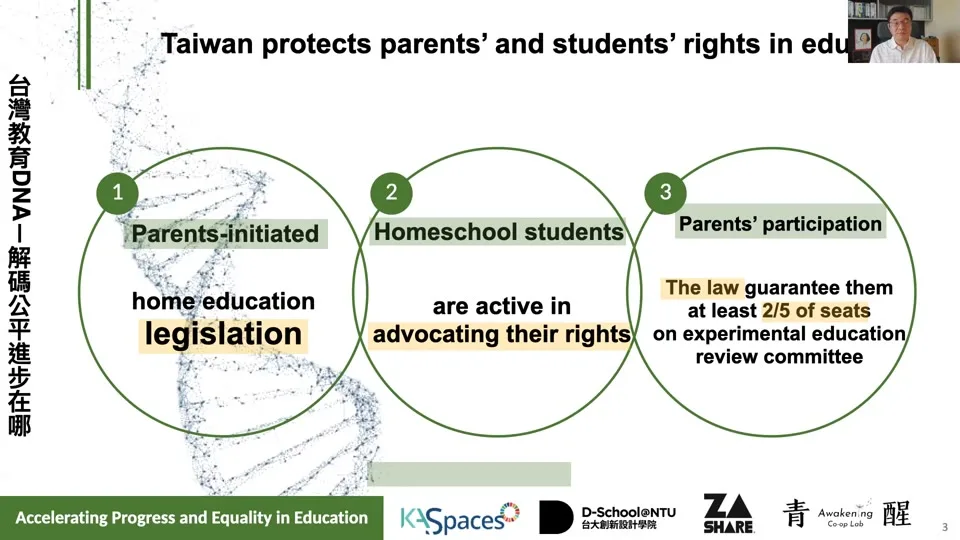
Chen introduced his family as a “global homeschool family” based across Taiwan, Japan, Poland, and the USA. His family had homeschooled since 2003, while he had advocated for educational choice in Taiwan since 2007. He had also participated in international home-education exchanges and advised the Taiwanese government on education policy.
He described several distinctive features of Taiwan’s system. Many reforms concerning home education and experimental education were parent-led, while students actively advocated for their own rights. Six students served on the national curriculum board alongside other members, including Chen. Parents also participated in the review committees responsible for implementing experimental-education rules.
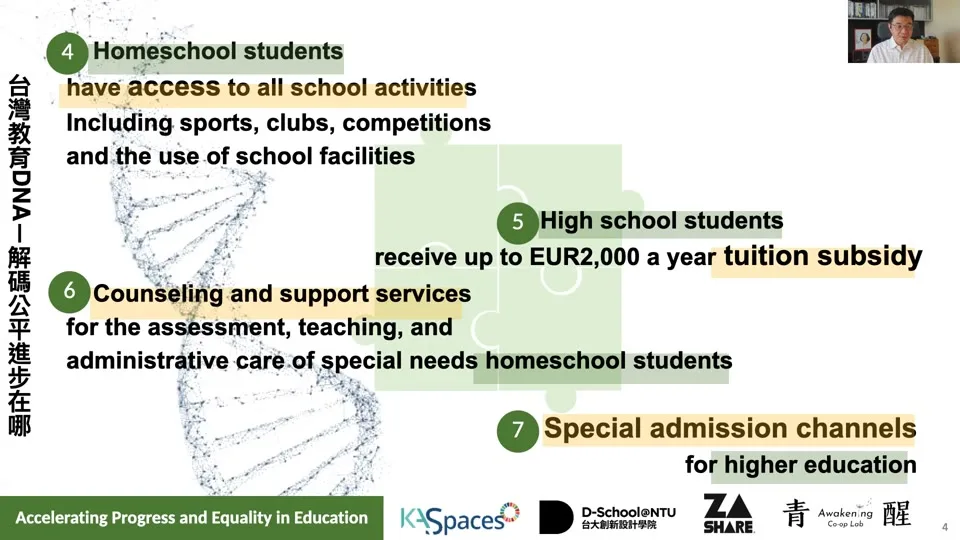
According to Chen, homeschooled students could use school facilities and participate in activities including sports, clubs, and competitions. Homeschooled high-school students could receive government tuition subsidies of about €2,000 per year, which he said gave them greater financial independence in choosing what to study. Government support also included counselling, assessment, teaching and administrative assistance, with additional provision for students with special needs. Special admissions channels were available for students seeking to enter higher education.
Chen said these arrangements had not appeared overnight. He reported a sevenfold increase in student participation in experimental education over the preceding nine years, reflecting growing interest among parents and students. (0:00:00–0:06:25)
From restricted schooling to local experiments
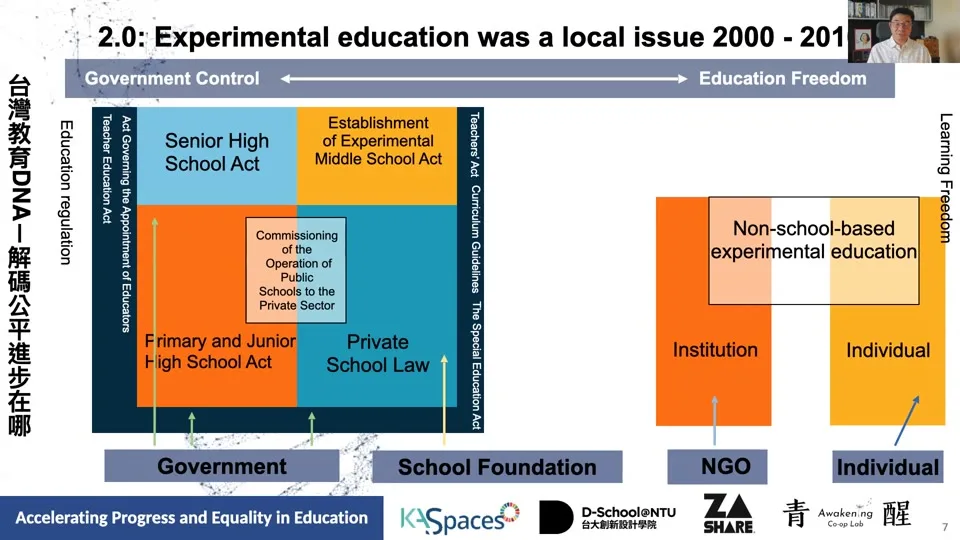
Chen placed the development of educational choice within Taiwan’s political democratization. Martial law was lifted in 1987, and the transition from dictatorship toward democracy began around 1990. During the same period, parents, educators, and students sought more educational options.
Before 1999, he said, choices were limited. At the primary level, students could attend either a public or private school, but private schools enrolled less than 1 percent of students. At the high-school level, the available categories were public or private vocational and regular high schools. More than half of high-school students attended vocational schools, and more than half of those schools were privately operated. Students in private schools, particularly vocational schools, paid more than those in public regular high schools.
Despite the public-private distinction, the national curriculum tightly regulated what schools taught. Chen argued that this left students with little meaningful choice concerning education or learning. Schools were established either by government or by foundations whose well-endowed founders had government connections, within a system in which education had been used to control citizens.
Change first appeared through local initiatives. Some local governments began allowing “non-school-based education,” including homeschooling and small alternative learning groups. Individual parents could apply for children not to attend school, while NGOs could establish small learning groups for students who did not want conventional schooling. Local governments also experimented with allowing private organizations to operate public schools, which Chen compared to charter schools and UK academies.
These arrangements initially lacked national legislation. Educational freedom therefore depended on jurisdiction: a family in Taipei might have access to options unavailable elsewhere. Chen became involved in advocacy in 2007 after five years as a homeschooling parent, seeking to extend to other families the choices his own family had exercised. (0:06:25–0:10:25)
National regulation and experimental-education laws
Before 2014, national reform proceeded through incremental changes. The government introduced common regulations intended to harmonize the differing experimental-education rules used by local governments, although these regulations had not yet been enacted by parliament. One result was that high-school homeschooling became possible from 2011.
Chen distinguished three forms of non-school-based education. An individual application allowed parents to educate their own children. A group application allowed parents of up to 30 students to use a common curriculum, resembling a US homeschooling cooperative. An institutional application allowed an NGO to conduct an educational experiment based on a particular philosophy. He said participation grew under these arrangements, while experimentation within senior high schools remained limited and concentrated mainly on curriculum.
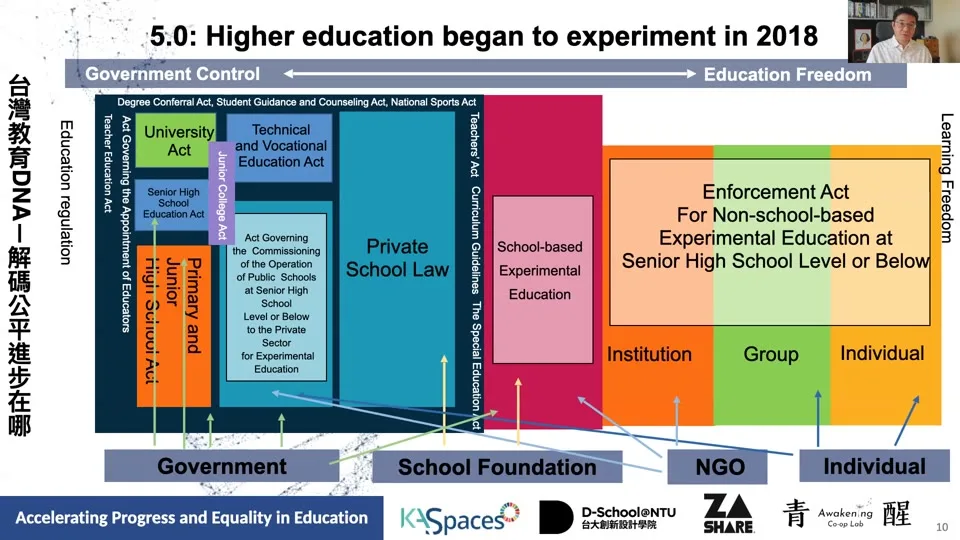
Concerned that administrative regulations could change with a change of government, advocates sought stronger legislative protection. Parliament passed legislation in the winter of 2014, and three experimental-education laws took effect in 2015. These covered non-school-based education, school-based experimental education, and the private operation of public schools. School-based experimentation allowed public and private schools to depart from some conventional regulations, while the new framework made privately operated public schools possible nationwide.
Three years later, the legislature revised the laws. Chen said the amendments strengthened protections for individuals and non-school-based learners and extended school-based experimentation into higher education. He emphasized that Taiwanese universities remained heavily regulated and, even by 2018, had only limited room to experiment, principally with curriculum. (0:10:31–0:15:51)
Toward learner autonomy
Chen identified learner autonomy as the next major direction. He connected this development to the national curriculum introduced in 2019, under which every high-school student had to complete at least one hour per week of independent or self-directed study. Students therefore had to decide what they would learn, while educational structures became less directive.
He described this movement as a shift toward “heutagogy,” in which learners assume greater independence and responsibility. Since 2018, some universities had begun allowing selected students to design their own degrees and curricula.
Chen also said that he and his partners were applying for a licence to operate an experimental university in 2022 based on heutagogical principles. Students would design their own curricula and tell the institution what they wanted to learn; the institution’s role would be to help them realize those plans. He expected this approach to spread through other levels of education over the following ten years. (0:15:51–0:17:59)
Democratic cooperation and educational rights
In closing, Chen characterized Taiwan’s development of educational and experimental choice as a multi-stakeholder process. It was neither an initiative imposed by a particular government or bureaucrat nor simply a bottom-up revolution. Students, parents, schools, and government worked together to establish rules governing experimental education.
He contrasted this approach with government micromanagement of education in China, including restrictions on subjects, time spent playing video games, and after-school classes. He then situated Taiwan’s experimental-education framework within international rights principles. He said it complied with the Universal Declaration of Human Rights by recognizing parents’ priority in choosing the education provided to their children. He also referred to the Convention on the Rights of the Child, emphasizing children’s right to education and to educational choice. (0:17:59–0:20:14)
How this connects
The centre is this page. Each mark is a page or a person that the site’s records link to it; a line between two marks means those two are linked as well.