Awakening Cooperative Lab · Library
Talk report: Kate Hsu on Design for Change and becoming a founder
This report follows Kate Hsu’s account of turning learning into action and sustaining change through difficult communication with family, teammates and herself.
- Event
- The INNER and INTER-changes of Creative Changemakers (TIES 2021)
- Date
- 2021-06-29
- Author
- Lab report (machine draft, unreviewed)
- First published
- Recording on YouTube
- Copy taken
- 2026-11-22
- Event
- The INNER and INTER-changes of Creative Changemakers (TIES 2021)
- Date
- 2021-06-29
- Author
- Lab report (machine draft, unreviewed)
- First published
- Recording on YouTube
- Copy taken
- 2026-11-22
Contents
Kate Hsu (許芯瑋), Founder and CEO of Design for Change, Taiwan, delivered the “Eastern perspective” talk in Section 1, “OTHERwise: Wit ain’t from nowhere,” at the online 2021 Taiwan International Education Summit on 29 June 2021. Introduced by summit curator and session host Adler Yang (楊逸帆), Hsu argued that creating change requires sustained communication with family and friends, teammates, and oneself, especially when expectations, failures, and relationships complicate the work.
From classroom answers to action
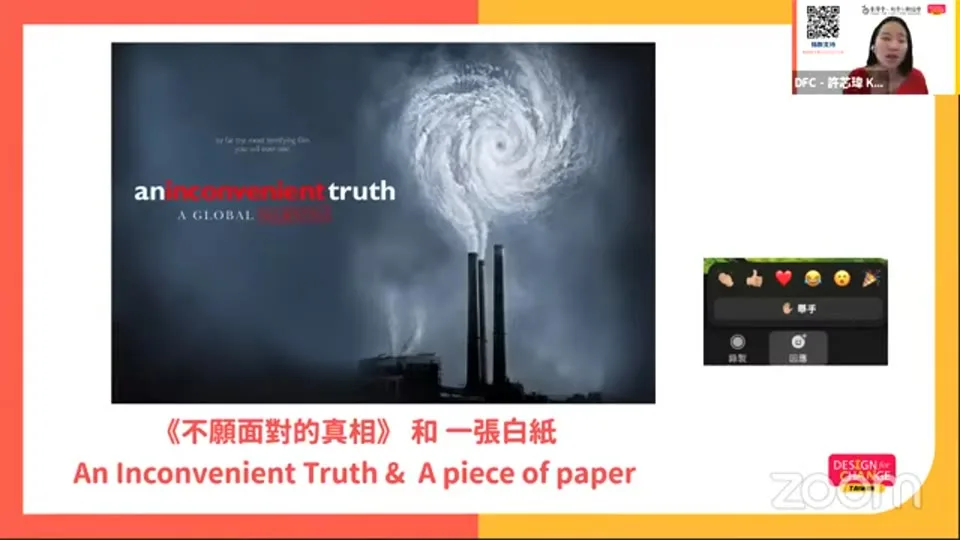
Hsu began with a photograph taken by her husband, using it to express her view that people are interconnected and that “nobody is an island.” Before founding Design for Change Taiwan, she had been an English teacher at the high school from which she had graduated. She said that she loved teaching and working with her students, but an experience involving the documentary An Inconvenient Truth changed her understanding of education.
After showing students part of the documentary, Hsu asked them to identify the causes of global warming and propose actions that might slow it. Their answers included switching off air conditioning, fans, and projectors after class. Participants in the online session offered similar suggestions, including eating less beef, raising air-conditioner temperatures, eating vegetables, reducing carbon emissions, and spreading awareness.
When the class ended, however, Hsu found that the fans and projector remained on. A student assistant explained that he had thought the answers were submitted only for marking. Hsu described this as her turning point: “I want my students to make common sense into common practice” (0:10:53). She wanted students to act on what they learned and extend their learning beyond textbooks, although at that stage she did not know how to accomplish this.
(0:02:09–0:11:46)
The Design for Change process
While searching for resources, Hsu encountered Kiran Bir Sethi, founder and principal of Riverside School in India, and her TED talk “Kids, take charge.” Hsu said that this talk changed her life and introduced the process she called FIDS: Feel, Imagine, Do, and Share. Children identify something that troubles them, imagine possible solutions, plan and take action, and then share their stories of change.
Hsu described the process as simple enough for children to use in addressing problems around them. Projects undertaken by students in Taiwan had dealt with cyberbullying, food waste, dangerous traffic around schools, excessive homework, and teachers whom students considered mean.
She then asked participants to anticipate teachers’ objections to using FIDS in class. Responses included the belief that children were too young to solve problems, a lack of class time, limited teacher interest, parental questions, and uncertainty about handling what children might attempt. Hsu said that she understood these constraints from her own teaching experience.
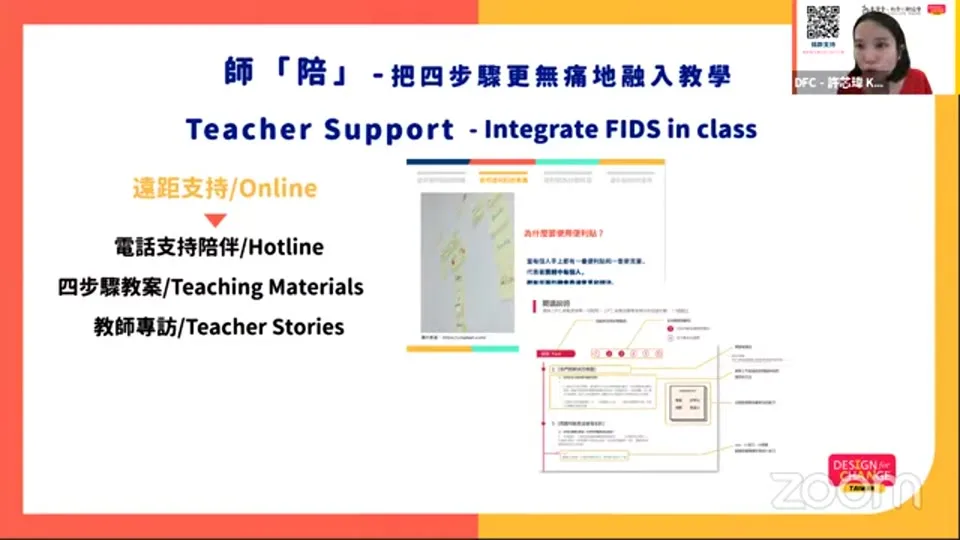
Design for Change Taiwan therefore provides both online and offline support. Its online assistance includes a working-hours hotline for discussion, free teaching materials, and stories showing how other teachers have used the process. Hsu emphasized that her organization did not necessarily possess ready answers, but could help teachers discuss problems and feel less isolated. Offline assistance includes school visits, classroom observation and feedback, talks, workshops, design-thinking courses, and certification programs for teachers and schools.
(0:11:46–0:18:25)
Leaving teaching and becoming a founder
Turning to the work behind the organization, Hsu recalled leaving a stable high-school teaching position to establish a nongovernmental organization. She asked participants what difficulties such a transition would create; they identified funding, financial support, accreditation, courage, team building, and communication with stakeholders.
Hsu summarized her daily experience as being repeatedly required to make choices and face failures. She disclosed that she had cried the previous night after making what she considered a bad decision and being uncertain how to respond. Although she was often less happy than she appeared, she continued because the work was what she wanted to do.
Participants named husbands, children, teachers, parents, friends, family members, and funders as people with whom a founder might need to communicate. Hsu agreed that teachers and funders mattered, but said she first had to address three closer relationships: family and friends, teammates, and herself.
(0:18:25–0:21:38)
Family, friends, and an early failure
Hsu showed a photograph of Design for Change Taiwan’s first meeting. Some of the friends pictured were no longer close to her, she said, because they had not understood why she was pursuing the project. They regarded her as naive and overly optimistic, descriptions she partly accepted. At the time, she did not know how to communicate her uncertainty because she believed that being a founder required her to appear strong.
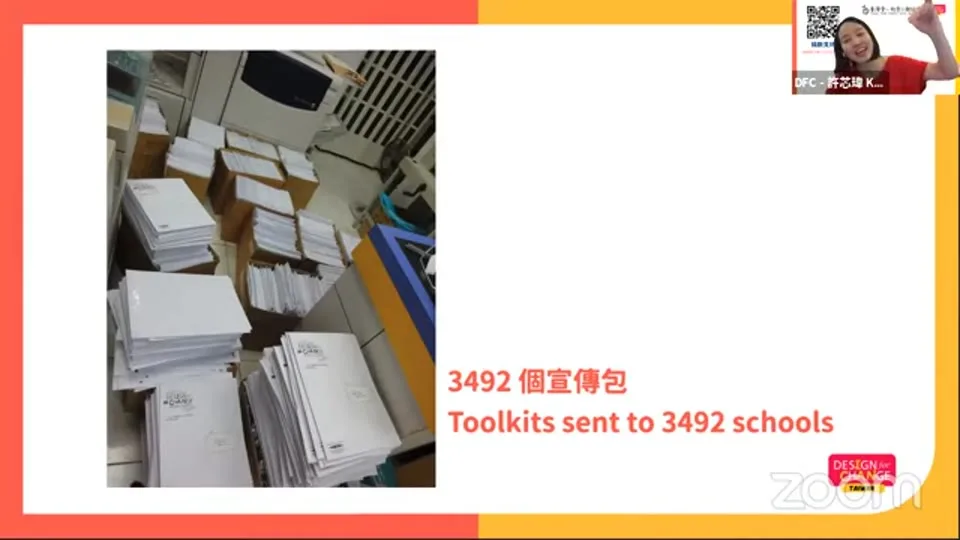
As an example, Hsu described spending all the money in her bank account in 2010 to print and distribute Design for Change toolkits. Because the approach had worked in India, she assumed it could also work in Taiwan. With help from her students, she packed 3,492 toolkits and sent them to schools. Only two schools responded.
The experience reinforced her friends’ view that she was naive, while also illustrating her difficulty with numbers. Her parents offered moral rather than financial support and believed that she was trying to do something beneficial. Nevertheless, Hsu said that they only began fully supporting her after she received public recognition and appeared in the news. Reaching that point required six years of repeatedly explaining and reassuring them that her work mattered to education in Taiwan.
(0:21:38–0:27:00)
Teammates and communication with oneself
Hsu described transforming a group of people with good intentions into a functioning organization as her hardest task. As a “free spirit” who valued friendship, she had initially wanted to be friends with everyone on the team. She later concluded that this was not possible and that some good friends were not necessarily suitable partners for founding an NGO.
She found it particularly difficult when team members wanted to leave or asked when they would be paid. Although other leaders advised her to hire slowly and fire quickly, she said she had been unable to dismiss people quickly. Her central organizational lesson was that a leader’s worst nightmare might be spending time on the wrong people, making the search for appropriate team members essential.
Hsu also cited a claim that 90% of employees leave a company or NGO because of its founder. Because she feared being disliked and tended to blame herself, she responded that the remaining 10% might be lying.
The third and most important person to communicate with, she said, was oneself. She continually asked what kind of leader she was, what kind she wanted to become, what suited her, what her mission should be, and what she could change. Against her tendency to depend on others’ judgments, she repeated: “Other people’s opinion of you does not have to become your reality” (0:30:48).
When she doubted herself, Hsu looked at examples of children who had changed their surroundings. Their actions reminded her that she possessed age and resources they did not have. She concluded that people often fear difficult conversations, but must enter them because they may find something beyond what they imagined.
(0:27:00–0:33:20)
Discussion
There was no time for a formal Q&A. Hsu said she would continue discussions in the event’s breakout rooms, share the link to the teacher-support group, and invited participants to support Design for Change Taiwan during the COVID period. Yang thanked her and connected her closing statement about finding treasure in unexpected places to the following talk.
(0:33:20–0:33:30)
How this connects
The centre is this page. Each mark is a page or a person that the site’s records link to it; a line between two marks means those two are linked as well.