Awakening Cooperative Lab · Library
Talk report: Hui-Chin Huang, “The Hometown Circle: Community Design for Education” (KASpaces Taiwan National Seminar, 2021)
This talk report follows Hui-Chin Huang’s decade of community-based education in Daxi, showing how local inquiry and intergenerational learning can create pathways for young people to return home.
- Event
- KASpaces National Seminar — Decoding the DNA of Taiwan Education: Where Do We See Progress and Equality?
- Date
- 2021-10-23
- Author
- Lab report (machine draft, unreviewed)
- First published
- The speaker’s recorded talk for the seminar
- Copy taken
- 2026-11-22
- Event
- KASpaces National Seminar — Decoding the DNA of Taiwan Education: Where Do We See Progress and Equality?
- Date
- 2021-10-23
- Author
- Lab report (machine draft, unreviewed)
- First published
- The speaker’s recorded talk for the seminar
- Copy taken
- 2026-11-22
Contents
Hui-Chin Huang, Lecturer in the Department of Interior Design and Management at Chien-Hsin University of Science and Technology, delivered this pre-recorded talk in Session 2 of the online KASpaces National Seminar on Accelerating Progress and Equity in Education, “Decoding the DNA of Taiwan Education: Where Do We See Progress and Equality?”, held on 23–24 October 2021. Presenting a decade of educational experimentation in Daxi, Huang argued that community-based learning can reconnect young people with their hometown, develop their agency, and create a support network for returning to work or establish local initiatives.
Recognising the disconnection between youth and community
Huang began returning to her hometown of Daxi in 2011, initially participating in an educational campaign encouraging young people to return to their hometowns. A local campaign to select Taiwan’s top ten tourist towns prompted her to reconsider how Daxi was represented and how little she, then a university student, knew about its residents and local life. She came to see young people’s lack of local knowledge and relationships as one reason they left their hometowns.
Huang argued that young people’s formal education in Taiwan was disconnected from community life, particularly within a system oriented toward academic progression. Her team therefore sought to work with high-school students before they left Daxi. Two secondary schools stood about a 15-minute walk from Daxi Old Street and were separated from each other by only a wall: one was academically and examination oriented, while the other was a private vocational school.
Beginning with vocational high-school students, the team examined their existing connections to the community. The students gathered at McDonald’s, an internet café, food and drink shops, and corners of public space. Some worked part-time in local businesses after school. Huang emphasised that these activities constituted a distinctive cultural and social context rather than an absence of community life. The students also had connections to Indigenous culture and other local cultural practices. This led the team to ask whether educational design could begin from young people’s own contexts and expand their sense of place. (0:00:02–0:04:28)
From study tours to the Daxi curriculum
The team initiated a youth study-tour programme that invited local participants to explore aspects of Daxi outside its established tourist framework. Activities included visiting riverside Indigenous communities, investigating what young people did around the old streets, entering Daxi’s mountain areas, and visiting historic rural settlements. The programme was intended to connect young people with one another and with the community while opening possibilities for returning home to start local enterprises.
These study tours were subsequently developed into a three-day informal summer course called Daxi Wow Wow Wow. Huang described three aims: eliciting local and personal identity, connecting young people to the community and broadening their sense of place, and combining their spatial ideas with presentations of local history. Six course modules moved from sensory engagement and impressions of Daxi through history and everyday life to investigation and public presentation.
Students’ maps revealed how their lived geography differed from formal representations. A basketball court appeared prominently because it was central to their after-school lives. A six-metre alley was perceived as a main road because insufficient parking forced pedestrians and vehicles into the same crowded space. The programme also used tactile activities, sound collection, music, street dance, film, interviews, and theatre. After six months, one group assembled its knowledge into a play about Daxi and performed it publicly.
The curriculum changed in response to participants. When an early walking tour left most students behind, the team introduced games and historical role-play to sustain attention. In later years it added mobile-phone-based reality games that allowed participants to explore community culture at their own pace. Huang summarised the resulting structure as a progression from receiving knowledge, to entering and investigating the community, to using youth creativity in ways that made young people’s perspectives visible. (0:04:29–0:10:50)
Intergenerational field learning
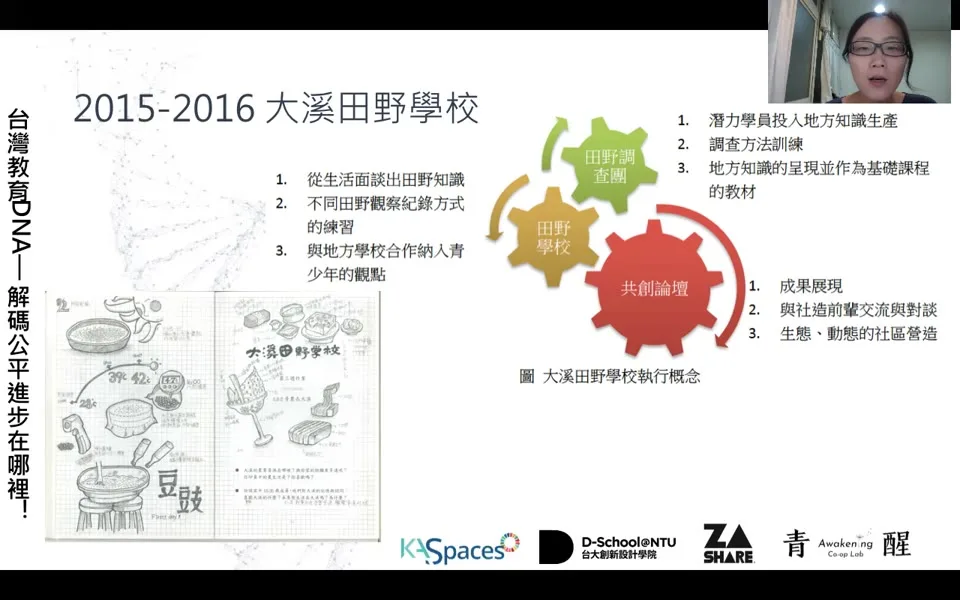
As the programme attracted community attention, a field-school project began in 2015. Its first theme concerned food culture and family dining-table stories. Community participants conducted fieldwork during the summer; after school resumed in September, the project was incorporated into a vocational high-school course so that students and residents could learn together.
Community members, most of them mothers, introduced students to the rituals and cultural meanings of offering tables. Participants then constructed an offering-table model together. In another class, people shared recipes for their families’ favourite dishes. Huang characterised the classroom as a setting in which older, middle-aged, and younger participants interacted on equal terms. The course produced recipes and postcards.
During a co-creation stage, a high-school instructor taught community members filmmaking. Participants designed storyboards and discussed the script, while students applied their school-based professional training to edit the film. A community premiere followed two months later. Huang described this as a learning mechanism involving people from 17 to 70 years old. In her account, the process created new social relationships and reduced unfamiliarity between young people and other residents. (0:10:50–0:13:53)
Developing youth agency and pathways home
Huang said the ten-year experiment sought to increase young people’s social and cultural capital. Its continuation depended on finding community partners who would join activities, help design high-school classes, develop curricula, and turn residents’ practical knowledge into local educational knowledge.
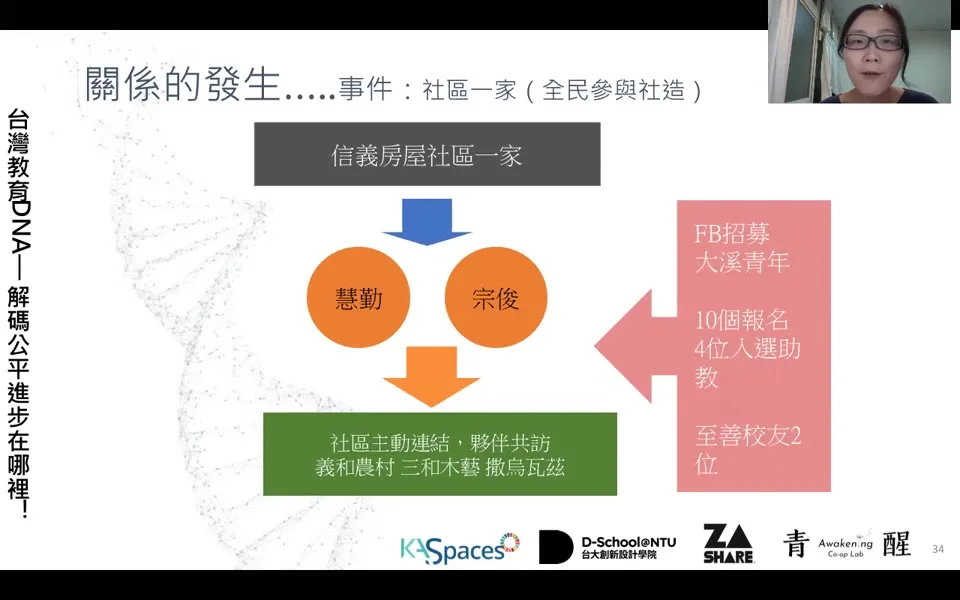
Online community networks also supported recruitment. After funding became available, a Facebook call attracted ten applicants, four of whom became teaching assistants; two former students from the vocational high school were also invited. Huang observed that the assistants brought experience from different fields and later began formulating community proposals themselves. One participant sought to combine traditional Chinese painting with local knowledge, while another connected school learning about community social marketing with local practice.
The programme also linked successive generations. A community summer camp initially organised by local mothers had cared for children and taught everyday skills. Eight years later, some of those children returned as university students and took leading roles. Huang discussed Momo, who had participated as a child, later joined Daxi Wow Wow Wow, and eventually returned to Daxi Elementary School as an arts and humanities teacher. She incorporated local practices, including Din Tao and Indigenous culture, into primary education.
Other former participants returned to work or establish projects. Huang mentioned Zhiwei, a participant in the programme’s second cohort who later served as a university-age teaching assistant and planned community educational activities drawing on Indigenous knowledge. Former assistants living elsewhere remained available to contribute professional experience, while schoolteachers, graduates, and current university students formed a broader youth community. (0:13:55–0:19:31)
An educational community for regional revitalisation
Huang concluded by describing three connected stages: investigating community issues and local knowledge, developing relationships through interaction, and proposing community action that demonstrated young people’s agency. Travelling, learning, connecting with residents, and jointly developing proposals positioned participants as co-creators of hometown initiatives.
Across ten years, these activities formed what Huang called an invisible educational community. It mediated relationships among young people, schools, and residents; supported co-learning between schools and communities; and provided social resources for those considering a return home. Educational design therefore generated relationships through which young people could accumulate local knowledge and creative resources.
For Huang, the process began with developing a sense of place and extended to young people creating possible lives in their hometown. Community-based educational design could thereby establish a continuing support network for regional revitalisation, grounded in relationships accumulated through shared learning and local action. (0:19:34–0:21:38)
How this connects
The centre is this page. Each mark is a page or a person that the site’s records link to it; a line between two marks means those two are linked as well.