Awakening Cooperative Lab · Library
Talk report: Adler Yang, “Two Major Issues in Taiwan’s Education” (2012 Taiwan Social Entrepreneurship Forum)
Adler Yang’s 2012 forum talk asks why Taiwan’s entrance reforms and college closures leave students without motivation or direction, and argues that the old education paradigm has died while no new one has been built.
Machine translation, not yet reviewed.
- Event
- 2012 Taiwan Social Entrepreneurship Forum
- Date
- 2012
- Author
- Lab report (machine draft, unreviewed)
- First published
- Recording on YouTube (青醒 channel, uploaded 2017-12-02)
- Copy taken
- 2026-11-22
- Event
- 2012 Taiwan Social Entrepreneurship Forum
- Date
- 2012
- Author
- Lab report (machine draft, unreviewed)
- First published
- Recording on YouTube (青醒 channel, uploaded 2017-12-02)
- Copy taken
- 2026-11-22
Contents
- Opening: a show of hands on the 12-year basic education plan, and the social-enterprise question
- Issue one: the entrance system, how should it be reformed to satisfy people?
- Issue two: higher education = high unemployment, how to resolve it?
- Two key problems that are overlooked
- When education = an entrance-exam industry
- Where do university students go?
- The old paradigm is dead and a new one has not been built
- Dispel the myths, offer a direction
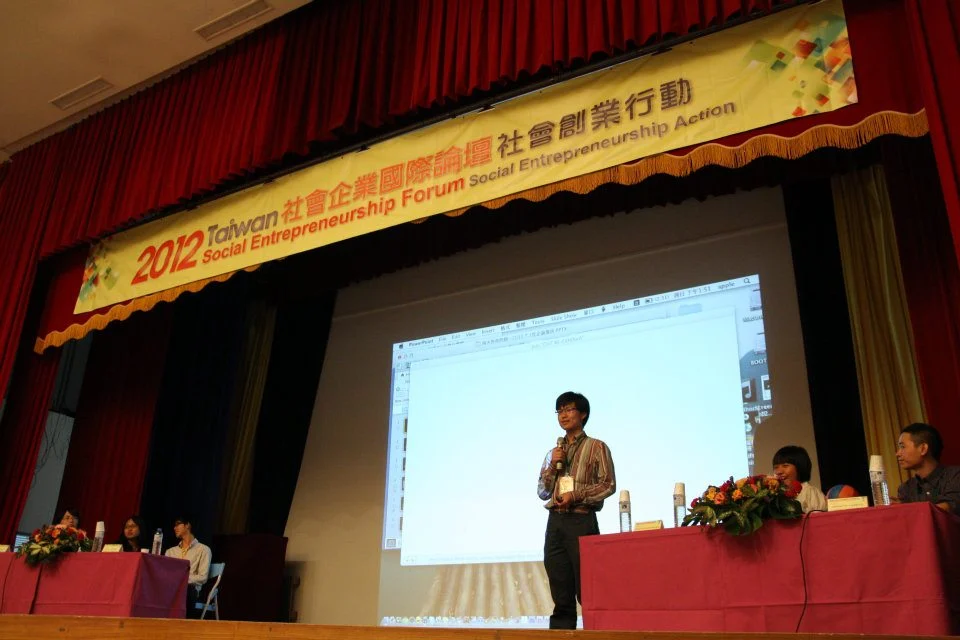
At the 2012 Taiwan Social Entrepreneurship Forum, held in Taipei between late June and early July 2012, Adler Yang spoke for about eight and a half minutes with slides on what he saw as the two major issues in Taiwan’s education: how the school-entrance system could be reformed to give satisfaction, and how to resolve the equation “higher education = high unemployment”. Using statistics on unemployment and on the number of universities and students, he asked whether the government’s plan to merge or close colleges treated the cause or only eased the pain. He then raised two critical problems that are usually overlooked, students’ lack of motivation to learn and their lack of a centre for their lives, and explained them through the metaphor of education as an “entrance-exam industry”, data on where graduates end up, and a cycle in which “the old paradigm is dead and a new one has not been built”. The recording breaks off as he reaches “dispel the myths, offer a direction”.
Opening: a show of hands on the 12-year basic education plan, and the social-enterprise question
Good afternoon, everyone. Let me ask you a question, a quick survey: in principle, who supports the 12-year basic education plan (十二年國教), the plan to extend compulsory education from nine to twelve years? Please raise your hand. OK, could you raise it a little higher? And whether or not you support it, those of you who have reservations about the 12-year plan, please raise your hands too.
Some of you may know that I made a documentary called I Don’t Want to Take the Exam (《不想考基測》). [unclear in recording, 0:00:29] I am not here today to talk about that film.
As I understand social enterprise, we all want to solve a social problem, and we want to do it in a way that is efficient and can be sustained. Everyone has been through education and has different ideas about it, but what I observe is that the government now faces two major issues. [unclear in recording, 0:00:57]
Issue one: the entrance system, how should it be reformed to satisfy people?
The first is how to fix the entrance system. We all know the path people have lived through, from the era of the joint entrance exam, to multi-channel admission, to the 12-year plan now. Through the past few rounds of reform, [unclear in recording, 0:01:18], and students’ stress has risen. Of course, we Taiwanese are sometimes quite optimistic: even though students suffer so much, [unclear in recording, 0:01:25] they win prizes; or, with the recent 12-year plan, everyone is thinking of volunteering, and perhaps Taiwan will become number one in the world for young people taking part in public-interest activities. OK, that is a joke. But for the government, this problem is a great headache.
Issue two: higher education = high unemployment, how to resolve it?
Next, the era of “higher education = high unemployment” has arrived. Let us look at the numbers, because numbers speak.
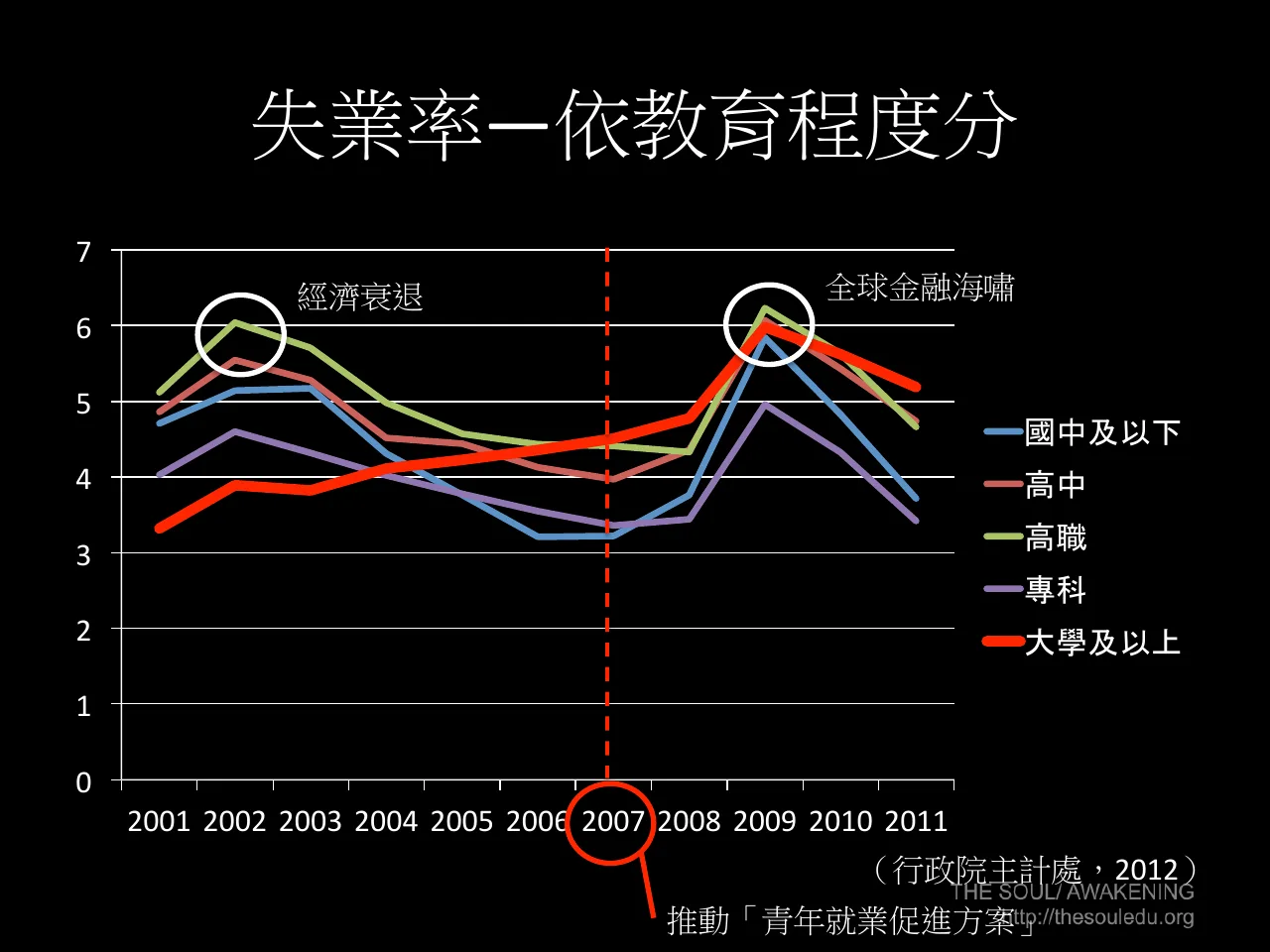
First, the unemployment picture of the past ten years: junior high and below, senior high, then vocational high school, junior college (and university and above). You can see two peaks: the first is the recession of around 2002, the second the recent financial crisis. The one line with a different trend is university and above. In 2007, for the first time in Taiwan’s history, it rose above the other education groups.
What is worth noting is that after 2007 the government kept introducing measures linking industry and academia, including a Youth Employment Promotion Programme (青年就業促進方案), mainly to promote industry-academia cooperation; yet unemployment among those with university degrees and above kept rising.
So some people have begun to ask: [unclear in recording, 0:02:45–0:02:58]
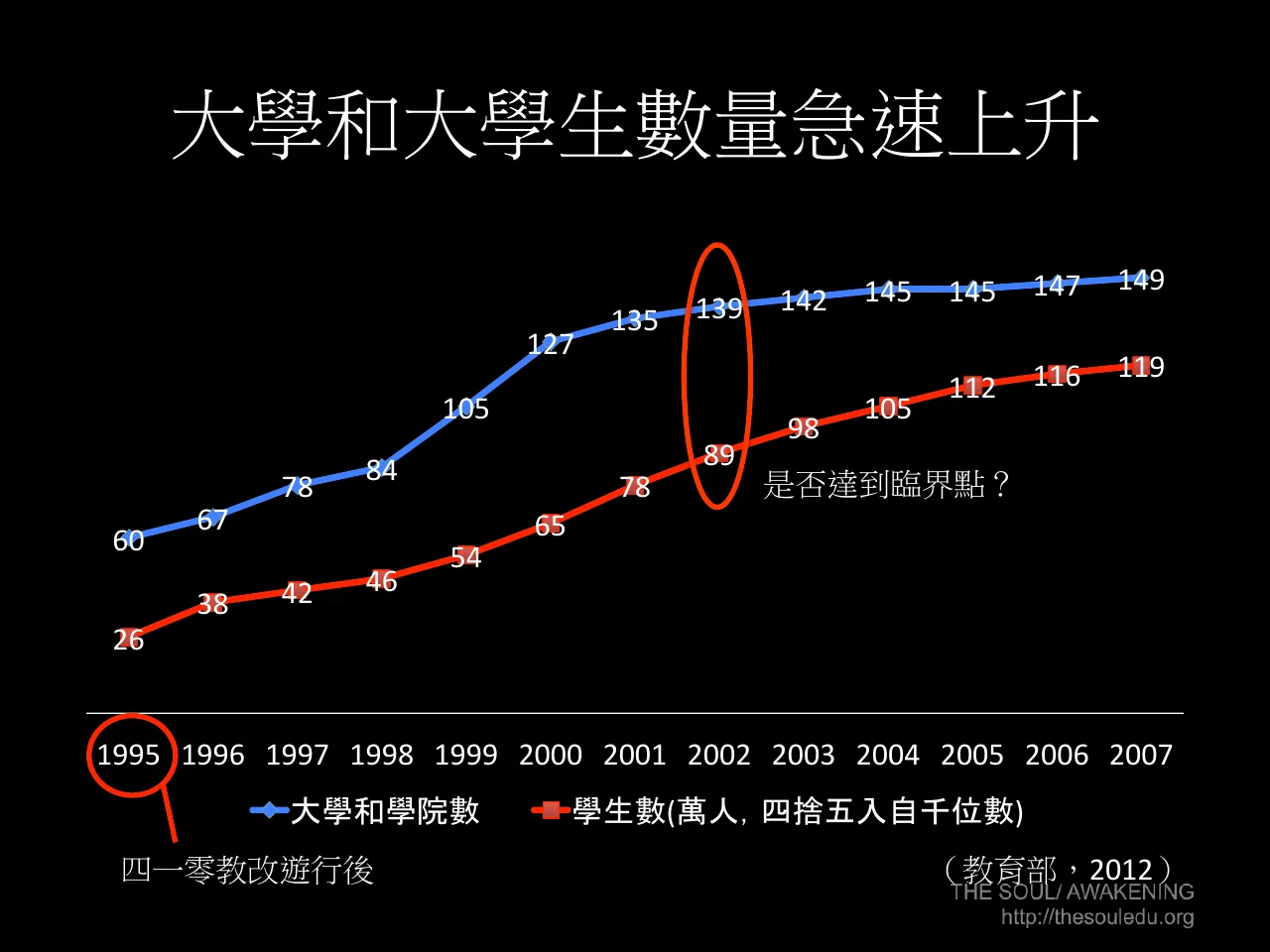
Over the past decade or so, the numbers of universities and of university students have kept growing. We know that the April 10 education-reform march of 1994 demanded more high schools and universities, [unclear in recording, 0:03:08]. There were originally 60 universities; by 2007 there were 140, [unclear in recording, 0:03:17]. As for students, they went from 260,000 to 1.19 million, also many times more. Have our student numbers reached a critical point?
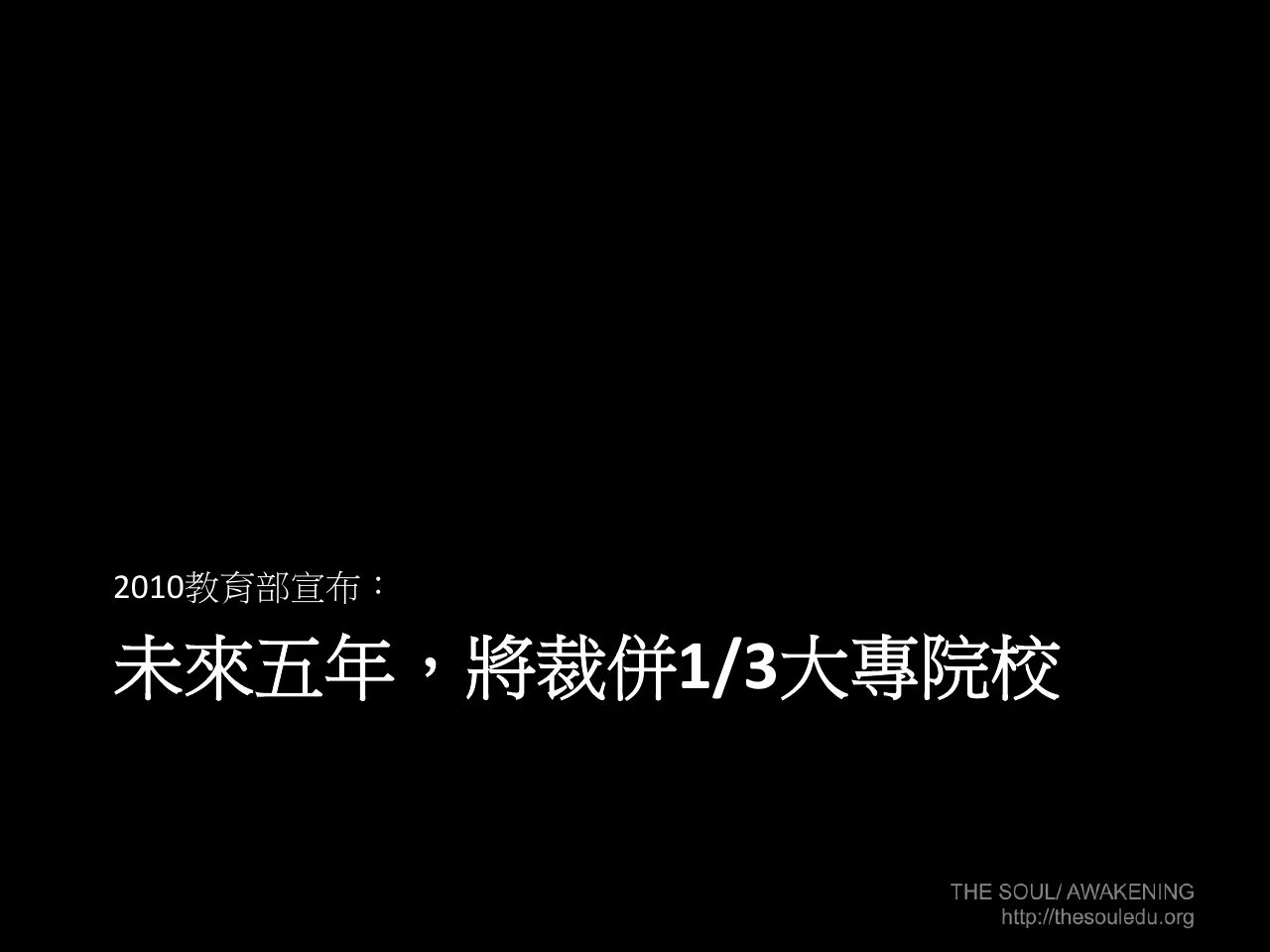
So, in response to the falling birth rate and the pressures above, in 2010 the government announced that within five years it would merge or close one third of colleges and universities.
I wonder about this: does it treat the root cause, or only ease the pain? If students who could have entered university no longer enter, will they still run into unemployment?
Two key problems that are overlooked
So I see two problems that people tend to overlook.
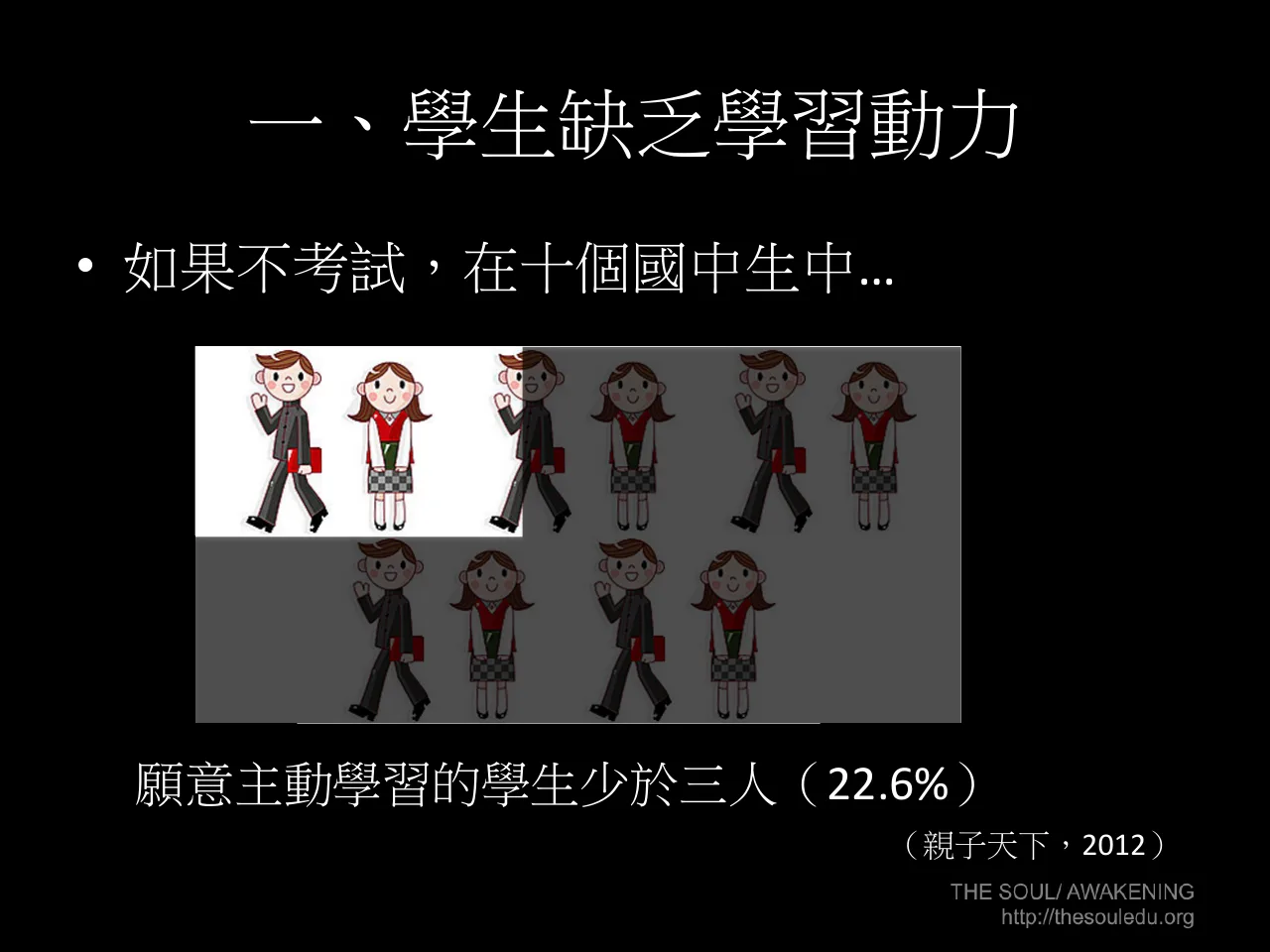
The first is that Taiwanese students lack the motivation to learn. According to a 2012 survey by Parenting magazine (《親子天下》), if there were no exams, only a little over two out of ten students would be willing to learn on their own.
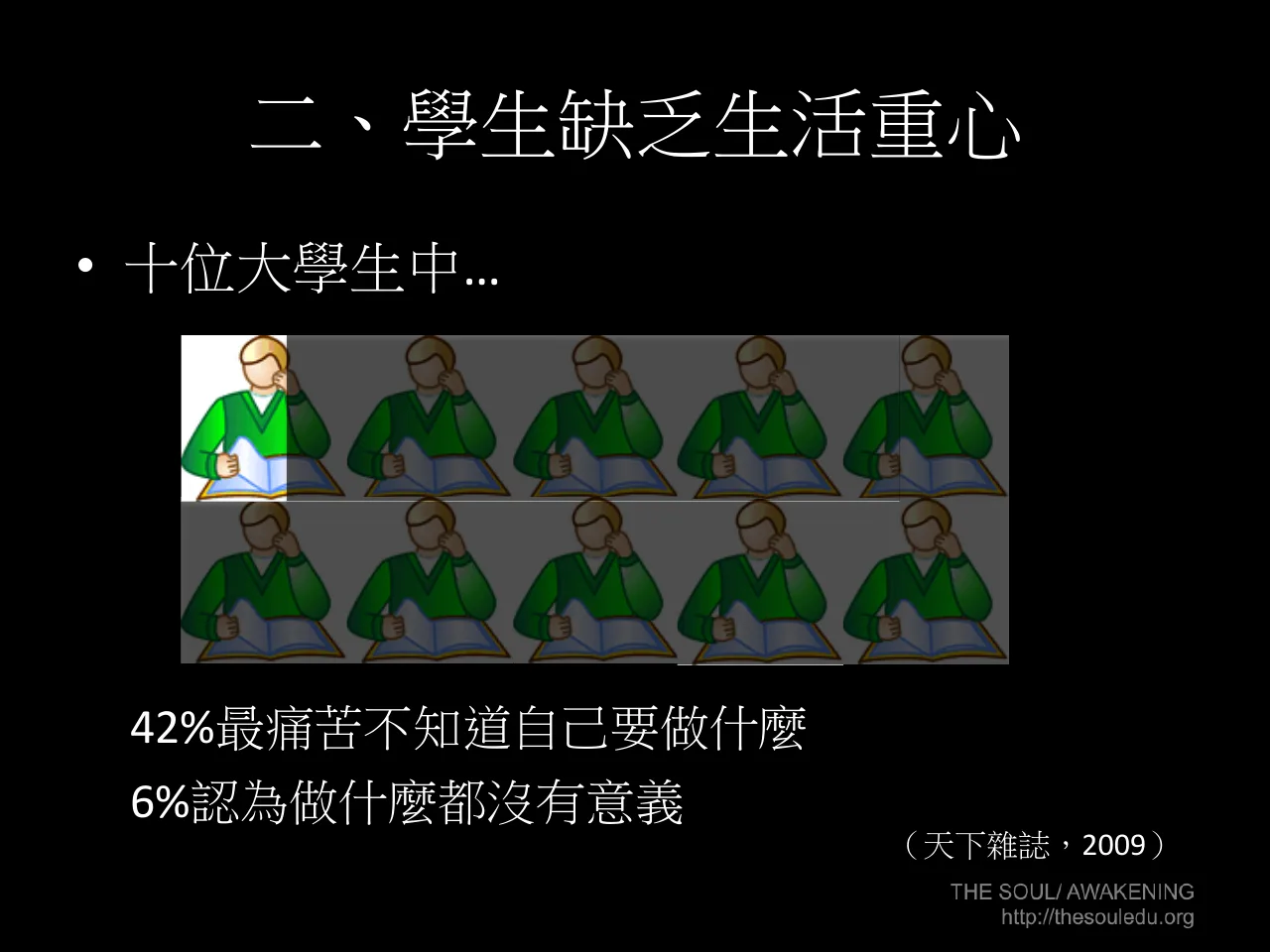
The second is that students lack a centre for their lives. A 2009 survey by CommonWealth Magazine (《天下雜誌》) found that among ten university students nearly half are troubled by the future and do not know what they want to do, and 6% already feel that nothing has any meaning and would rather give themselves up.
When education = an entrance-exam industry
Why is it like this? And does it matter?
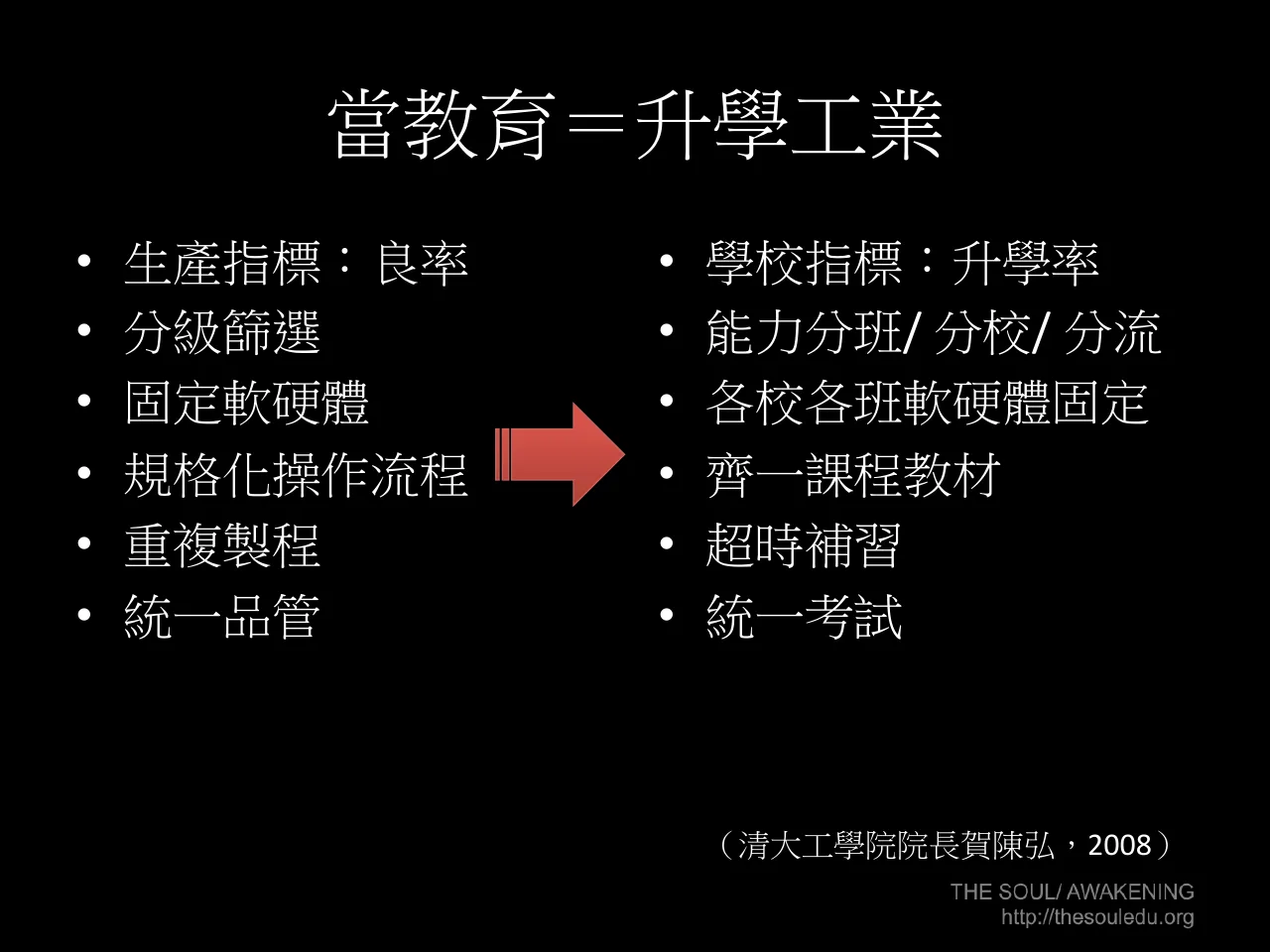
The dean of engineering at Tsing Hua University made an observation about education: he sees the shadow of industry in it. The production indicator of industry is the yield rate; products are graded and screened; hardware and software are fixed; procedures are standardised; processes are repeated; quality control is uniform. Interestingly, look at schools: the indicator is the entrance rate; then ability grouping and tracking, so that those who can study go on to senior high and university and the rest go to vocational schools and junior colleges; then fixed facilities in every school and class, a uniform curriculum and textbooks, overtime cram classes, and uniform exams. So all students are like products on a production line, sent out again and again into society for everyone to consume. That is a metaphor.
Where do university students go?
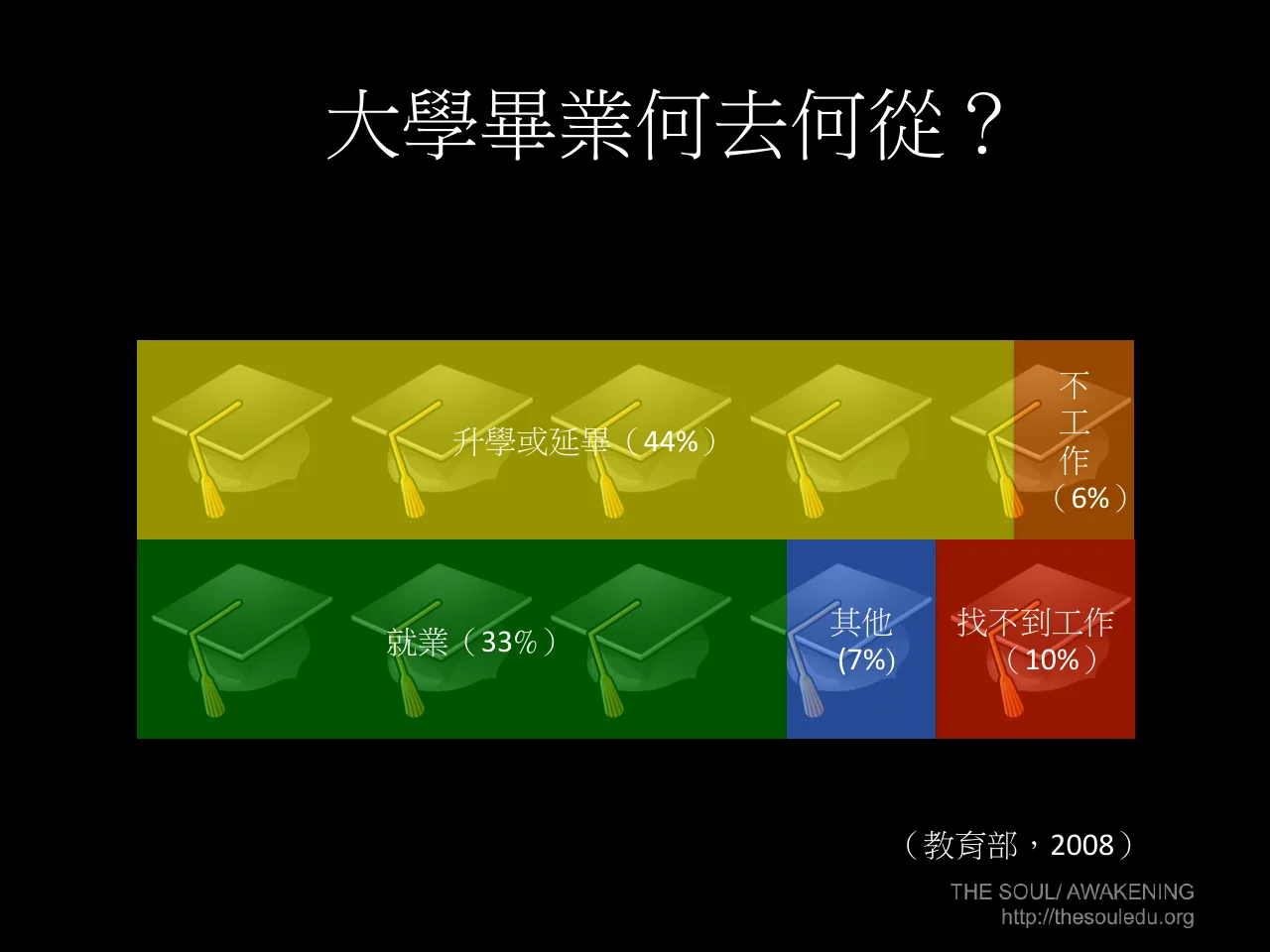
Under education as it is now, where do university students go? A 2008 Ministry of Education survey found that about 44% continue their studies or delay graduating, perhaps by sitting graduate-school exams; 6% neither work nor take part in training, and become what is called [unclear in recording, 0:05:48]; about 33% find jobs, 10% cannot find work, and the rest [unclear in recording, 0:05:56].
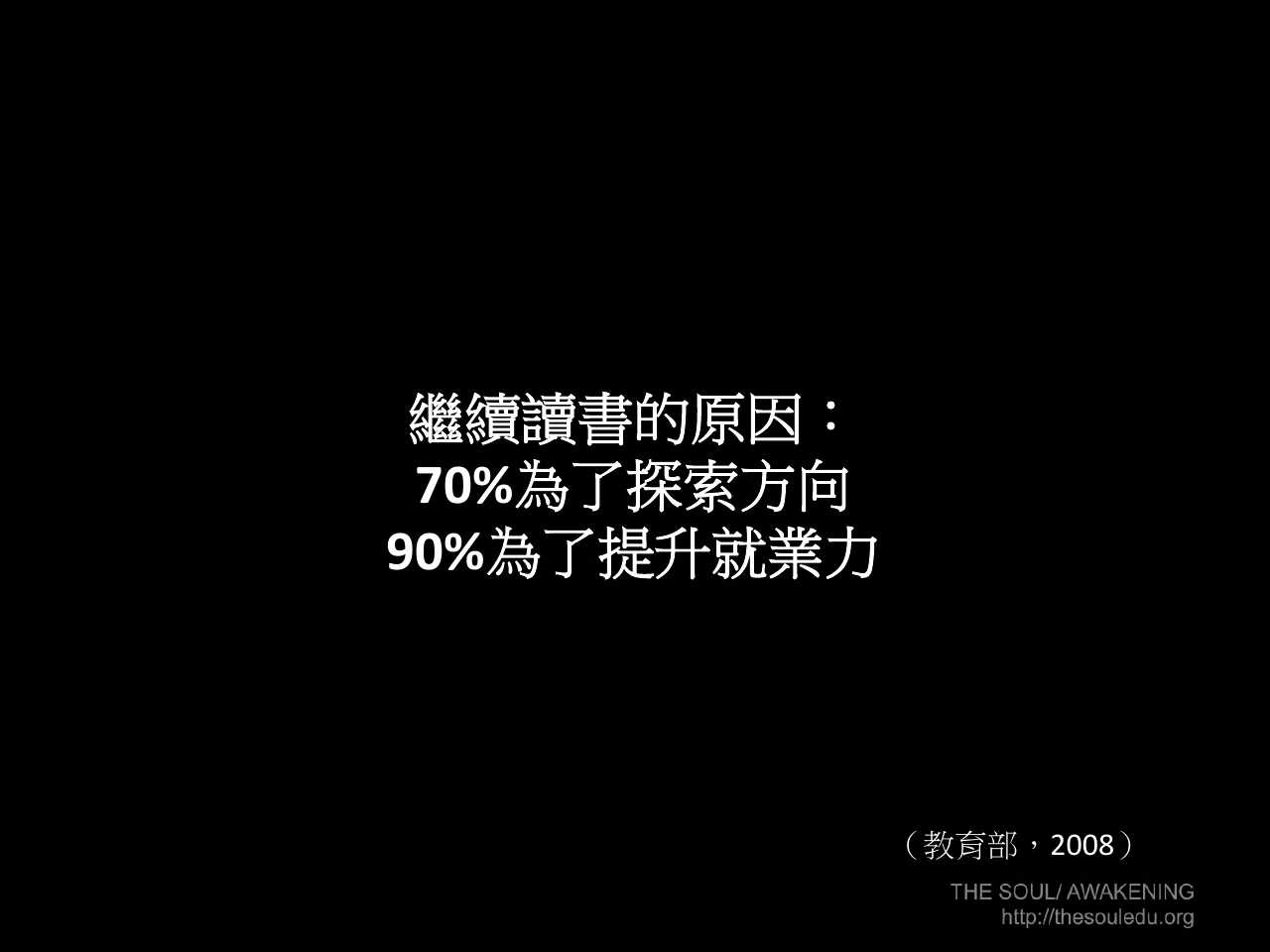
Interestingly, of the reasons for continuing to study, 70% are to find a direction and 90% to improve employability.
The old paradigm is dead and a new one has not been built
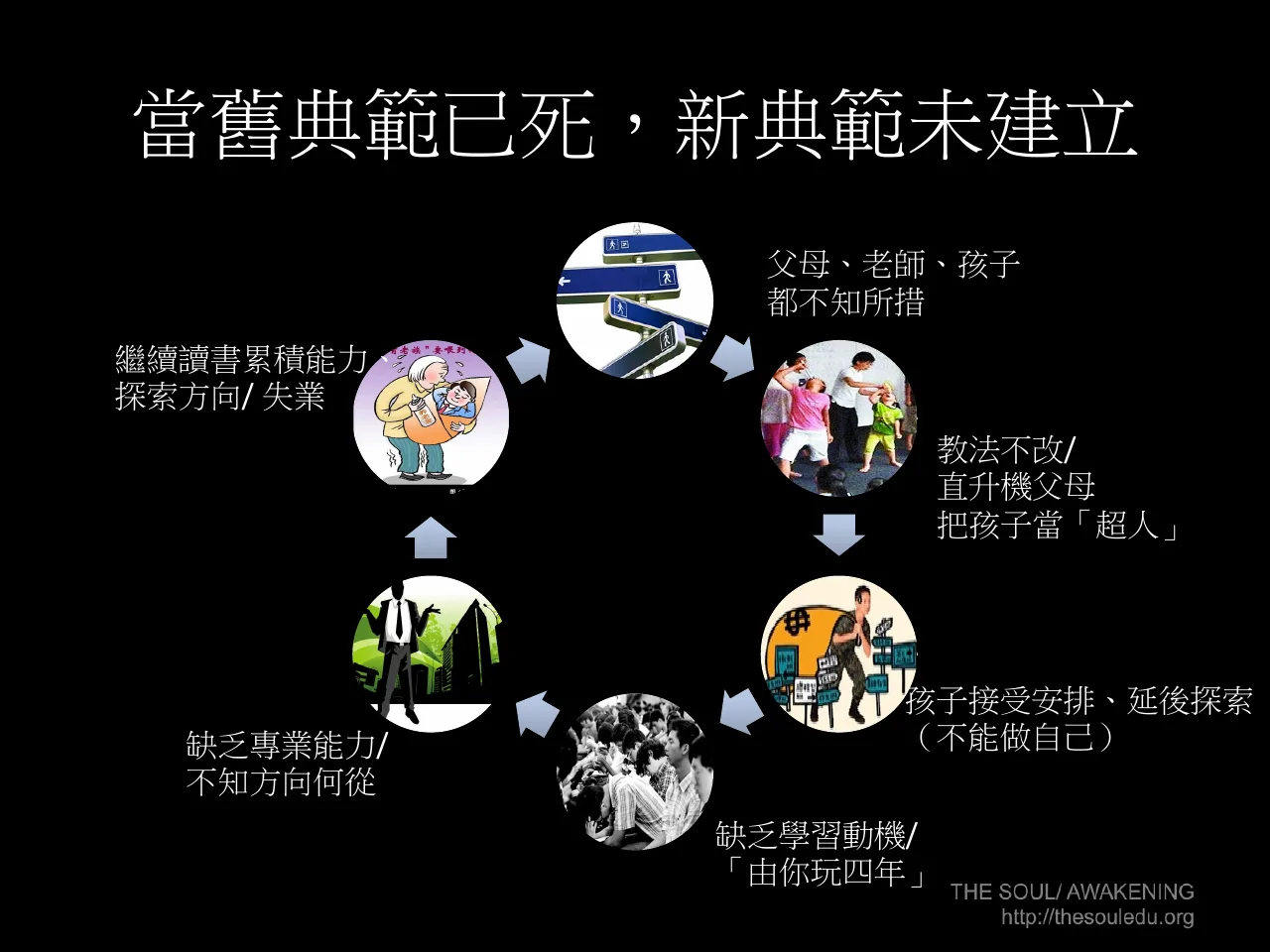
So we see some phenomena. After several decades of education reform we no longer accept the old education, but the new paradigm has not been built [unclear in recording, 0:06:16]. The result is that parents, teachers and children are all at a loss and do not know what to do about the future.
Next, because nobody knows what to do, our methods of teaching have in fact not changed much. In addition, anxious parents have produced the so-called helicopter parents, who stress “winning at the starting line”. There was a 2009 news report, which some of you may have heard of: a cram school in Tainan charging more than 300,000 a month (the currency is not stated in the recording; presumably New Taiwan dollars), whose course promised to “develop potential and cultivate an invincible competitive edge”. Guess what it was. Many of you have already guessed: sword-swallowing and walking on broken glass, for primary and junior-high students. Here is a child who dared not swallow, and then an adult [unclear in recording, 0:07:07]. It is strange, but [unclear in recording, 0:07:10] Taiwan’s parents and elders. So we see that children carry [unclear in recording, 0:07:16] [unclear in recording, 0:07:18] the chance to learn to be themselves.
Next, when they go on to university, they may lack motivation to learn. This is a photo that went viral on China’s Xinhua site or Weibo, claimed to show a classroom at a university in Taiwan, [unclear in recording, 0:07:35]. I think many of you may care about this.
Next, after four years of university, for the student it may be “I don’t know what my direction is”, and for employers a lack of employability. Finally, to make up for this shortfall, students choose to keep studying, [unclear in recording, 0:07:53], and in the end this indirectly affects youth employment as a whole. The problem comes back into society and causes [unclear in recording, 0:08:03–0:08:08].
Dispel the myths, offer a direction
So what we see is this: we have long assumed [unclear in recording, 0:08:11], and kept falling into a myth, [unclear in recording, 0:08:15]. To dispel the myth and offer a new direction, [unclear in recording, 0:08:22]. And that is why— (the recording ends here)
Read the original text
楊逸帆在 2012 年 6 月底至 7 月初於台北舉行的「2012 台灣社會企業國際論壇」上,以約八分半鐘的簡報說明他所看到的台灣教育兩大課題:一是升學制度要怎麼改才令人滿意,二是「高學歷=高失業率」如何解決。他用失業率、大學數量與學生數量的統計,指出裁併大專院校究竟是治本還是止痛;再提出常被忽視的兩個關鍵問題,即學生缺乏學習動力與缺乏生活重心,並以「教育=升學工業」的比喻、畢業生去向的數據與「舊典範已死、新典範未建立」的循環說明其成因。錄音在他說到「破除迷思、提供方向」處中斷。
開場:十二年國教的舉手調查與社會企業的問題意識
各位在場的朋友,大家午安。先請問大家一個問題,做個簡單的調查好了:就概念上,支持十二年國教的,請舉手。OK,可不可以舉高一點?那麼,沒關係,不論你支持十二年國教,你們對於十二年國教有疑慮的,也請舉手。
現在可能有人知道,我拍了一部叫做《不想考基測》的紀錄片。[unclear in recording, 0:00:29]我今天不是來談這部片的。
我們知道社會企業這件事情,就我的認知來講,是我們都想要去解決一個社會問題,然後希望用一個有效率、能夠永續進行的方式來進行。每個人都經歷過教育,也會有不同的想法,但是我觀察到,現在政府面對到兩大課題。[unclear in recording, 0:00:57]
課題一:升學制度,怎樣改才滿意?
首先第一個,是升學制度要怎麼樣去修。我們知道,大家過去經歷了從聯考時代到多元入學,到現在的十二年國教。在過去幾次改革的過程當中,[unclear in recording, 0:01:18],學生的壓力也增加了。當然,有時候我們台灣人還蠻樂觀的:雖然學生這麼痛苦,但是[unclear in recording, 0:01:25]就是拿獎啊;或者說最近的十二年國教,大家想著當志工,說不定以後台灣也會成為全世界青少年參加公益活動的第一名。OK,這是開玩笑的。但是這個問題,對政府來講是很大的困擾。
課題二:高學歷=高失業率,如何解決?
再來,是「高學歷=高失業率」的時代已經來臨。讓我們來看看數字,因為數字會說話。
首先是過去十年來的失業率狀況:國中及以下、高中,再來是高職、專科(以及大學及以上)。大家可以看到有兩個高峰,第一個是 2002 年前後的經濟衰退,再來是前陣子的金融海嘯。唯一趨勢不同的,是大學及以上學歷的這一條。我們可以看到,在 2007 年,它在台灣史上首度超過其他的學歷組別。
這裡值得一提的是,2007 年之後,我們知道政府不斷在做一些產學結合的措施,提出了「青年就業促進方案」,主要在推動產學結合這件事情;但是大學及以上的失業率仍然持續向上。
那麼有人開始思考:[unclear in recording, 0:02:45–0:02:58]
過去十幾年間,大學以及大學生的數量不斷地增長。我們知道,1994 年四一〇教改遊行的訴求是廣設高中大學,[unclear in recording, 0:03:08]。那時候的大學原本是 60 所,到了 2007 年變成 140 所,[unclear in recording, 0:03:17]。再來是學生的數量,從 26 萬到 119 萬,也增長了很多倍。我們的學生數量,是不是已經達到一個臨界點了?
於是,因應少子化還有上述的衝擊,政府在 2010 年宣布,未來五年要裁併三分之一的大專院校。
我在思考一個問題:這到底是治本,還是止痛?如果這些原本可以進入大學的學生不再進入大學,他們是否還是會遇到失業的問題呢?
被忽視的兩大關鍵問題
所以我看到兩個問題,是大家往往忽視的。
第一個,是台灣學生缺乏學習的動力。根據《親子天下》2012 年的調查,如果不考試的話,在十位學生當中,大概只有兩位多一點點會願意主動學習。
再來,是學生缺乏生活重心。2009 年《天下雜誌》的調查發現,十位大學生當中,近一半為未來所苦,不曉得自己要做什麼,甚至有 6% 的人已經覺得做什麼都沒有意義,寧願放棄自己。
當教育=升學工業
那為什麼會這個樣子?這很重要嗎?
清華大學工學院的院長對教育提出了一個觀察:他在教育身上看到了工業的影子。我們知道,工業的生產指標是良率,然後產品要分級篩選,軟硬體固定,操作流程規格化,製程重複,最後統一品管。有趣的是,你到學校去看看:學校的指標是升學率;再來是能力分班、分校、分流——能讀書的進高中、進大學,讀不來的就走高職、專科等等;再來是各校各班的軟硬體固定、課程教材齊一、超時補習,以及統一考試。所以所有的學生就像生產線上的商品,不斷被送到整個社會上去,給大家消費。這是一個比喻。
大學生去了哪裡?
我們能夠看到,在現在這樣的教育底下,大學生去了哪裡。2008 年教育部的調查發現,大約 44% 的學生升學或延畢,可能是考研究所或者延畢;6% 的人不工作、不參加教育訓練,也不工作,成為所謂的[unclear in recording, 0:05:48];再來大概 33% 的人就業,10% 的人找不到工作,其他[unclear in recording, 0:05:56]。
有趣的是,繼續讀書的原因,70% 是為了尋找方向,90% 是為了提升就業能力。
舊典範已死,新典範未建立
所以我們看到一些現象:經歷這幾十年的教改以來,我們對過去的教育已經有所不認同,但是新的典範卻還沒有建立[unclear in recording, 0:06:16]。這樣的結果是,父母、老師和孩子其實都不知所措,不知道未來該怎麼辦。
再來,因為不知道該怎麼辦,我們教學的方法實際上並沒有太大的改變。除此之外,父母因為焦慮,出現了一群所謂的直升機父母,強調「贏在起跑點」。這裡有一則 2009 年的報導,可能有人聽過:台南有一家補習班,月費是三十幾萬,他們的課程要「開發潛能、培養無懈可擊的競爭力」。大家猜猜看——不少人已經猜到了——他們的內容是吞劍、踩碎玻璃,對象是國中小學生。這裡有一個孩子不敢吞,然後有一個大人[unclear in recording, 0:07:07]。這很奇怪,但[unclear in recording, 0:07:10]台灣的父母還有長輩們。所以我們看到,孩子身上背著[unclear in recording, 0:07:16],[unclear in recording, 0:07:18]學習做自己的機會。
再來,繼續進入大學的時候,可能缺乏學習動機。這是大陸新華網還是微博上一張很紅的照片,號稱是台灣某所大學的上課情況,[unclear in recording, 0:07:35]。我想各位可能都有所關心。
再來,大學四年畢業之後,對學生自己來說,可能是「我不知道我的方向是什麼」;對企業來說,可能是缺乏就業能力。最後,為了彌補這樣的不足,學生選擇繼續讀書,[unclear in recording, 0:07:53],最後間接影響到整體的青年就業。這樣的問題重新回到我們社會裡面,造成[unclear in recording, 0:08:03–0:08:08]。
破除迷思,提供方向
所以,我們看到一件事情:我們過去一直覺得[unclear in recording, 0:08:11],然後一直陷入一個迷思當中,[unclear in recording, 0:08:15]。為了破除迷思、提供新的方向,[unclear in recording, 0:08:22]。所以這就是為什麼——(錄音在此中斷)
How this connects
The centre is this page. Each mark is a page or a person that the site’s records link to it; a line between two marks means those two are linked as well.