Awakening Cooperative Lab · Library
Talk report: Pi En-Ju, “Action-Oriented Media: Bearing Witness to Awakening through Action” (2012 Taiwan Social Entrepreneurship Forum)
Pi En-Ju presents Awakening, a magazine started by teenagers for 15-to-25-year-olds, with its reader-participation model, income sources and the team’s own open problems.
Machine translation, not yet reviewed.
- Event
- 2012 Taiwan Social Entrepreneurship Forum
- Date
- 2012
- Author
- Lab report (machine draft, unreviewed)
- First published
- Recording on YouTube (青醒 channel, uploaded 2017-12-02)
- Copy taken
- 2026-11-22
- Event
- 2012 Taiwan Social Entrepreneurship Forum
- Date
- 2012
- Author
- Lab report (machine draft, unreviewed)
- First published
- Recording on YouTube (青醒 channel, uploaded 2017-12-02)
- Copy taken
- 2026-11-22
Contents
- Introduction and opening
- A teenager’s situation, and the gap in existing magazines
- Who can answer me? Positioning: a walkthrough for self-exploration, a benchmark for new education
- How the magazine works: readers are the magazine’s ingredients
- Where to read it
- Sources of income
- Operating model
- Our own operating challenges
- Closing: bearing witness to awakening through action
At the 2012 Taiwan Social Entrepreneurship Forum, Pi En-Ju (閉恩濡) spent a little over eight minutes presenting Awakening, a magazine launched by teenagers. It is meant for people aged 15 to 25 who find nothing for self-exploration beyond exam preparation and leisure, and it offers “a walkthrough for self-exploration and a benchmark for new education”. She explained how readers take part (cover story, columns, international focus, the “Voice of Education” platform and “seed magazine” branches), where the magazine is read, how it earns income (fundraising and sales) and how its operating model works, and closed by openly naming the team’s own four difficulties (repositioning the target age, new-media skills, high turnover of members, and a sustainable operating model) and asking the seniors present for advice.
Introduction and opening
(The introduction from the stage appears, from its content, to be by Adler Yang; the recording does not name the speaker.) When I was in the second year of junior high I made a documentary called I Don’t Want to Take the Exam (《不想考基測》), which comes out again this year in a completely new form. [unclear in recording, 0:00:07] Another girl, then also a junior-high student, launched this Awakening magazine with me. We hope to give practical help to children, teenagers and young adults who feel lost, a practical reference for exploring their careers and lives. So let us welcome Pi En-Ju with warm applause.
Thank you. Honoured guests, esteemed seniors, good afternoon. I am En-Ju, planning director of Awakening, and I am in my teens. Let me now introduce our magazine’s operating model.
A teenager’s situation, and the gap in existing magazines
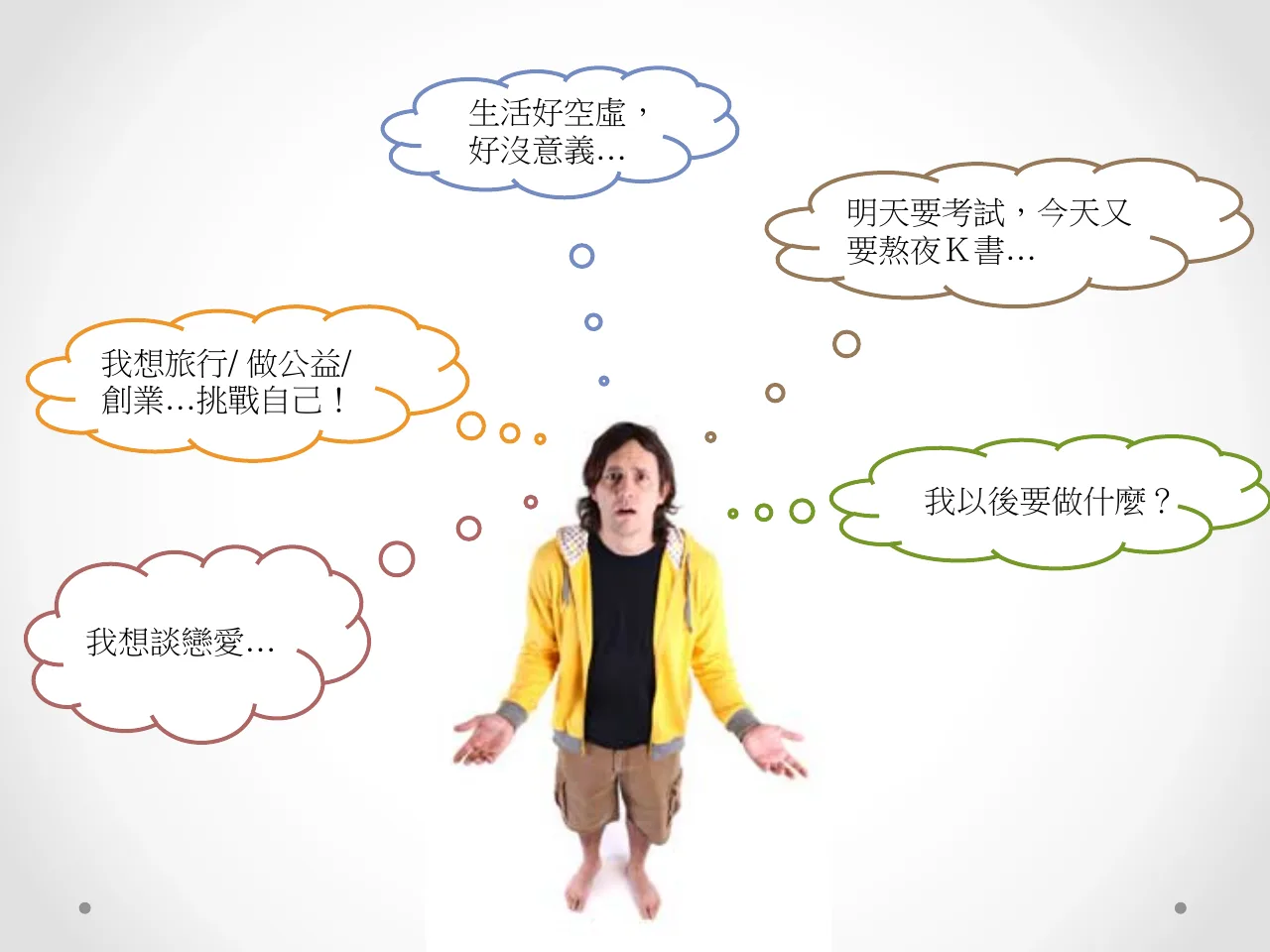
First, let me simulate a situation, the problems a teenager might meet. One: every day he stays up late studying for exams. Two: he may have emotional needs or troubles. Three: he does not yet know where his direction lies, which school to aim for, or what job he will do later. His days look busy, but he does not really know what he is doing, which, put that way, feels rather empty. What I actually want to do is start a business, or travel, but the present environment does not let me.
So our teenager begins to look for help, using the education and career-exploration magazines on the market.
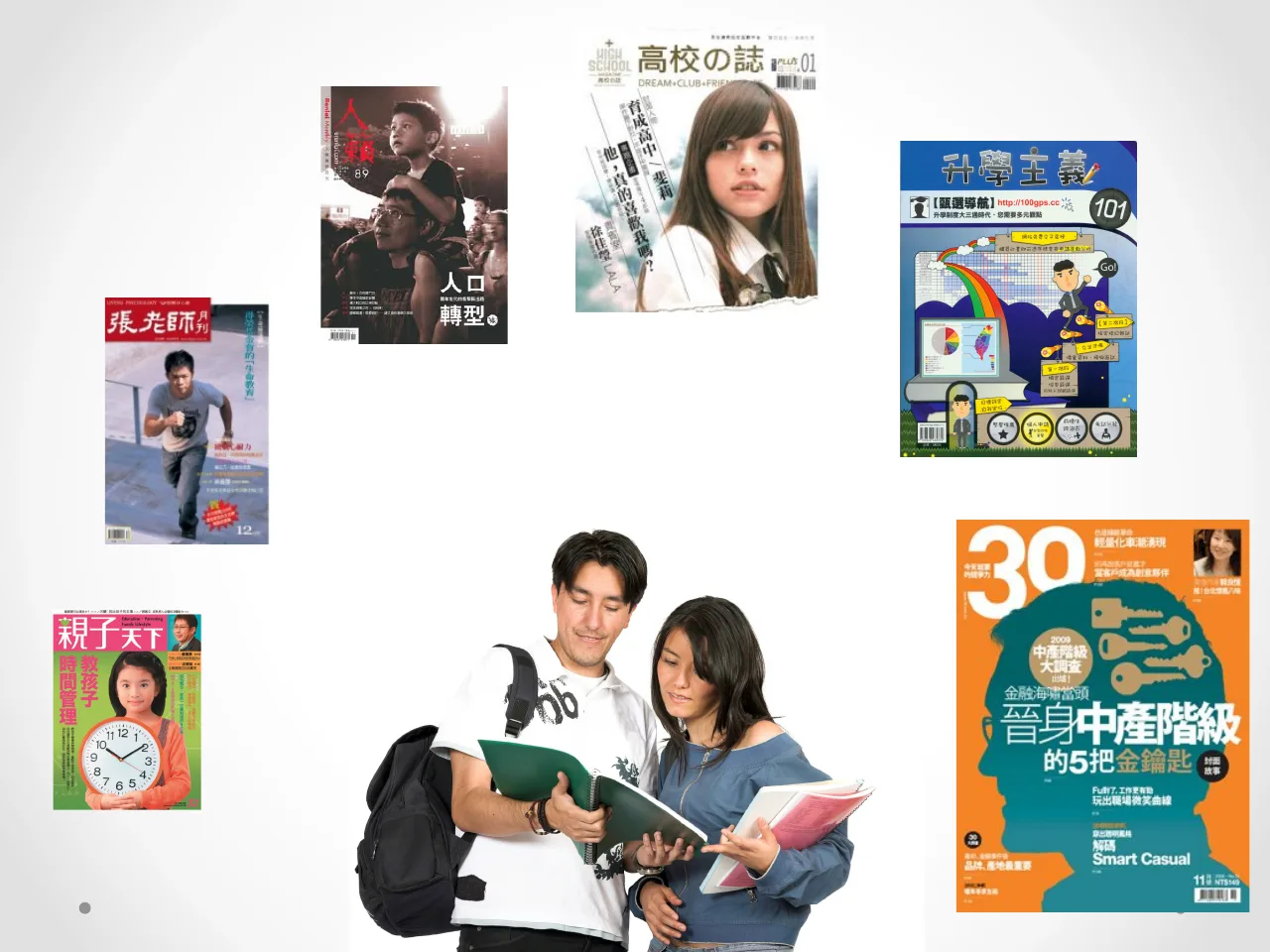
Let us look first at the one on the far left, the career magazine: “be a good employee” seems to have little to do with me. Next, the exam-preparation magazine: I hear enough of that at school every day. Campus life and leisure are fine, but they do not solve the underlying problem. Social affairs: we cannot even solve our own problems, so how can we help society? Counselling magazines: we do not seem to need those. Parenting magazines: we are already past that age range.
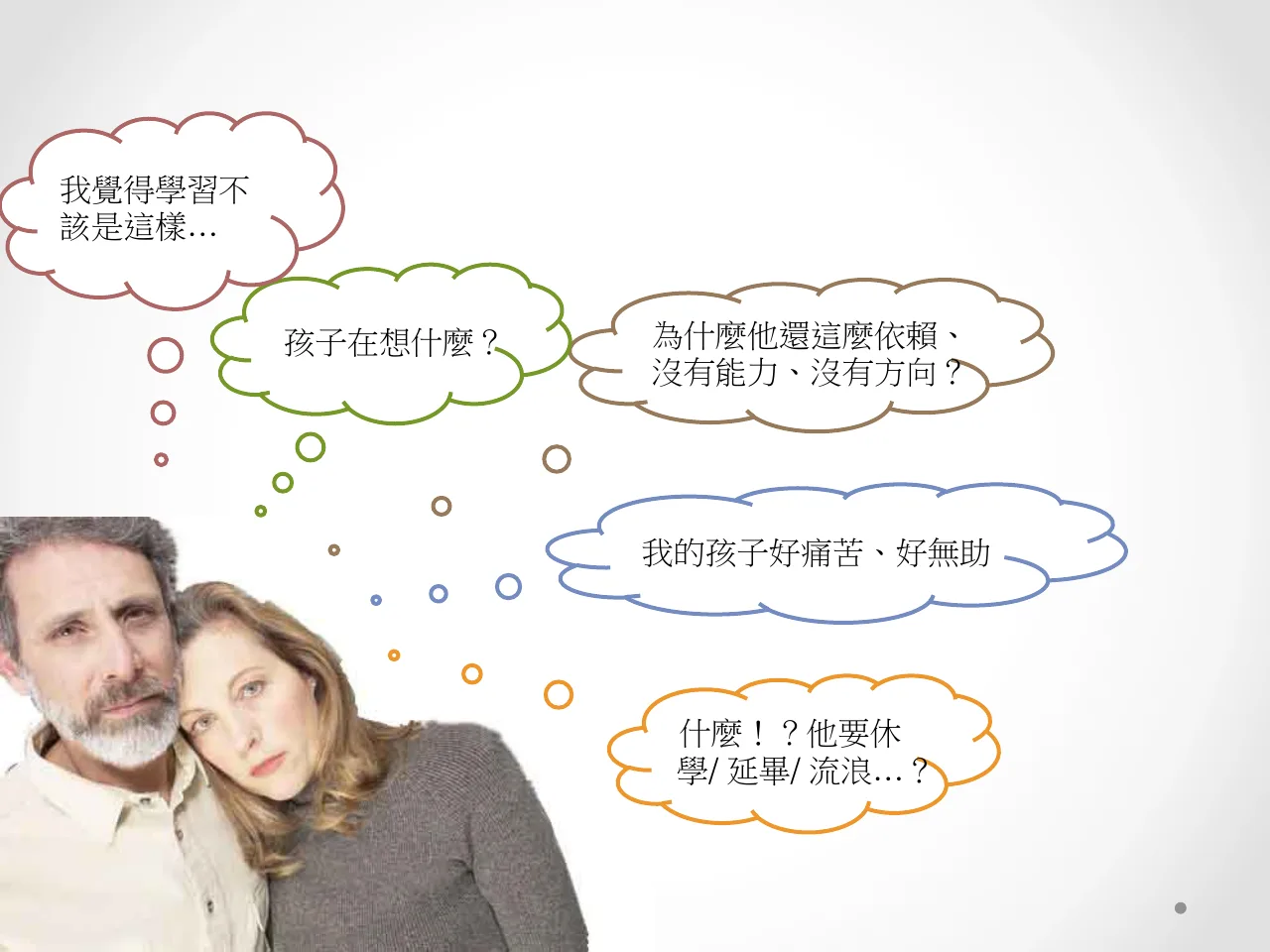
And how do the parents see their child? They may be puzzled: what? why does he say he wants to take a leave of absence, to delay graduating? [unclear in recording, 0:02:20] Why, when our child is so grown up, does he still not know where his direction lies, and depend so much on others? What is the child thinking? I do not understand at all. And I am deeply dissatisfied with the existing education system. [unclear in recording, 0:02:38] this generation?
Who can answer me? Positioning: a walkthrough for self-exploration, a benchmark for new education
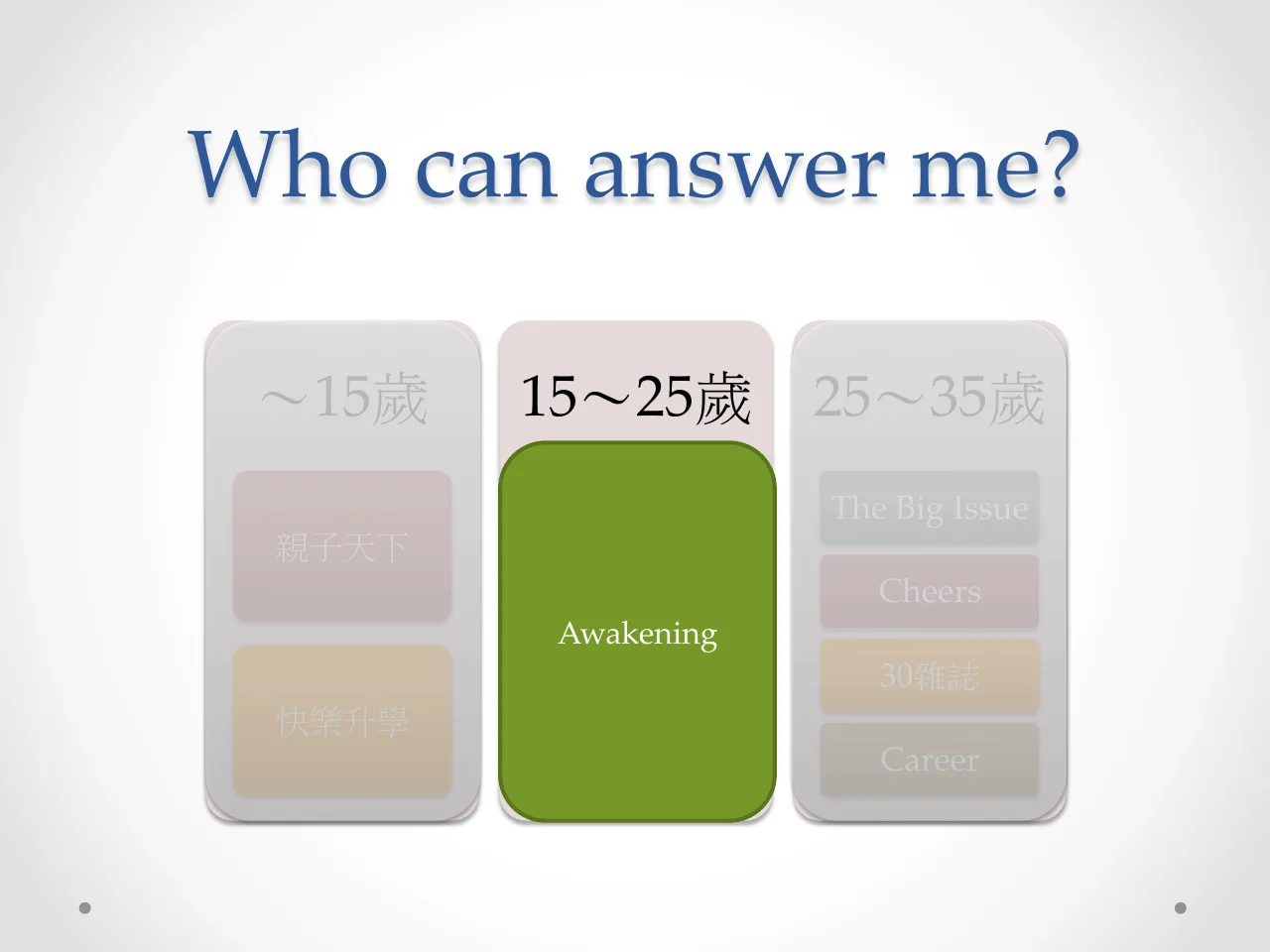
We divide the education and career magazines on the market into three blocks by age. On the left and right, the scope and the topics are relatively broad, so the ways of thinking they build and the conclusions they reach also cover more ground. But look at the middle: in the 15 to 25 block there is only exam preparation and leisure. So Awakening wants to fill this gap in information and offer teenagers more varied ways of exploring themselves.

So we position our product as “a walkthrough for self-exploration, a benchmark for new education”. A walkthrough: in a video game, there is never just one method, one road to the final goal. We think that for life, and for self-exploration, there should not be just one method or one road either, so our magazine offers readers methods they can actually use. As for the “benchmark for new education”, we hope to lead readers in exploring the essence of things instead of taking everything for granted, and together to look for new paradigms and keep improving. So we hope this new wave can be started by teenagers, led by teenagers, and draw more people to awaken.
How the magazine works: readers are the magazine’s ingredients
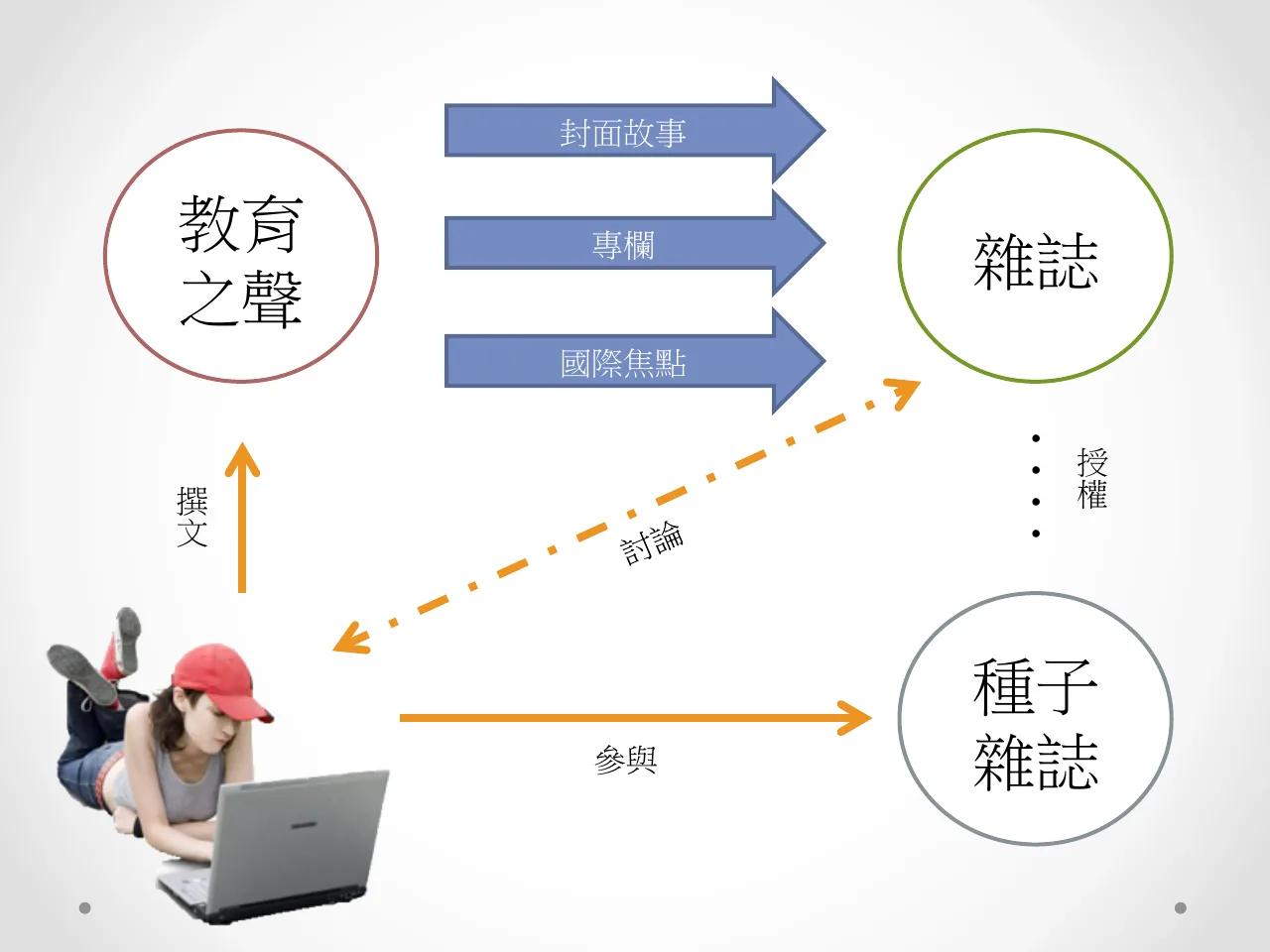
So how does our magazine actually work? First, we stress readers’ participation: readers are the magazine’s ingredients. Each issue has roughly three kinds of content: the cover story, columns and international focus. Once the cover story for an issue is decided, it is opened for online discussion. The benefit is, first, that we learn how interested people are in the topic, and second, that we get first-hand information and stories.
We will also set up a platform called “Voice of Education” (教育之聲). Because our magazine stresses that everyone, in every role, is a citizen journalist, you can submit pieces on this platform; if what you submit fits the cover story or column theme of that issue, it can become part of the magazine. International focus is mainly about global issues of youth and education practice, so if readers translate original material into Chinese, it can also go on our platform and become magazine content.
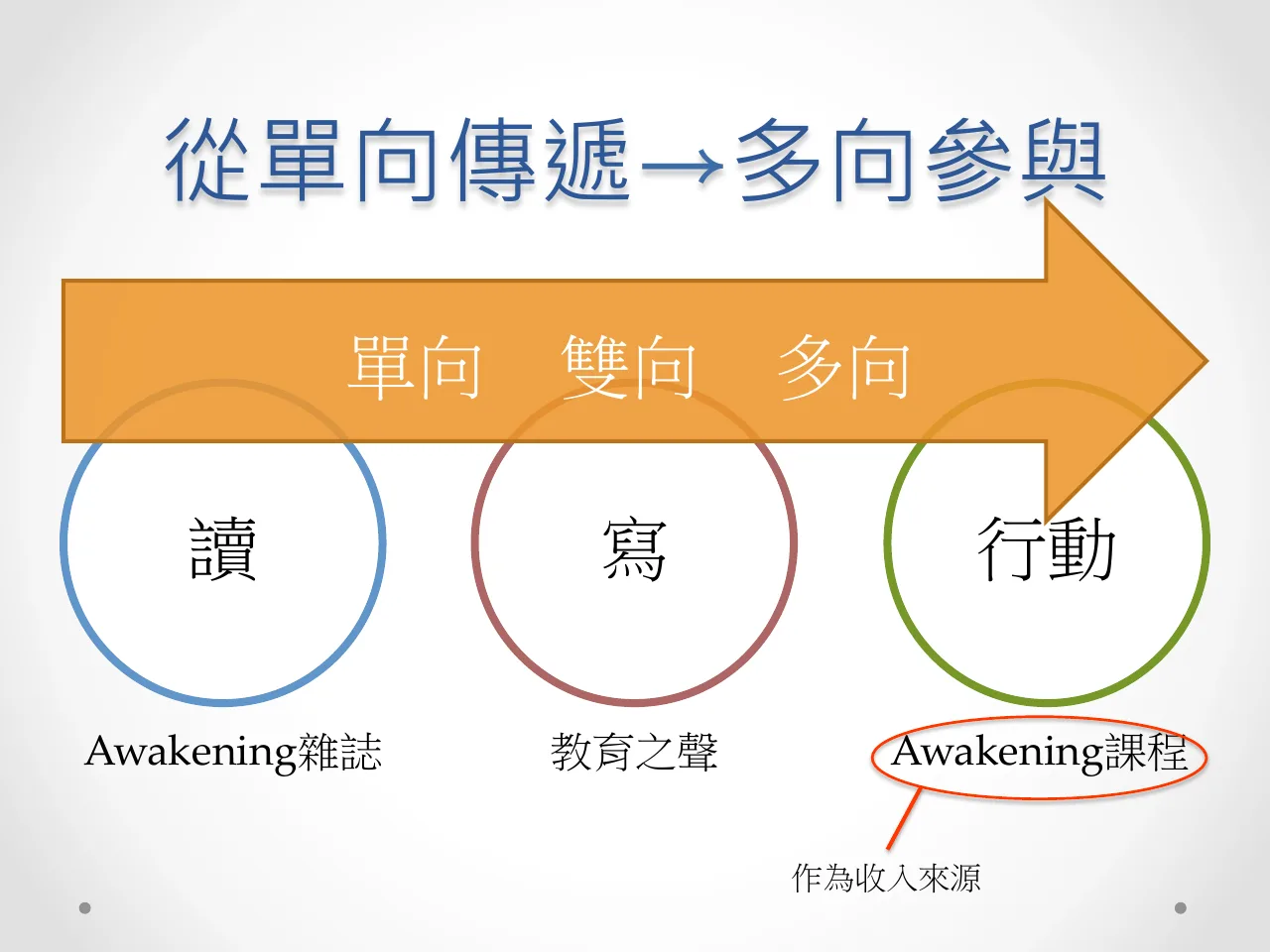
What is a seed magazine? For readers who share our ideas, after they take part and are certified, we authorise them to set up a seed branch in the county or city where they live, so that Awakening blossoms everywhere.
Where to read it
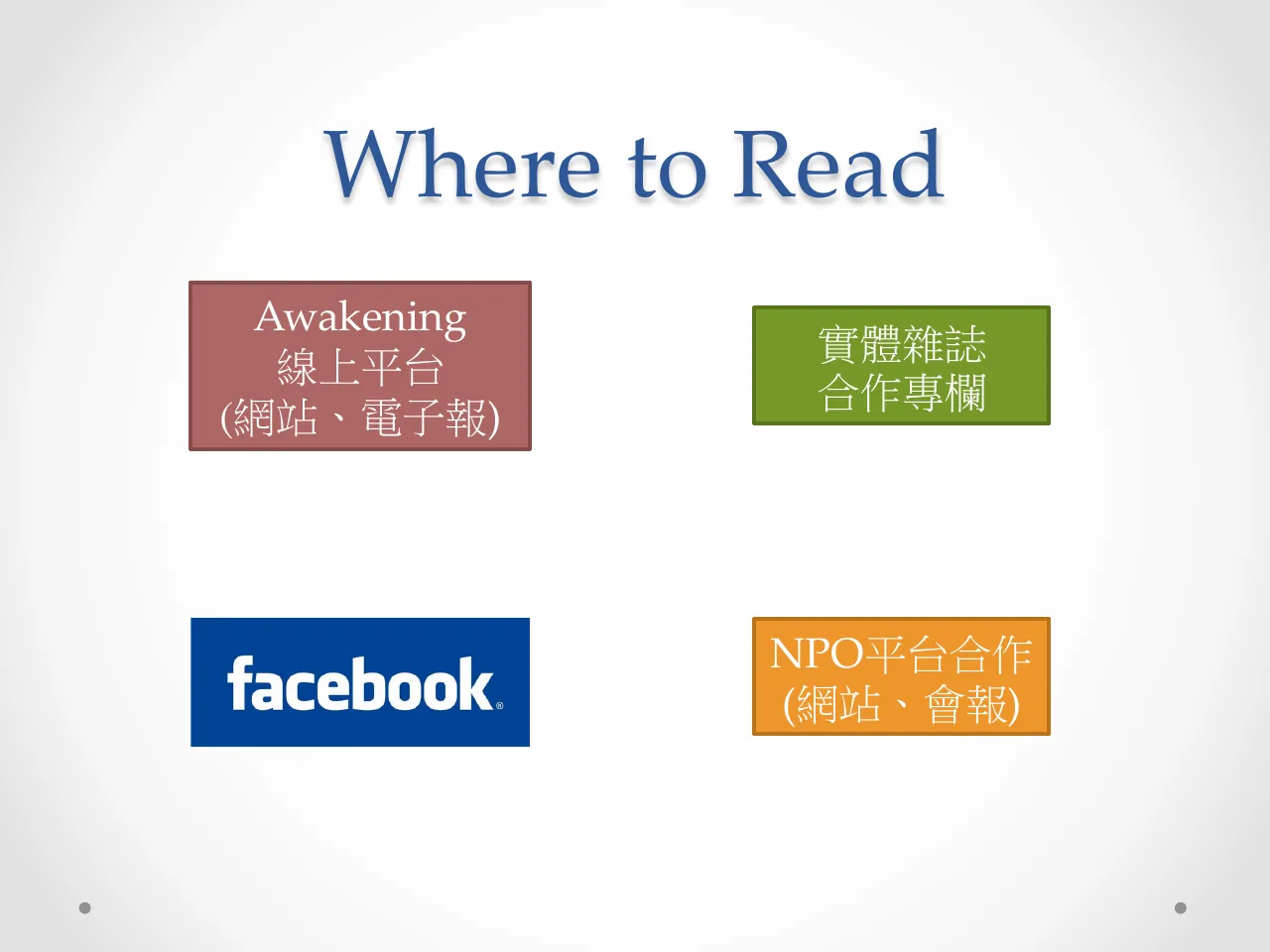
So where can you read our magazine? Besides the online platform at top left (website and e-newsletter) and our Facebook fan page, we hope to cooperate with some print magazines so that they have a partner column dedicated to us. We also hope to work with some NPOs, so that on their online platforms or newsletters our latest news can be shown.
Sources of income
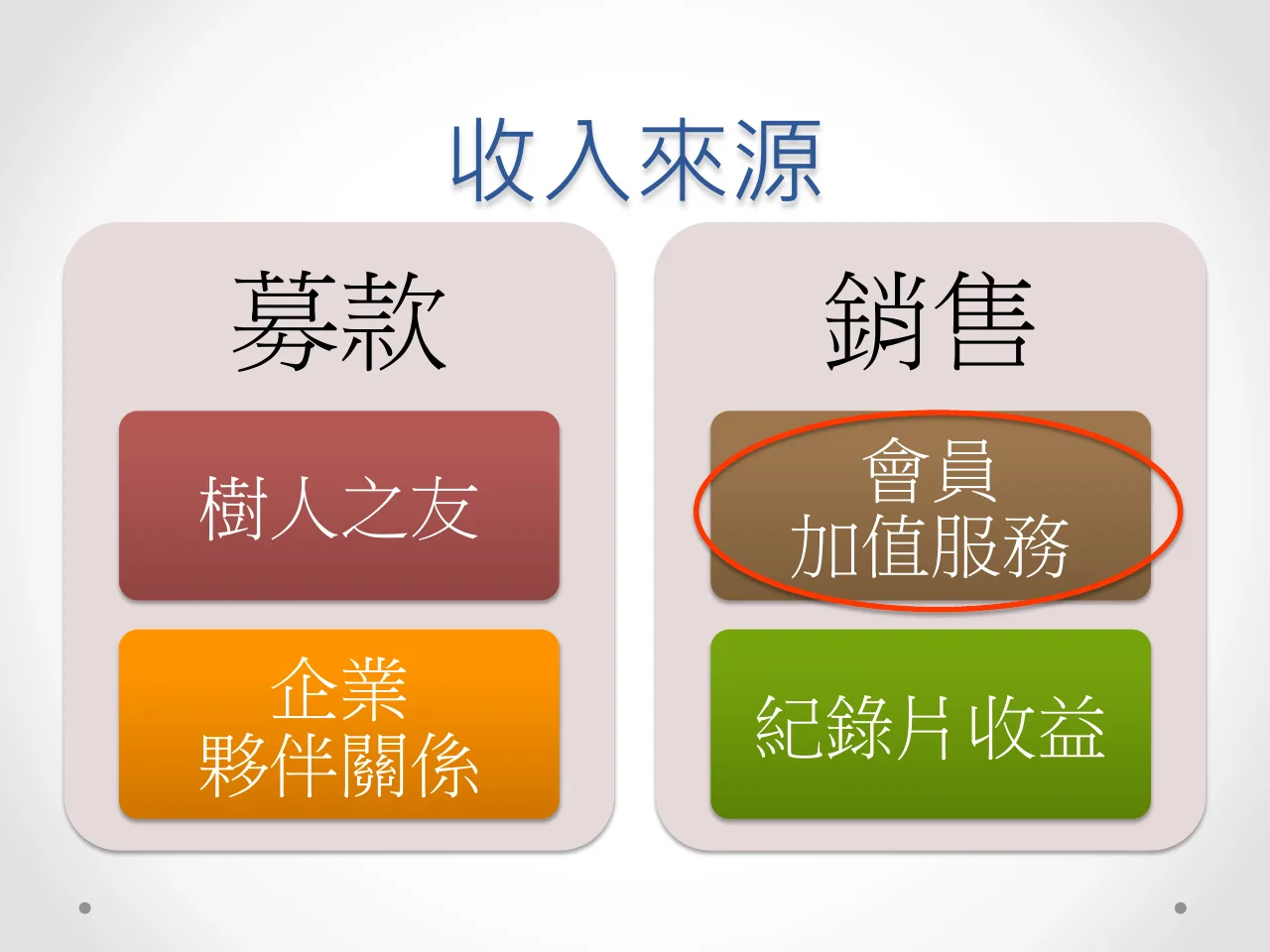
Our income comes mainly from two items: fundraising and sales. “Friends of Shuren” (樹人之友) is like the “Friends of PTS” (公視之友, the supporters’ club of Taiwan’s public television) and relies on donations from the public. For corporate partnerships, we hope to build a donation relationship that is a win for both the magazine and the company. For example, we could design a donation points card: consumers take the card to partner shops and spend, and the company, according to the points accumulated, remits donations to our magazine.
Next, premium member services: we hope to work with companies that share our ideas, introducing their products to our readers, giving readers more new choices for self-exploration, while increasing our income and bringing a stable customer base. Documentary revenue is the sales income from the documentary our team made, The Soul (《學習的理由》).
Operating model
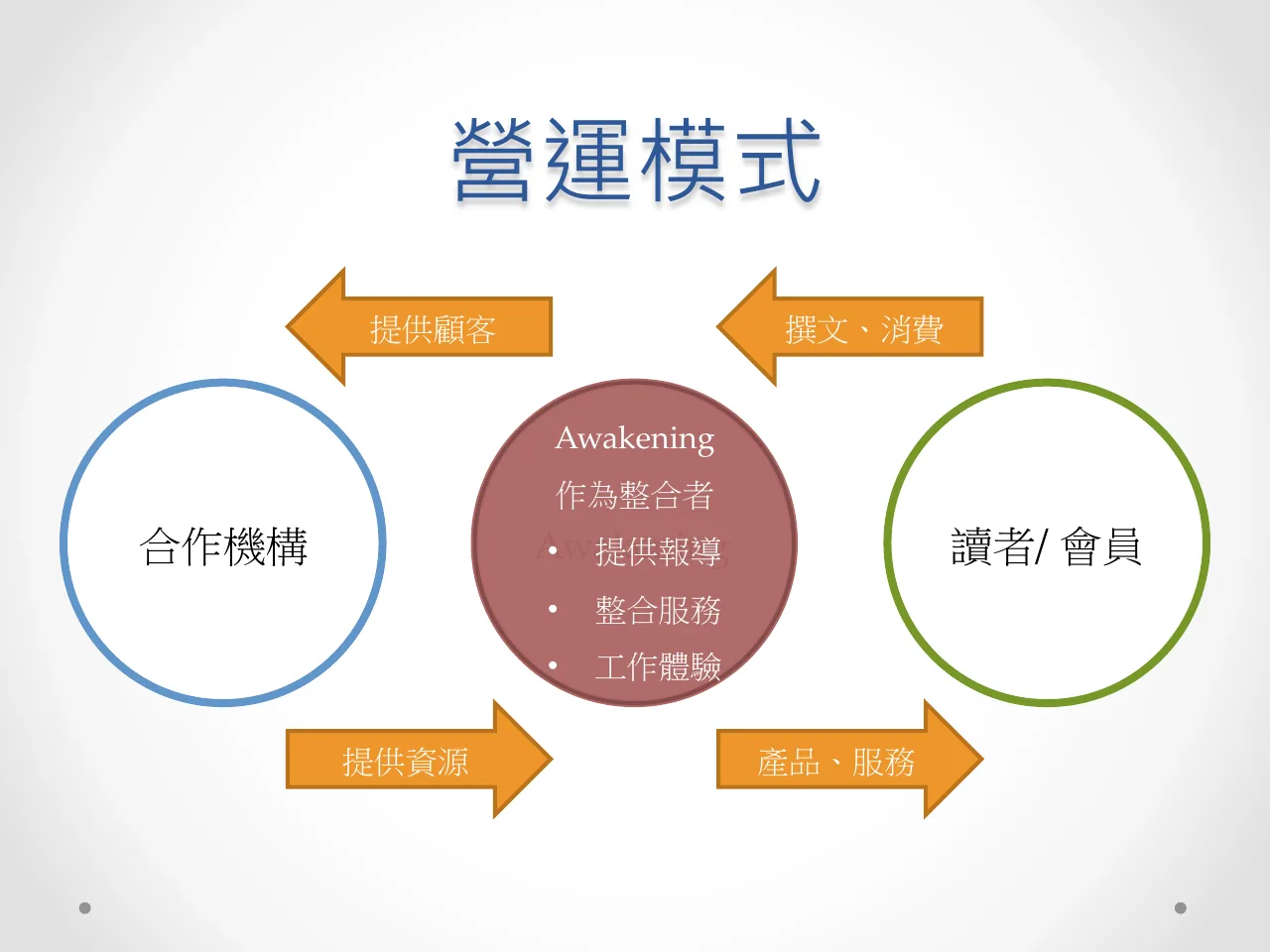
Now the relationship among magazine, companies and readers. Readers write for the magazine and spend on it; the magazine gives companies a stable customer base; what companies give the magazine is resources, such as funds or products; and what the magazine gives readers is products and services. So among these three, Awakening is the integrator of relationships: we offer reporting to the public, we integrate the services of all partner companies, and we give readers the working experience of making a magazine.
Our own operating challenges
What I turn to now is how our own operation stands, the problems we have met, and we ask the seniors here for plenty of advice.
The first is [unclear in recording, 0:07:10]: we describe our audience as 15 to 25 years old, but the needs of senior-high and university students differ, so we would like to know how to serve both, or whether we need to reposition.
Next, mastering new media technology. For an online magazine what matters is not only text and pictures but a whole new experience of video and interaction, but our team currently has neither the talent nor the funds for that.
Third, the high turnover of members. Because our team members are mostly students like us, and each person’s career develops differently, membership changes a lot.
And the sustainability of the operating model. We hope everyone here can offer more operating models for us to consult.
Closing: bearing witness to awakening through action


To restate what I have said: our idea is to explore the essence, keep improving and keep looking for new paradigms; our mode of interaction stresses that readers are the magazine’s ingredients; and our role is to integrate the strengths of the magazine and of companies. We hope to use the strength of both sides to bear witness to awakening through action.

Thank you, everyone.
Read the original text
閉恩濡在「2012 台灣社會企業國際論壇」上,以八分多鐘介紹由青少年發起的《Awakening》雜誌:它要為十五至二十五歲、在升學與休閒之外找不到自我探索資源的年輕人,提供「自我探索的攻略、新教育的標竿」。她說明雜誌如何讓讀者參與(封面故事、專欄、國際焦點、「教育之聲」平台與「種子雜誌」分社)、在哪裡被閱讀、收入來源(募款與銷售)與營運模式,最後坦率提出團隊自身的四個難題(目標年齡的重新定位、新媒體技術、成員高流動性、營運模式的永續性),向在場前輩求教。
介紹與開場
(台上的介紹詞,從內容看應為楊逸帆;錄音中未點名。)我在國二的時候,拍了一部叫《不想考基測》的紀錄片,今年將以全新的面貌登場。[unclear in recording, 0:00:07]另外一位當時也是國中生的女生,也與我發起了這個《Awakening》雜誌。我們希望為迷惘中的孩子、青少年、青年,提供一些實際的協助,讓他們在生涯探索方面有實際的參考。那就讓我們以熱烈的掌聲歡迎閉恩濡。
謝謝。各位在場的來賓、各位前輩,大家好。我是《Awakening》雜誌的企劃總監恩濡,我今年十幾歲。現在就為大家介紹一下我們雜誌的營運模式。
青少年的處境與現有雜誌的缺口
首先,我來模擬一個情況,是一個青少年可能會遇到的問題。第一,每天都為了考試熬夜讀書;第二,可能有感情上的需求或困擾;第三,還不知道自己的方向在哪裡,不知道自己要考什麼學校、以後要做什麼工作。每天的生活看似很忙碌,但其實並不知道自己在做什麼,這樣說起來實在有點空虛。其實我真正想做的是創業、是旅行,但是現有的環境不允許我這麼做。
於是,我們的青少年開始尋求協助,運用市面上的教育與生涯探索雜誌。
我們先來看最左邊的這個,職涯雜誌:「當個好員工」,似乎跟我沒有太大的關係。再來是升學雜誌,每天在學校都聽膩了。校園生活與休閒娛樂是不錯,但是它並沒有解決根本的問題。社會現象類:我們連自己的問題都解決不了,要怎麼去幫助社會呢?心理輔導雜誌,我們好像沒有這樣的需求。教養雜誌,我們已經超出了那個年齡範圍了。
那麼,父母又是如何看待孩子的呢?他可能會覺得很納悶:什麼?為什麼他說他要休學、他要延畢?[unclear in recording, 0:02:20]為什麼我們的孩子都這麼大了,卻不知道自己的方向在哪裡,還這麼依賴別人?孩子到底在想什麼,我完全不懂。而且我對現有的教育體系有很多的不滿。[unclear in recording, 0:02:38]這樣的世代呢?
Who can answer me?定位:自我探索的攻略、新教育的標竿
我們用年齡層把市面上的教育與生涯類雜誌分為三個區塊。可以看到左右兩邊,它們所包含的面向、探討的內容都比較廣泛,因此它們建立的思考模式,還有導出來的結論,涵蓋性也比較廣。但是看中間,15 到 25 歲這個區塊,只有升學還有休閒。因此,《Awakening》雜誌要彌補這樣的資訊不足,提供青少年更多元的自我探索。
因此我們把產品定位成「自我探索的攻略、新教育的標竿」。所謂的攻略,在電玩遊戲中要達到最終目標,絕對不會只有一種方法、一條路。我們認為,對於人生、對於自我探索,也不應該只有一種方法、一條路,所以我們的雜誌會提供實際可用的方法給讀者。至於「新教育的標竿」,我們希望能夠帶領讀者一起探究本質,而不是再將一切視為理所當然,並且一起尋找新的典範,不斷地精進。所以我們希望這一波新的風潮可以由青少年來發起、由青少年來帶領,並且引領更多人的覺醒。
雜誌如何運作:讀者就是雜誌的成分
那麼,我們的雜誌實際上如何運作呢?首先,我們強調讀者的參與:讀者就是雜誌的成分。每一期雜誌大致分為三大內容:封面故事、專欄,還有國際焦點。每一期的封面故事決定出來以後,會開放給網友討論,好處是,第一,可以知道網友對這個主題的興趣;第二,我們可以得到第一手的資訊與故事。
我們還會設立一個平台,叫「教育之聲」。因為我們的雜誌強調每個人、每個身分都是公民記者,你可以到這個平台上投稿;所投稿的內容如果跟當期雜誌的封面故事或專欄主題相合,就可以成為雜誌的一部分。國際焦點主要是談全球性的青少年或教育實施議題,因此讀者如果把原文資料翻譯成中文,也可以放在我們這個平台上,成為雜誌的內容。
什麼是種子雜誌呢?認同我們理念的讀者,在參與認證以後,我們會授權給他,讓他在自己居住的縣市也成立一個種子分社,讓我們的《Awakening》雜誌遍地開花。
在哪裡可以讀到
那麼,在哪裡可以讀到我們的雜誌呢?除了左上角的線上平台(網站、電子報)和 Facebook 粉絲頁以外,我們希望可以和一些實體雜誌合作,讓它們有專屬於我們的合作專欄。另外,我們也希望能夠和一些 NPO 合作,在它們的網路平台或會報上,開放我們的近期消息。
收入來源
我們的收入來源主要有兩大項:募款與銷售。「樹人之友」就像「公視之友」一樣,注重大眾捐款。企業夥伴關係方面,我們希望建立雜誌與企業雙贏的捐款關係,例如設計一張捐款集點卡:消費者拿集點卡到特約商店消費,累積的點數,企業會依照點數以捐款的方式匯給我們的雜誌。
再來是會員加值服務:我們希望和一些認同我們理念的企業合作,把他們的產品介紹給我們的讀者,提供讀者更多自我探索的新選擇,同時增加我們的收入,也帶來穩定的客戶群。紀錄片收益,就是我們團隊製作的紀錄片《The Soul》(《學習的理由》)的銷售收入。
營運模式
接下來談雜誌、企業與讀者三者之間的關係。讀者撰文,並且消費給雜誌;雜誌提供穩定的顧客群給企業;企業提供給雜誌的是資源,像是資金或者產品;而雜誌提供給讀者的,是產品與服務。因此《Awakening》在這三者之間,是一個關係的整合者:我們把報導提供給大眾,並且整合所有合作企業的服務,還有,我們提供寫雜誌的工作體驗給讀者。
我們自身營運的考驗
現在要講的是我們自身營運的狀況,也就是我們遇到的問題,還請在場的前輩給我們多多的建議。
第一個是[unclear in recording, 0:07:10]:我們把對象標榜為 15 歲到 25 歲,但是高中生和大學生的需求不同,所以我們想了解,如何能夠同時顧及兩方的需求,或者我們需要重新定位。
再來是新媒體技術的掌握。線上雜誌重視的不僅是圖文,更是影音互動的全新體驗,但是我們的團隊目前沒有這樣的人才,也沒有這樣的資金。
第三是成員的高流動性。由於我們的團隊成員就像我們一樣,都是以學生為主,每個人的生涯發展不同,所以成員的變動性很大。
還有營運模式的永續性。我們希望在場的各位能夠提供更多營運模式,給我們做參考。
結語:以行動見證覺醒
所以,重申上述所說的:我們的理念在於探究本質、不斷精進、不斷尋找新的典範;我們的互動模式強調讀者就是雜誌的成分;而我們的角色,是整合雜誌與企業兩方的力量。我們希望運用兩方的力量,在行動中見證覺醒。
謝謝大家。
How this connects
The centre is this page. Each mark is a page or a person that the site’s records link to it; a line between two marks means those two are linked as well.