Awakening Cooperative Lab · Library
Talk report: Naciem Nikkhah, “Instilling a Love of Learning in Children with a Companion Robot”
This report records Naciem Nikkhah’s account of ROYBI’s companion robot, explaining how its design, curriculum, speech technology, and adult involvement shape early language and STEM learning.
- Event
- Towards an Anti-Fragile Paradigm in Education: Shifting the focus from EE (Effectiveness & Efficiency) to RR (Resilience & Robustness) (TIES 2020)
- Date
- 2020-11-22
- Author
- Lab report (machine draft, unreviewed)
- First published
- Recording on YouTube
- Copy taken
- 2026-11-22
- Event
- Towards an Anti-Fragile Paradigm in Education: Shifting the focus from EE (Effectiveness & Efficiency) to RR (Resilience & Robustness) (TIES 2020)
- Date
- 2020-11-22
- Author
- Lab report (machine draft, unreviewed)
- First published
- Recording on YouTube
- Copy taken
- 2026-11-22
Contents
Naciem Nikkhah, Ph.D., Program Manager of Education Technology at ROYBI, spoke at Session 1, “The Possibility of Holistic Education Technology,” during the online 2020 Taiwan International Education Summit on 22 November 2020. Introduced by summit curator and session host Adler Yang, Nikkhah argued that the design, educational content, and supporting technology of a companion robot could work together to foster language and STEM learning, curiosity, and continued engagement among young children.
Designing a learning companion
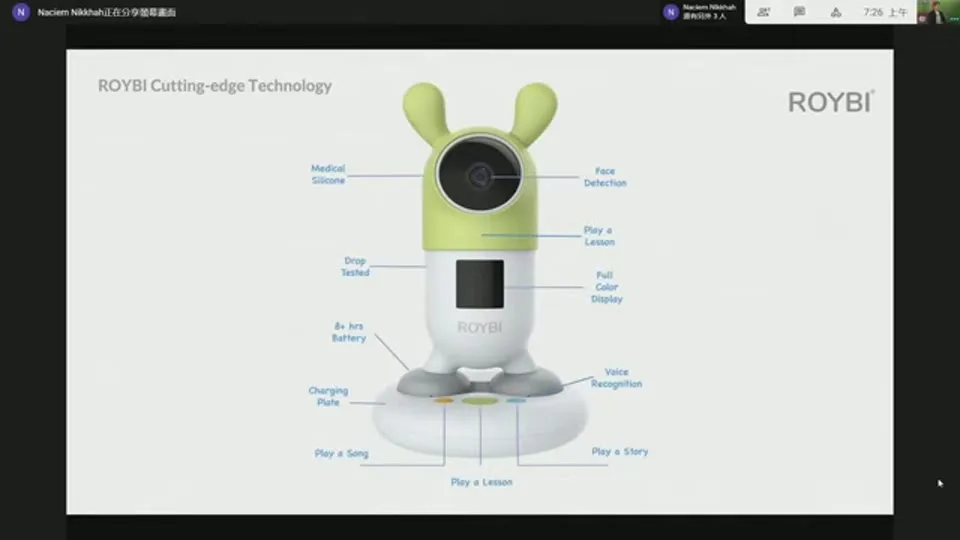
Nikkhah began by connecting her work at ROYBI with her approximately ten years of language-teaching experience. Classroom experience, she said, made the prospect of teaching with a robot particularly engaging for someone with a humanities background. Her presentation would explain how the robot’s physical design and curriculum operated together to teach languages and STEM skills while encouraging a love of learning and the enjoyment of discovery from an early age.
ROYBI was founded in 2019 to develop AI-powered technology for early childhood education, particularly for children aged three to seven, and to expand access to language learning through a global community. Nikkhah said the robot had been recognized by Time magazine as one of the top 100 inventions of 2019 and had received the Tech for Good Award in the same year. It taught languages and basic STEM concepts to children aged three and older, providing more than 500 lessons, songs, and stories. Parents could manage these materials through an accompanying application compatible with iOS and Android.
The robot’s built-in camera supported facial-recognition technology intended to detect a child’s emotions and respond through stories, educational songs, and games. Its introductory lessons presented ROYBI as a robot arriving on Earth from a distant place in outer space. Science lessons then used the character’s curiosity about Earth and human discoveries to connect storytelling with instruction.
Nikkhah said the curriculum designers tried not to assign the robot a gender. They also avoided humanoid features because the product was intended to be understood honestly as a robot rather than mistaken for a human companion. Its small, lightweight body allowed children to carry it and hold it closely while interacting. She argued that this combination of character, physical design, and curriculum could support self-guided learning and encourage children to continue seeking knowledge. (0:23:01–0:27:59)
Parent involvement and speech-recognition technology
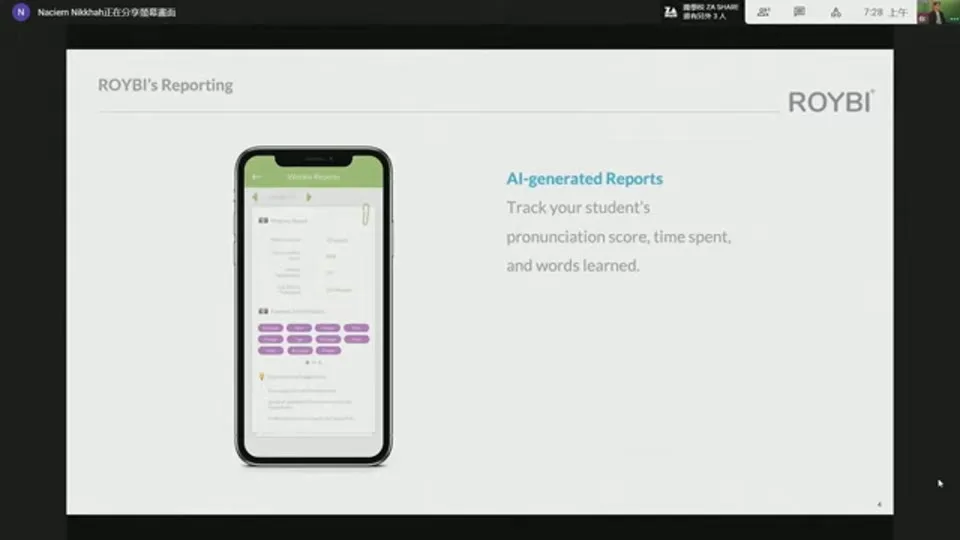
Although the learning experience was designed to offer children some independence, Nikkhah said ROYBI placed parents “in the driver’s seat” through its free companion application. The application allowed parents and educators to monitor a child’s progress and participate in the learning process.
Weekly reports recorded the number of words learned, pronunciation scores, weekly improvement, and average time spent with the robot. Learned words were grouped into the categories “fantastic,” “fair,” and “fizzle.” Each report also offered three suggestions through which parents could support the child’s further development.
Nikkhah then described ROYBI’s 2019 acquisition of another venture, [unclear in recording, 0:28:55], which added technology for children’s embedded automatic speech recognition, or ASR, and edge AI. She defined the latter as on-device voice recognition. The acquired system drew on linguistics, neuroscience, and embedded artificial intelligence to provide online and on-device recognition of children’s speech in multiple languages.
According to Nikkhah, the technology had been developed using more than 150,000 recordings of children’s voices in English, Mandarin, and several other languages, along with more than five years of data collection and machine learning. She said the data practices complied with the Children’s Online Privacy Protection Act, or COPPA. Reliable recognition of children’s speech was important because effortless interaction was the first step toward establishing rapport between a child and the robot. (0:27:59–0:30:21)
Learning from families and changes in use
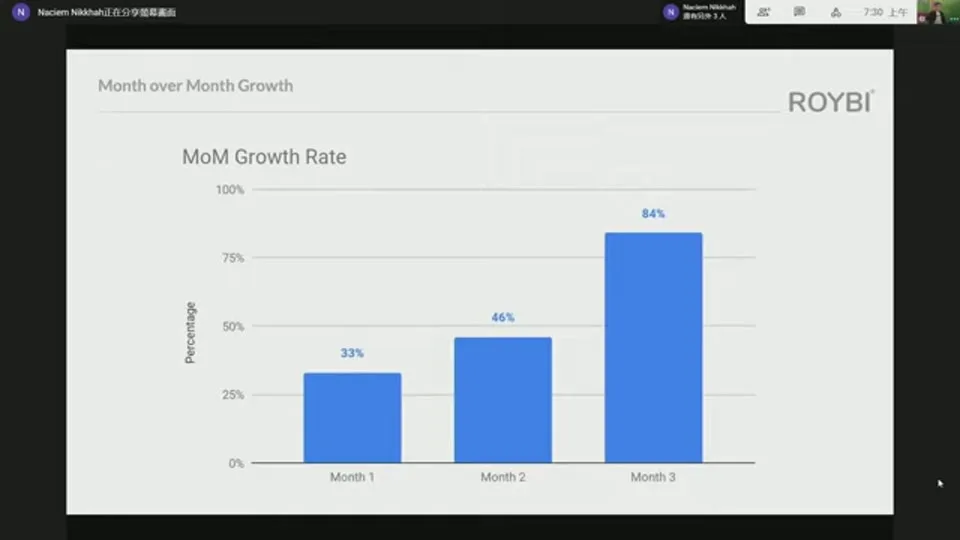
ROYBI could measure growth or decline in users’ interactions with its content. Nikkhah reported that interaction with the robots had recently increased by 84 percent. She did not attribute this change solely to pandemic-related stay-at-home orders. Improvements to the AI technology and educational content, introduced around March after extended user research and collaboration with academics and professionals, had also contributed, she said.
The pandemic created new challenges for communicating with users. In response, ROYBI formed a community of parents and teachers who participated regularly in user-experience research. These conversations showed that parents often needed guidance on how to use the technology effectively at home. Staff therefore discussed AI and machine learning with parents, explaining their possible educational uses. Nikkhah said that greater attention to customer education was followed by increased engagement with the robot and greater interest and trust among customers.
She argued that although interaction with AI would be part of children’s future, adults were not adequately prepared to help children enter that future because AI and machine learning remained new to them as well. ROYBI consequently sought to involve parents, educators, and researchers in developing a research-based product.
Preliminary interviews examined children’s home environments and their use of the robot. A Facebook community also enabled families to contribute directly to decisions about product features. Through these discussions, the company learned that some parents of children with autism incorporated ROYBI lessons into daily routines for teaching social and communication skills. Families also reported that the robot became part of children’s stories about relatives and friends. Its lessons prompted children to ask parents additional questions about newly introduced stories and concepts, an outcome aligned with the company’s aim of encouraging curiosity. (0:30:21–0:33:44)
Classroom evaluation and curriculum revision
Nikkhah next described a collaboration with Education Alliance Finland. Five kindergarten teachers in Finland used ROYBI in their classrooms to teach English vocabulary to children with no previous knowledge of English. After several months, the teachers completed a review that rated the robot’s pedagogical approach at 78 percent out of a possible 100 percent.
A subsequent virtual meeting with one participating teacher helped the company examine both the results and possible improvements. The research indicated that the existing content was too advanced for children who had neither previous English knowledge nor regular exposure to the language at home or at school. Although these students struggled to engage with the robot independently, assessment data suggested that they responded better when teachers guided the interaction. Adult-directed co-engagement also increased children’s enthusiasm for continuing to use the robot.
These findings led to meetings with the company’s mentors and a plan to separate two educational needs. Existing content would be redeveloped for children in English-speaking countries who already had some knowledge of or exposure to English, while a distinct curriculum would be created for learners of English as a second language. ROYBI hired an ESL-certified teacher to produce 100 lessons, while its research and development team redesigned the companion application to support them. Nikkhah said the lessons had been released without fees in October and were undergoing further research to assess their effectiveness.
She concluded that language development had remained closely connected to both ROYBI’s curriculum and its technology throughout the product’s development. Teachers, academics, and researchers participated through a mentorship group that regularly advised the company. The curriculum emphasized vocabulary, pre-literacy skills, and school readiness among children in the transitional pre-kindergarten age group. In the context of pandemic-driven online learning, Nikkhah said children’s comfort and ability to learn through technology would become an increasingly valued outcome. (0:33:44–0:36:58)
Discussion
After the presentation, Yang asked whether Nikkhah had visited the summit’s online exhibition website. He explained that the site used a role-playing format in which visitors became wandering stars that had accidentally collided with Earth and then began a learning journey. He compared this premise with ROYBI’s story of arriving from outer space and discovering Earth.
Nikkhah responded that she had not yet visited the exhibition but would do so. She suggested that the joy of discovering a new place and encountering new things was a broadly shared theme. Yang encouraged her to visit before the temporary exhibition closed. The excerpt then moved into a panel discussion, but Nikkhah’s response to the panel’s opening question was not included. (0:36:58–0:39:00)
How this connects
The centre is this page. Each mark is a page or a person that the site’s records link to it; a line between two marks means those two are linked as well.