Awakening Cooperative Lab · Library
Talk report: Dennis Li, “Building better learners by teaching them how to learn”
This report presents Dennis Li’s approach to student reflection and education technology, showing how repeated analysis and teacher feedback can develop learning strategies without replacing human relationships.
- Event
- Towards an Anti-Fragile Paradigm in Education: Shifting the focus from EE (Effectiveness & Efficiency) to RR (Resilience & Robustness) (TIES 2020)
- Date
- 2020-11-22
- Author
- Lab report (machine draft, unreviewed)
- First published
- Recording on YouTube
- Copy taken
- 2026-11-22
- Event
- Towards an Anti-Fragile Paradigm in Education: Shifting the focus from EE (Effectiveness & Efficiency) to RR (Resilience & Robustness) (TIES 2020)
- Date
- 2020-11-22
- Author
- Lab report (machine draft, unreviewed)
- First published
- Recording on YouTube
- Copy taken
- 2026-11-22
Contents
Dennis Li, Co-founder and CTO of Sown To Grow, spoke at Session 1, “The Possibility of Holistic Education Technology,” of the online 2020 Taiwan International Education Summit on 22 November 2020. Introduced by summit curator and session host Adler Yang, Li argued that goal-setting and progress tracking become more useful when students also reflect on how they learn, and that education technology should help teachers develop this practice without attempting to replace their relationships with students.
Sown To Grow and its reflective practice
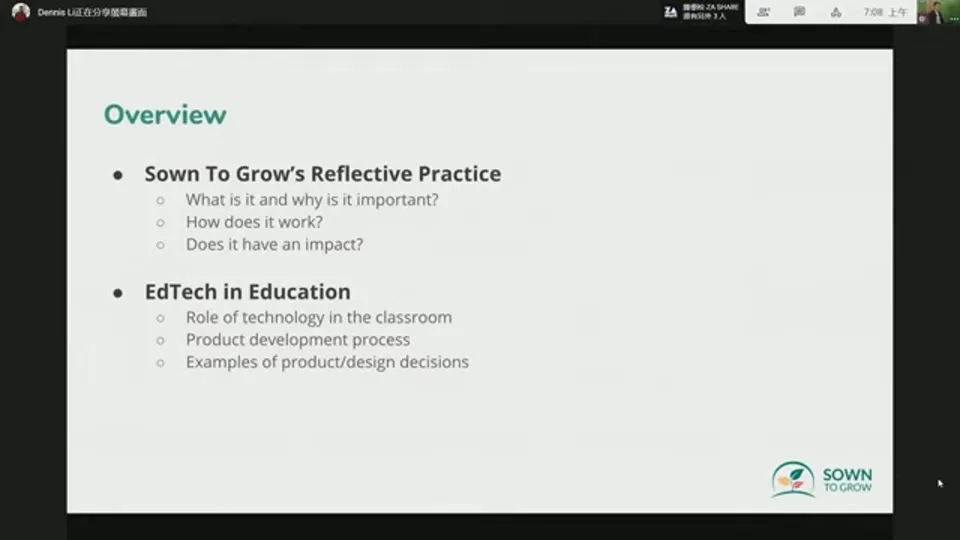
Li introduced Sown To Grow as a US-based education technology company founded about five years earlier by Li and his co-founder, Rupa Gupta. Students in hundreds of US schools used its platform to set learning goals, monitor their progress, and reflect on the strategies contributing to their results. Teachers used the platform to guide this process. With funding from the National Science Foundation, the company had also incorporated machine-learning and language-processing technology intended to help teachers provide better feedback.
As chief technology officer, Li had built the platform with his team. He described his background as spanning engineering, public policy, education policy, private-sector software development and analytics, and work as an administrator in a large school district in San Jose, California.
The practice underlying the product followed a recurring sequence. Students set goals, tracked their progress, completed a brief emotional check-in, and wrote a reflection analysing their performance. In most implementations, students completed this cycle weekly. Li noted that schools might already have experience with goal-setting and data tracking, but said the reflection stage tended to attract particular interest. It created a regular opportunity for students to consider not only whether they had achieved a goal, but why a particular result had occurred. (0:05:17–0:09:27)
From fixed conclusions to alternative strategies
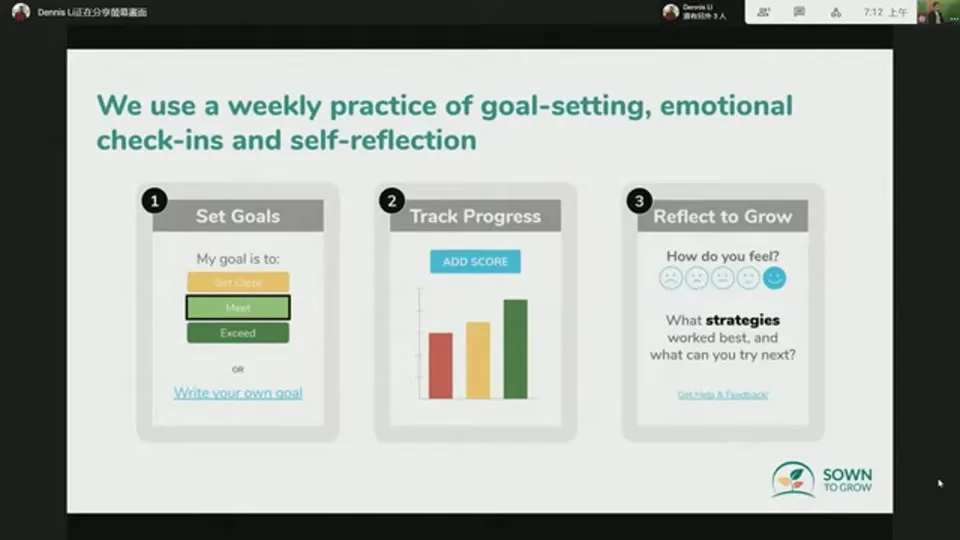
Li argued that goal-setting and progress tracking alone could sometimes reinforce an unhelpful conclusion. He gave the example of a middle-school student taking a weekly vocabulary quiz. The student might set a goal of receiving an A and carefully record every result. If the student continued to receive a C each week, however, the accumulated data could lead to the belief that the student lacked the innate ability to succeed. Li associated this conclusion with what research calls a fixed mindset.
Reflection was intended to improve the likelihood that students would instead develop what he called a growth mindset: the belief that abilities can be developed. Rather than treating a disappointing result as evidence of a permanent limitation, students could identify approaches to change. For a vocabulary quiz, they might take practice quizzes the night before, ask a friend to explain definitions that were difficult to understand in a dictionary, or attend to their well-being by getting sufficient sleep. Successful approaches could be retained, while unsuccessful ones could be replaced in the next cycle.
Li illustrated this process with his own experience. Although he had earned good grades in high school and entered a strong university, he struggled when he began studying computer science without previous programming experience. Friends who were performing more successfully showed him different ways to work. He began programming assignments earlier, improved his time management, attended office hours to seek help, and pursued internships where he could apply classroom theory in practical settings. His performance in the final two years of college was considerably better than in the first two. Sown To Grow, he said, sought to remove the element of luck involved in encountering such support by establishing a consistent reflective practice for students. (0:09:27–0:13:38)
Developing reflection and measuring results
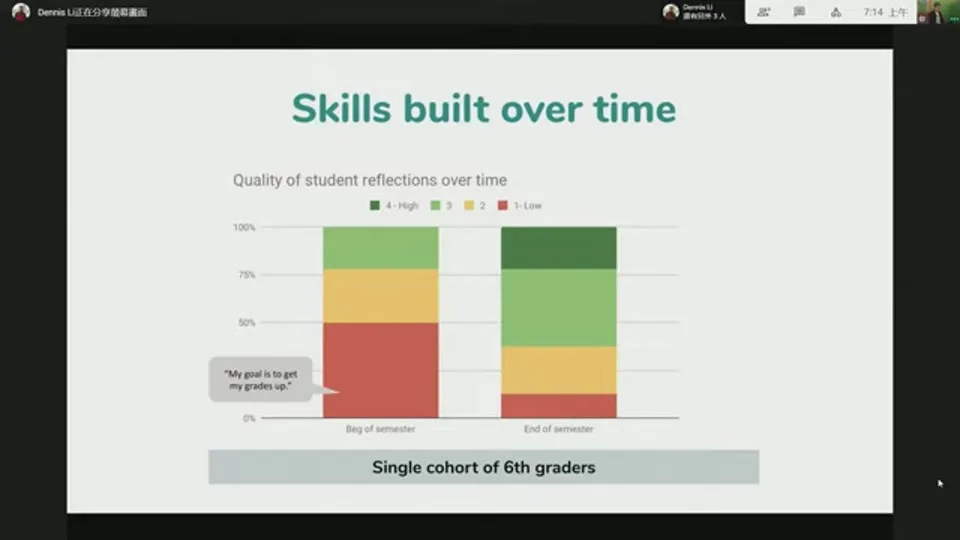
Simply allocating time for reflection was not sufficient, Li said, because reflection itself was a skill that needed to be developed. With National Science Foundation funding, Sown To Grow created a four-point rubric for assessing reflection quality. When students first began the practice, many produced low-quality responses that stated a goal without explaining how they would reach it. Through regular practice and, importantly, feedback from teachers, students could improve their metacognitive skills.
Li referred to a study of sixth-grade students who used the reflective practice for an entire semester. By the end of the semester, the quality of their reflections had improved significantly. Their later responses connected specific actions, such as studying more vocabulary during a break, with a learning goal and a way of determining whether the goal had been achieved.
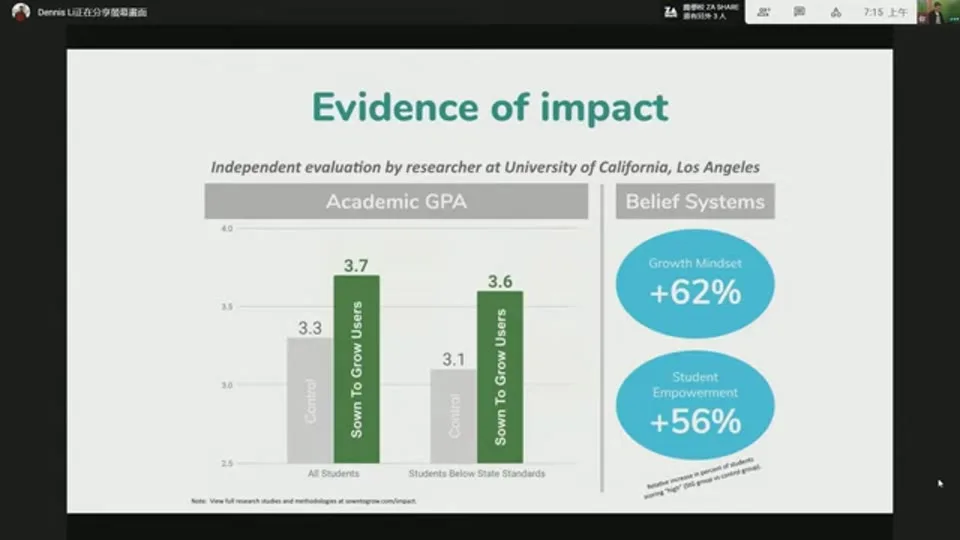
The company also measured the practice by comparing two similar groups of students at one school, one using Sown To Grow and one not using it. At the end of the semester, students who routinely completed the practice on the platform had higher grades. Among students who began the year below state benchmarks in mathematics and language arts, the difference between the groups was more pronounced. Pre- and post-surveys concerning growth mindset and students’ sense of empowerment in their learning likewise produced higher scores for the group using the practice. (0:13:38–0:15:40)
Principles for education technology
Li then turned from the reflective practice itself to the principles guiding the product’s design. The first was the need to understand the classroom context. Schools and educators faced numerous competing priorities. Building metacognitive skills mattered, but so did learning mathematics, science, language arts and social studies. Even if educators valued reflection, they might not be able to allocate an hour every week to it. The design challenge was therefore to make the practice accessible alongside teachers’ other responsibilities.
The second principle concerned the role of educators. Drawing on their previous work in education, Li and Gupta believed that teachers, counsellors and administrators performed functions that technology could not easily replace. Their approach was to use technology to improve educators’ interactions and relationships with students.
The third principle was efficiency. Li said that appropriate uses of technology could make educational work more efficient. In the reflective practice, this meant finding ways to reduce the effort required from teachers while preserving their role in guiding students and providing feedback. (0:15:40–0:17:43)
Translating the principles into product decisions
Sown To Grow initially made its platform highly flexible, allowing teachers to decide what students would track and reflect upon. The company then observed the different settings in which teachers used the product and identified routines that appeared broadly applicable. It packaged these routines as ready-to-use modules.
One such module was the “weekly academic check-in.” Students recorded their grades across all classes once a week and reflected on what they would do during the following week to improve them. Sown To Grow added the necessary scaffolding so that teachers could begin the routine with only a few steps.
Feedback presented another design problem. Teachers needed to suggest new strategies to students, but some had more than 100 student reflections to address each week. Using its National Science Foundation grant, the company developed machine-learning technology that read students’ reflections and suggested feedback based on their content. The same technology grouped similar reflections, allowing a teacher to respond to multiple students with related feedback. Li said these tools were intended to help teachers reach more students while deepening, rather than replacing, their relationships with them. (0:17:43–0:20:54)
How this connects
The centre is this page. Each mark is a page or a person that the site’s records link to it; a line between two marks means those two are linked as well.