Awakening Cooperative Lab · Library
Education Agenda 2032 (“Taiwan Education Vision 2032”): A Ten-Year Outline of Issues for Exploration
A ten-year outline of eight issues for building an education ecosystem in Taiwan, sorted on two axes (universal to local, restoration to creation) and written in 2022 as a proposal at a think tank’s invitation.
Machine translation, not yet reviewed.
- Date
- 2022
- Author
- Adler Yang
- First published
- Written in 2022 as a proposal at a think tank’s invitation (the think tank is not named); first posted by the author in December 2024
- Copy taken
- 2026-11-22
- Date
- 2022
- Author
- Adler Yang
- First published
- Written in 2022 as a proposal at a think tank’s invitation (the think tank is not named); first posted by the author in December 2024
- Copy taken
- 2026-11-22
Contents
- 1. The problem framing
- 2. Dimensions of issues, with examples
- With labour and health insurance heading for bankruptcy, how can a future social safety net be possible? (Restoration / Local)
- As social opposition keeps polarising and communication “across temperature layers” grows harder, how can democracy be possible? (Restoration / Local to Universal)
- Facing great changes in industrial structure and the global situation, new ways out for Taiwan’s forms of work (Creation / Local)
- Facing the great wave of technology, how to ride the wave and not be swallowed by it (Restoration to Creation / Local)
- Facing environmental disasters that may strike at any moment, how can Taiwan move towards an “anti-fragile” society that is resilient and robust? (Restoration / Local)
- Facing mounting international tension, how can the people of Taiwan respond together to the test of national security? (Restoration / Local)
- Facing great shifts in the international order, how can Taiwan seize the chance to gain the strategic high ground? (Creation / Local to Universal)
- How can Taiwan respond to universal issues and take part in global governance, moving from a “follower” to one of the “leaders” of the international order? (Restoration to Creation / Local to Universal)
By Adler Yang
(Written in 2022 as a proposal, at the invitation of the commissioning think tank.)
Section 1 below also appeared, under a co-author’s byline, as ZA Share: A Net of Imagination Weaving Taiwan’s Educational Future, published on VoiceTank.
1. The problem framing
Education is the process, and the nurturing system, through which individuals and groups grow and develop upward and toward the good. Every field of affairs that bears on this upward, good-directed growth needs education to take part. Education is therefore not only the root of society; it is also the best placed to become the net that weaves society together.
In Taiwan in the past, and in most countries today, education has mostly been narrowed down to “schooling”. Because the school is an institution set up ahead of society and often cut off from it, an education narrowed to schooling can, “in the best case”, be only the root of society. “In practice”, schools are often among the main “hotbeds” or “original sins” of society. As the root of society, the school was also implanted at the birth of mass education with the gene of “division into specialisms”, which is why “coherent integration” has stayed difficult to this day. As a result, the great majority of countries have not realised education’s potential to “weave a net”.
Fortunately, Taiwan’s free, democratic and plural soil gave ZA Share (雜學校) the chance to grow into a very “ㄎㄧㄤ” shape (kiang: Taiwanese slang for off-beat, out of the ordinary). Concretely, most people see ZA Share fly the banner of “education” yet cannot say what ZA Share has to do with “education”. In fact it is not that ZA Share has no direct relation to education; it is that most people’s understanding of education is still confined to what happens inside schools. The “雜” (za, “miscellaneous”) in ZA Share comes from cutting the “equals sign” that has been imposed between “education” and “schooling”, pulling down the walls that divide knowledge and skills into specialisms, and working, with the strength of civil society, to realise education’s potential to “weave a net”.
The world changes ever faster and humanity’s crises grow ever more complex. Education as the “root” must not only give people the ability to respond, and even to “create change”, amid the torrent; education as the “net” must also link and integrate growth and development across all sectors, so as to answer crises that specialised disciplines cannot handle. This confirms once more the strategic high ground that education holds. Precisely because of that high ground, even though ZA Share has worked for many years to “weave the net”, the whole citizenry and the state still need to join forces to weave the net of education more resilient, steadier, richer and more varied.
The “root” and the “net” reflect exactly the two properties of an ecosystem: it “nurtures” and it “connects”. A mature education therefore necessarily develops into an education ecosystem.
To build an education ecosystem for Taiwan, ZA Share holds that we must break the narrowing of education to “schooling”, and, taking human worth and dignity and the mutual subjecthood of people and society as the premise, think systemically in a way that sees both the trees and the forest.
2. Dimensions of issues, with examples
Based on Taiwan’s context, this outline sorts the issues expected to be explored over ten years into four quadrants along two axes: “Universal — Local” and “Restoration — Creation”.
The “Universal — Local” axis measures issues by “the universality and particularity of needs”. The closer an issue lies to the “universal” end, the more it starts from the needs of all humankind; the closer to the “local” end, the more it starts from the needs of Taiwan itself.
The “Restoration — Creation” axis classifies issues by the difference in aim between “responding to existing problems” and “opening up an ideal future”. The closer an issue lies to the “restoration” end, the clearer the existing problem; the closer to the “creation” end, the more vagueness and unknowns remain to be sorted out and imagined.
All issues take as their premise and direction the question: “What role can education, in the broad sense of being at once the root and the net of society, play in it?” The figure and the text below take the major current-affairs issues of recent years in Taiwan to list examples of issues that could be explored over the next ten years:
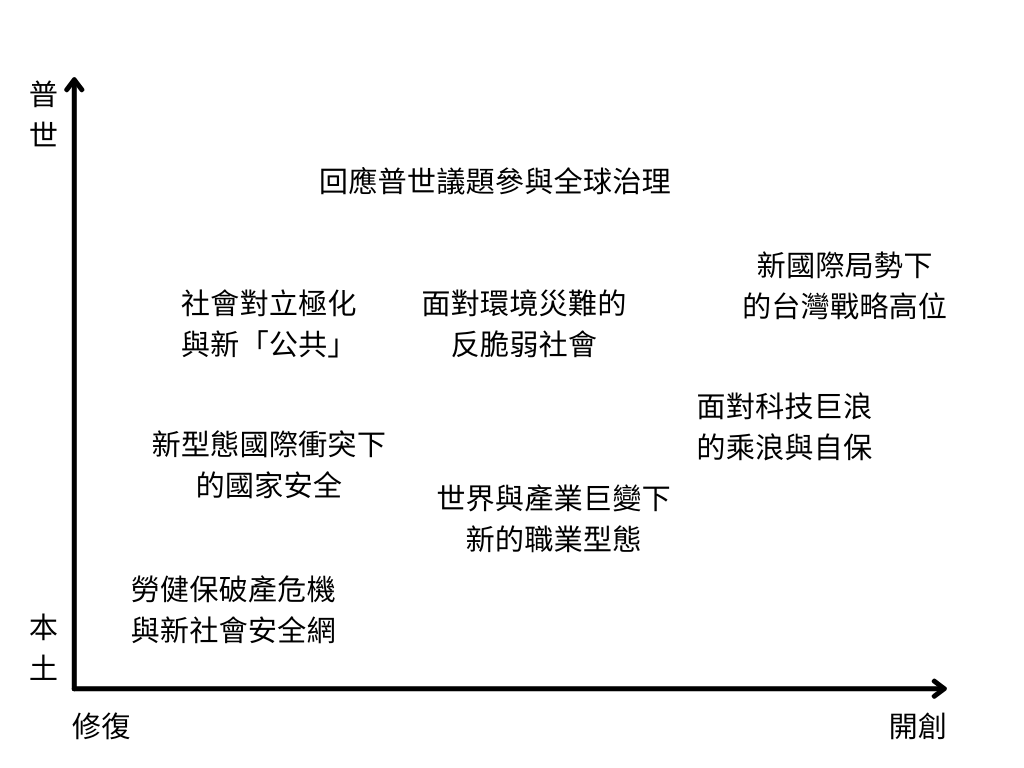
With labour and health insurance heading for bankruptcy, how can a future social safety net be possible? (Restoration / Local)
If the “redistribution” model of labour and health insurance hits a bottleneck, is there a social safety net beyond redistribution? The dimensions of a social safety net include not only physical and medical care but also the psychological, livelihood, interpersonal and environmental-safety dimensions. Moreover, besides the different needs of different life stages, which must be answered and constructively transformed, special groups such as Indigenous peoples and new immigrants also have tensions between cultures that need to be held.
Returning to the essence of a social safety net, that “whoever meets hardship and needs help can be safely caught and protected by the net”, we might return to the situations of people’s various spheres of life and imagine how an education ecosystem could improve family function, school structure, and working environments and forms of work; and, faced with physical communities that are disappearing and a digital environment and culture that is ever more immersive and all-encompassing, how an education ecosystem could shape new forms and cultures of community that do not lose the spirit of neighbours watching out for one another.
As social opposition keeps polarising and communication “across temperature layers” grows harder, how can democracy be possible? (Restoration / Local to Universal)
As physical community life disappears, human experience and its order are increasingly steered by algorithms; the ties of everyday life grow weaker and more formal, and the visible and invisible manipulation by “agents” shows itself in every kind of micro- and macro-level social scene. If “the common” and “connection” were once the foundation that made democracy possible, then, given this vast structural change, how can new “communication” and a new “public” become possible?
Facing great changes in industrial structure and the global situation, new ways out for Taiwan’s forms of work (Creation / Local)
As the VUCA world arrives, “forecast-based” talent development has reached the limit of its nature. How can a new model of talent development be possible?
First, we should think about how to develop talent-development and industrial strategies that answer and solve the crises of the twenty-first century. Beyond raising a next generation able to respond to twenty-first-century crises (for example the SDGs), and supporting them on the industry side to make a living through important work such as “stopping global warming / ending poverty / …”, this means supporting these “social changemakers” in body and mind so that they can grow and develop as whole persons.
In addition, the school system, through tracking, has in the past formed the engine behind regionally unbalanced development. A new model of talent development could draw on or link with community building and regional revitalisation, changing an entrance-exam tracking system that “ships the elite to the cities and leaves the failures in the countryside”, and so support balanced regional development.
With the coming of a society of fewer children and an ageing population, and the rise of every kind of awareness of equal rights, we need to deconstruct the existing definitions of “useful” and “useless”, so that the new talent-development system supports and embodies the subject-worth of “widows, widowers, orphans, the childless, the disabled and the ill” (鰥寡孤獨廢疾) and of other outliers, and gives birth to related development systems and industries. Under a new employment ecology in which side careers, job changes, gap years, short-term contract labour and technological unemployment are ever more common, the existing definitions of concepts such as “unemployed” and “between jobs” also need to be reviewed and revised.
Facing the great wave of technology, how to ride the wave and not be swallowed by it (Restoration to Creation / Local)
Under the trends of decentralisation, the integration of the virtual and the real, and AI automation, seen in the Metaverse, Web 3.0 and token economies, in what direction should infrastructure and industry develop? How should the work be divided?
What new models will appear in learning, work, life and the governance of the public?
What assumptions about values and ethics lie within an order dominated by “algorithms”?
Faced with leaping growth that “no law can govern”, how can we support innovation and the prevention of harm together?
How can we prevent the crises of “technological despotism” and a “useless mass”? Could the practice of “digital democracy” play a key role?
As the pace of technological innovation climbs ever higher, how do we answer the challenge of technology, information and digital divides?
How can Taiwan take part in setting the rules for, and leading in, the “undefined” territory described above?
Facing environmental disasters that may strike at any moment, how can Taiwan move towards an “anti-fragile” society that is resilient and robust? (Restoration / Local)
Faced with natural and human-made disasters such as energy and food crises, ecological catastrophe, sea-level rise, extreme weather, great earthquakes, epidemics, and shocks to the supply of electricity, water and networks, how should the normal system be adjusted and an emergency system prepared?
Facing mounting international tension, how can the people of Taiwan respond together to the test of national security? (Restoration / Local)
As geopolitical tension, cross-strait tension, and even the potential crisis of a world war all rise, faced with entirely new kinds of warfare — psychological, ideological, informational, technological, financial, economic, resource and energy warfare — how can an education ecosystem support the whole population in prevention and in wartime response strategies?
Facing great shifts in the international order, how can Taiwan seize the chance to gain the strategic high ground? (Creation / Local to Universal)
Amid geopolitical and cross-strait tension, the international arrangements for Chinese-language education and scholarly exchange are being reshuffled. Could Taiwan open up a new imagination of cultural and educational diplomacy built on Chinese-language learning? How should the opportunity be grasped as others look elsewhere for places to learn Chinese and to cooperate academically? With the situation in Hong Kong changed entirely, could Taiwan step in to fill the gap? Facing the Greater China region (Hong Kong, Tibet, Xinjiang and so on) and even international refugees (the Middle East, Ukraine and so on), could Taiwan take them in, and even support and make good use of them?
On the basis of the international community’s heavy dependence on Taiwan’s semiconductor and other industries, could Taiwan go further and make good use of the flexibility of its education policy and law (for example experimental education), acting more actively towards other countries’ education innovators and reformers and answering their challenges and predicaments, and so exert international influence and raise the international community’s dependence on Taiwan? (For example: Silicon Valley, the world’s technology innovation; the Virgin Islands, the world’s offshore-company haven; Switzerland, the world’s stronghold of information security and privacy.)
How can Taiwan respond to universal issues and take part in global governance, moving from a “follower” to one of the “leaders” of the international order? (Restoration to Creation / Local to Universal)
Could Taiwan’s character as an “abnormal state” become, and how could it become, a key resource for answering the world situation rather than a burden? Facing the inner challenges of the “Westphalian system”, shown in tensions over territory, sovereignty, nation, secession and independence, could the Taiwanese experience lead possible forms of governance for a “post-Westphalian system” and “post-nationalism”?
When democratic institutions formed on Western culture meet major challenges and bottlenecks, and different institutional visions compete with one another amid geopolitical tension, could Taiwan, as the “beacon of Asian democracy”, combine the cultural genes of Asia and Oceania to lead a global democratic transition that is not Western-centred and can hold many cultural contexts?
Faced with the human crises of economic, social and environmental sustainability, and with the Western world’s solutions (such as the various climate agreements and the SDGs) stretched thin, could Taiwan, building on the cultural genes of Asia and Oceania, its cultivation in Africa and South America, and its friendship with the democracies of Europe and America, become a proposer of non-Western-centred visions, a leader in discourse and a pioneer in practice?
Read the original text
文:楊逸帆
(筆於2022年,由某智庫邀約提案)
下方第一節亦曾以共同作者署名刊於 VoiceTank:雜學校──編織台灣教育未來的想像之網。
一、問題意識
教育是個體與群體的向上向善成長發展的過程與孕育體系。凡涉及向上向善成長發展的事務領域,皆須教育參與。因此,教育不但是社會之根,也最有條件成為編織社會之網。
過去的台灣與今日多數國家,教育(education)多被窄化為「schooling(上學,或譯為學校教育)」。由於學校作為社會前置且往往與之隔閡的存在,窄化為schooling/上學的教育「最理想的狀況下」只能做社會之根——「實際上」,學校往往是社會的主要「溫床」或「原罪」之一。作為社會之根的學校,也在大眾教育誕生之始,被植入「專分」的基因,使「融貫」至今困難。因此,絕多數國家皆未能實現教育「織網」的潛能。
所幸,台灣自由、民主、多元的土壤,讓雜學校有機會長出很「ㄎㄧㄤ」的樣子——具體而言,多數人看雜學校打著「教育」的旗號卻說不出雜學校到底跟「教育」有什麼關係。其實,不是雜學校跟教育沒有直接關係,而是多數人對教育的認識仍侷限於學校裡。雜學校的「雜」,來自切斷「education/教育」與「schooling/上學」間被強加的「等號」、拆除知識技能專分的壁壘,以民間力量努力實現教育「織網」的潛能。
世界變遷日益加速,人類危機也日益複雜,作為「根」的教育,不但要使人有能力在洪流中應變甚至「創變」,作為「網」的教育更需串連融貫各界的成長發展,才能回應專業分科無法處理的危機。這再次證明教育的戰略高位。也因其戰略高位,縱使雜學校已努力「織網」多年,仍須全民與國家協力,讓教育之網織得更柔韌、穩健、豐富多采。
「根」與「網」,恰恰反映生態系「孕育」且「連結」的屬性。因此,成熟的教育,必然發展為教育生態系。
要為台灣構築教育生態系,雜學校認為:必須打破「schooling/上學」對教育的窄化,以人的價值尊嚴與社會互為主體為前提,進行見樹又見林的系統性思考。
二、議題向度與範例
基於台灣脈絡,本大綱將預計橫跨十年探討的議題,依「普世——本土」與「修復——開創」的雙軸光譜,分為四個象限。
「普世——本土」軸以「需求的普遍與個殊性」為標準衡量議題,議題越靠近「普世」端,越以全人類需求為出發點;越靠近「本土」端,越以台灣本土需求為出發點。
「修復——開創」軸則基於「回應既有問題」或「開拓理想未來」的標的差異分類議題,議題越靠近「修復」端,既有問題越明確;越靠近「開創」端,有越多模糊與未知性有待梳理與想像。
所有議題皆以「(同時作為社會之根與網的廣義)教育如何在其中扮演角色?」為議事前提與方向。以下段落圖示與內文,試以近年台灣重大時事議題列舉未來十年可探討的議題範例:
勞健保破產危機下,未來的社會安全網如何可能(修復/本土)
若勞健保的「再分配」模式遭遇瓶頸,「再分配之外」有無社會安全網的可能?社會安全網的維度,不僅包含生理醫療,亦包含心理、生計、人際關係、環境安全等。此外,除不同人生階段有不同需求需回應與建設性轉化,原、新住民等特殊族群亦有異文化張力需承接。
回歸社會安全網在「凡遭遇窘迫需要求助時皆能安全地被網接住、保護」的本質,或可回歸人民各種生活場域情境,想像教育生態系如何改善家庭機能、學校結構、職業環境與型態;面對消失中的實體社區、日益沈浸無所不包的數位環境與文化,教育生態系如何形塑不失守望相助的新型態社區形式與文化。
當社會對立持續極化、「跨溫層」溝通日益困難,民主如何可能(修復/本土~普世)
隨實體社區生活的消失,人類生活經驗及其秩序日益受演算法主導,日常生活連結變得弱化與形式化,「代理人」的有形無形操控亦體現於微觀巨觀社會百態。若「共同」與「連結」曾是民主之所以可能的基石,基於上述結構的巨變,如何使新的「溝通」與「公共」成為可能?
因應產業結構與全球局勢大幅變革,台灣職業型態的新出路(開創/本土)
當VUCA世界來臨,「預測本位(forecast-based)」人才育成已面臨其性格之極限。新人才育成模式如何可能?
首先,應思考如何發展回應解決二十一世紀危機的人才育成與產業發展策略——除了培養有能力回應二十一世紀危機(如:SDGs)的下一代,在產業端支持下一代透過「停止全球暖化/終結貧窮/…」等重要工作養活自己,更在身心支持這些「社會變革者」得以全人成長發展。
此外,過去學校教育系統透過分流,形成了區域失衡發展的背後引擎。新人才育成模式可借鏡或連結社區營造、地方創生,改變「將菁英輸送都會,將失敗者留在偏鄉」的升學分流體系,支持區域均衡發展。
隨少子高齡化時代來臨、各種平權意識抬頭,需解構「有用」「無用」的既有定義,使新人才育成體系支持並體現「鰥寡孤獨廢疾」與其他異數(Outliers)的主體價值,催生相關育成體系與產業的發展。在斜槓、轉職、Gap year、短期契約勞動、科技性失日益普及的新就業生態下,亦須檢討修正「失業」「待業」等既有概念之定義。
面對科技巨浪,如何乘浪而非被浪吞噬(修復~開創/本土)
在Metaverse、Web3.0、token economies等去中心化、虛實整合化、AI自動化趨勢下,基礎建設與產業應朝何方向發展?如何分工?
學習、工作、生活、群眾治理的將出現什麼新模式?
這種「演算法」主宰的秩序下,蘊含的何種價值倫理預設?
面對「無法可管」的飛躍性成長,如何支持創新與防弊的兼容?
如何預防「科技專制」與「無用大眾」的危機?「數位民主」的實踐是否可能發揮關鍵角色功能?
當科技創新速率日益飆升,如何回應科技/資訊/數位落差的挑戰?
台灣如何參與上述「未定義」疆域的制定與引領?
面對隨時可能發生的環境災難,台灣如何走向堅韌(resilient)而穩健(robust)的「反脆弱(antifragile)」社會(修復/本土)
面對能源、糧食、生態浩劫、海平面上升、極端氣候、大地震、疫情、電力水力網路供應震盪等天災人禍,如何調整常態體系、預備非常態體系?
面對持續升溫的國際緊張局勢,台灣人民如何共同回應國家安全的考驗(修復/本土)
全球地緣政治緊張、兩岸緊張情勢乃至世界大戰的潛在危機升溫,面對心理、思想、資訊、科技、金融、經濟、資源、能源等全新戰爭型態,教育生態系如何支持全民預防與戰時應對策略?
面對國際秩序大變動,台灣如何藉機取得戰略高位(開創/本土~普世)
國際地緣政治緊張與兩岸緊張情勢之下,華語文化教育與學術交流的國際合作格局出現重組,台灣是否可能開創華語文化教育外交的新想像?當各方轉而尋找華語學習與學術合作的新去處,這個契機應如何把握?當香港的情勢全面改變,台灣是否可能補位?面對大中華地區(香港、西藏、新疆等)乃至國際難民(中東、烏克蘭等),台灣是否有受容乃至支持、善用的可能?
基於國際對台灣半導體等產業高度依存的基礎之上,台灣是否可能進一步善用教育政策法制的靈活彈性(如:實驗教育),針對他國教育創新與變革者更加積極作為,回應其挑戰與困境,進而發揮國際影響力/提升國際對台依存度?(如:矽谷——全球科技創新;維京群島——全球離岸公司天堂;瑞士——全球資安隱私重地)
台灣如何回應普世議題,參與全球治理,從國際秩序的「追隨者」轉變為「引領者」之一(修復~開創/本土~普世)
台灣的「非常態國家」特性是否可能、如何可能成為回應世界局勢的關鍵資源而非負擔?面對領土、主權、民族、脫離與獨立等張力體現的「西發利亞體系」內在挑戰,台灣經驗是否能引領「後西發利亞體系」「後國家主義」的可能治理型態?
當基於西方文化形成的民主制度遭遇重大挑戰與瓶頸,國際間各種不同的制度構想也在地緣政治緊張中相互競逐,台灣作為「亞洲民主燈塔」,能否結合亞洲、太洋洲文化基因,引領非西方本位、兼容多元文化脈絡的全球民主轉型?
面對經濟、社會、環境永續之人類危機,以及西方世界引領解方(如各種氣候協議、SDGs)的捉襟見肘,台灣基於亞洲、大洋洲文化基因,對非洲南美的耕耘,與歐美民主國家的友善,形成非西方中心主義的願景提出、論述引領、實踐先行者?
How this connects
The centre is this page. Each mark is a page or a person that the site’s records link to it; a line between two marks means those two are linked as well.