Post-Enlightenment Horizons of Cultural, Social, and Educational Change
Contents
- What Is This Framework?
- Three Layers of Modern Knowledge’s Dominance
- C Matrix: Horizons of Cultural and Knowledge Change
- S Matrix: Horizons of Social Organization Change
- E Matrix: Horizons of Educational Change
- Cross-Matrix Dynamics
- Using the Framework
- Theoretical Positioning
- References
- See Also
- See this framework in action with this AI-simulated debate:
- Read more
Why do the movements that most loudly oppose the system so often end up rebuilding it in a new form?
This framework does not answer that question by declaring one approach correct. Instead, it builds a diagnostic map: three interrelated matrices — the Knowledge/Cultural Matrix (C), the Social Organization Matrix (S), and the Educational Process Matrix (E) — that chart the landscape of possible responses to modernity’s structural crises. Developed through the tradition of Japanese Synthetic Anthropology (総合人間学, sōgō ningen gaku, the integrative study of the whole humanity), the framework treats every quadrant as a serious wager, not a ranked hierarchy. Its purpose is to help changemakers see where they already stand, why they keep colliding with other approaches, and what they are systematically unable to see from where they are.
What Is This Framework?
The framework begins with a diagnosis: modern knowledge (近代知, kindai chi) does not merely transmit information — it organizes what counts as knowledge at all, who can be a knower, and which problems are legible as problems. This organizing function — the dominance of modern knowledge (近代知の支配性, kindai chi no shihasei) — persists even in movements designed to oppose it.
Three interacting matrices map the terrain of responses to this dominance. The C Matrix maps horizons of cultural and epistemic change: what counts as valid knowledge, and who can hold it? The S Matrix maps horizons of social structural change: how are resources, expertise, and decisions distributed? The E Matrix maps horizons of educational change: what is the relationship between knowledge, learner, and the reproduction or transformation of culture and society? Each matrix contains four quadrants — not ideal types to aspire to, but change horizons whose real diagnostic power emerges only when all three matrices are held simultaneously.
Three Layers of Modern Knowledge’s Dominance
To use this framework well, it helps to understand what exactly is dominant, and why. Adler Yang’s analysis traces three nested layers of power inherent in how any knowledge gets formed — and then shows how Western modern knowledge concentrates and amplifies all three.
〈人為知〉(jin’i chi, humanly constructed knowledge) names the irreducible limitation of all knowledge as a human act: every knower perceives from a positioned aspectiveness — a specific vantage point that makes certain aspects of the world visible and others structurally invisible [1]. The Daodejing opens with this: “the Dao that can be Dao-ed is not the constant Dao”) — the moment any human act of knowing fixes the Dao (the Way/generative principle of all things), something of the whole is already lost [1].
〈定型知〉(teikei chi, codified knowledge) names what happens when fluid perception crystallizes into fixed categories. Once codified, knowledge makes only the static aspects of things visible while concealing their dynamism — the Zhuāngzǐ illustrates this with the master carpenter Jiǎng Shí, whose expert categories correctly diagnose the “uselessness” of a great tree while rendering invisible the very quality that gives the tree its long life [1]. DSRP theory (Cabrera et al. 2015) formalizes this: every act of identification (是, “this is so”) simultaneously produces a “not-this” (彼/非) excluded from view, and the point of view (視座, shiza) from which one looks determines what appears in one’s field of vision [1]. Once “this is so” and “this is not” (是 & 非) harden into fixed knowledge, the co-presence of both within any thing becomes invisible — producing the incommunicability that opens between people whose knowledge has crystallized in different directions [1].
〈言論知〉(genron chi, discursive/logocentric knowledge) names the Western-specific amplification of these universal limitations into a particular architecture of domination. The claim of logos-centrism, as Derrida identifies it, is that the structure of language and the structure of reality coincide — that what can be rationally stated is what truly is [1]. Bhaskar calls this the epistemic-ontic fallacy: collapsing reality into what our knowledge can represent, which makes all alternative epistemologies appear as deficiencies rather than different windows onto the real [1]. Bhaskar further traces this to a Platonic-Aristotelian fault-line — a two-thousand-year tension between idealist reduction (everything into autonomous rational ideas) and empiricist reduction (everything into autonomous sense-data) — that together create a primal squeeze marginalizing any epistemology that refuses this binary [1].
Modern knowledge (kindai chi) is Western knowledge strengthened by external material factors — the Needham-Pomeranz thesis that interventionist, mechanistic knowledge won global dominance not through intrinsic superiority but through the material conditions of colonial extraction and military competition [1] — and by internal cultural ones: the convergence of Greek rationalism, Judeo-Christian absolutism, and early modern scientific-state alliances (Bacon, Descartes, Locke) into an epistemic formation that naturalizes intervention, hierarchy, and universalism as simply “how knowledge works” [1].
C Matrix: Horizons of Cultural and Knowledge Change
The C Matrix maps how different change approaches respond to the question: what counts as valid knowledge, and who can possess it? It is organized on two axes [1]:
- Univocal vs. Multivocal: Is there one correct understanding of any given reality, discoverable through objective methods — such that even ethics or aesthetics have correct answers? Or can different perspectives on the same reality each be epistemically valid, with disagreement itself generating knowledge, and one’s embodied position, historical location, and standpoint shaping what one can know?
- Singular vs. Plural bodies of knowledge: Is there only one legitimate body of knowledge — Science, Reason — with everything else (ethics, aesthetics, indigenous knowing, embodied practice, spiritual insight) demoted to mere opinion? Or do multiple bodies of knowledge each have domains where they are authoritative and irreducible to scientific explanation?
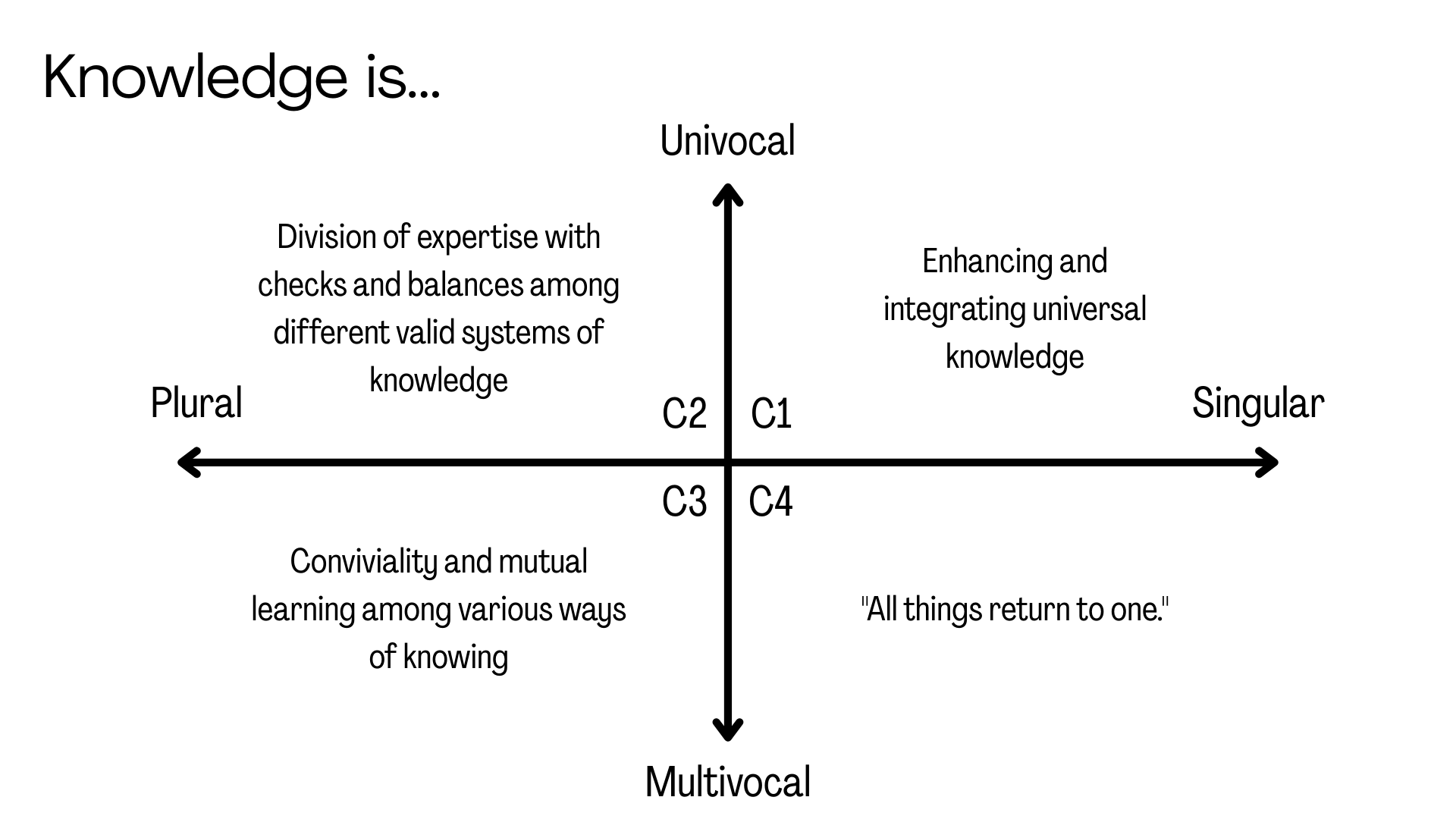
C1 (Univocal × Singular): One correct understanding, discoverable through objective method, and only Science/Reason qualifies as knowledge. This is the horizon of reform through better enlightenment: fix modernity’s problems by applying more rigorous science and expertise. Popper’s falsificationism defends this position by excluding self-justifying ideologies from legitimate knowledge [1]; inclusive C1 efforts seek to expand the single framework by integrating non-Western contributions — for instance, WHO programs validating traditional medicine through randomized controlled trials [1]. The persistent blind spot: any universal standard of legitimacy already encodes particular assumptions about what knowledge looks like, tending to reproduce the very hierarchy it sought to dissolve [1].
C2 (Univocal × Plural): Multiple bodies of knowledge coexist — science, ethics, aesthetics, spiritual insight — each with objective criteria within its domain, each requiring intersubjective validation. Habermas’s communicative reason protects purpose-oriented rational discourse from colonization by instrumental reason [1]; Mou Zongsan’s distinction between 外延真理 (wàiyán zhēnlǐ, formal/extensional truth, the domain of science) and 內容真理 (nèiróng zhēnlǐ, content truth, the domain of moral cultivation and concrete universality) insists both are legitimate but irreducible to each other [1]. The structural trap: when shared decision-making defaults to evidence-based policy (EBPM), the implicit “science = fact, other knowledge = opinion” asymmetry reinstates C1 by the back door — C2 is absorbed into C1 without anyone noticing [1].
C3 (Multivocal × Plural): Different perspectives on the same reality can each be valid, disagreement is generative, and indigenous or embodied cosmologies are not “alternative science” but different epistemologies with different validity conditions. Feyerabend’s scientific anarchism shows that “anything goes” historically produced more knowledge than methodological uniformity [1]; poststructuralism (Derrida, Foucault, Lyotard) exposes knowledge as power and the archive as violence [1]; decolonial thought (Mignolo, Smith) demands the recovery of indigenous knowledge systems as complete epistemologies rather than folk supplements to real science [1]. The doubled risk: C3 faces fierce criticism for incoherence and fragmentation; more structurally, when C3 achieves institutional dominance through unified social channels — curriculum mandates, DEI policy, discursive norms — it produces a new univocality while claiming plurality, collapsing into what it was designed to oppose [1].
C4 (Multivocal × Singular): Many different perspectives on the same underlying body of knowledge — reality is one, but knowledge of it is always contested, always perspectival, always provisional. Apparent contradictions between theories or traditions are misunderstandings about vantage point, not incompatible truths. Wilber’s AQAL model (All Quadrants, All Levels) positions every theory as occupying a different quadrant of a single integral map, making Marx vs. Smith or science vs. spirituality into a question of where you are standing, not whose truth wins [1]. Laszlo’s Akashic field theory posits a single connecting medium underlying quantum entanglement, biological evolution, consciousness, and cross-cultural spiritual experience, each being partial windows onto the same whole [1]. The structural impasse: C4 cannot defend itself using the discursive standards that C1 and C2 require without self-contradiction — to demonstrate the limits of genron chi using only genron chi is a performative paradox, and C4 positions are routinely dismissed as pseudoscience or mysticism before their claims are examined [1].
S Matrix: Horizons of Social Organization Change
The S Matrix maps how different change approaches answer the question: how should power, resources, and expertise be distributed? It is organized on two axes [1]:
- Expert-Dependent vs. Self-Sufficient: Should complex decisions require credentialed specialists, professional bureaucracies, and centralized coordination — treating communities as incapable of solving their own problems without external expertise? Or do communities already have embedded knowledge and capacity, such that they may access external resources but retain decision-making authority — redistributing agency rather than concentrating it?
- Unified vs. Diversified: Should the components of society be integrated into one seamlessly synchronized system, with diversity something to manage, overcome, or absorb into unity? Or should multiple valid forms of organization coexist permanently, with diversity recognized as fundamental to resilience and justice rather than a transitional stage toward eventual unity?
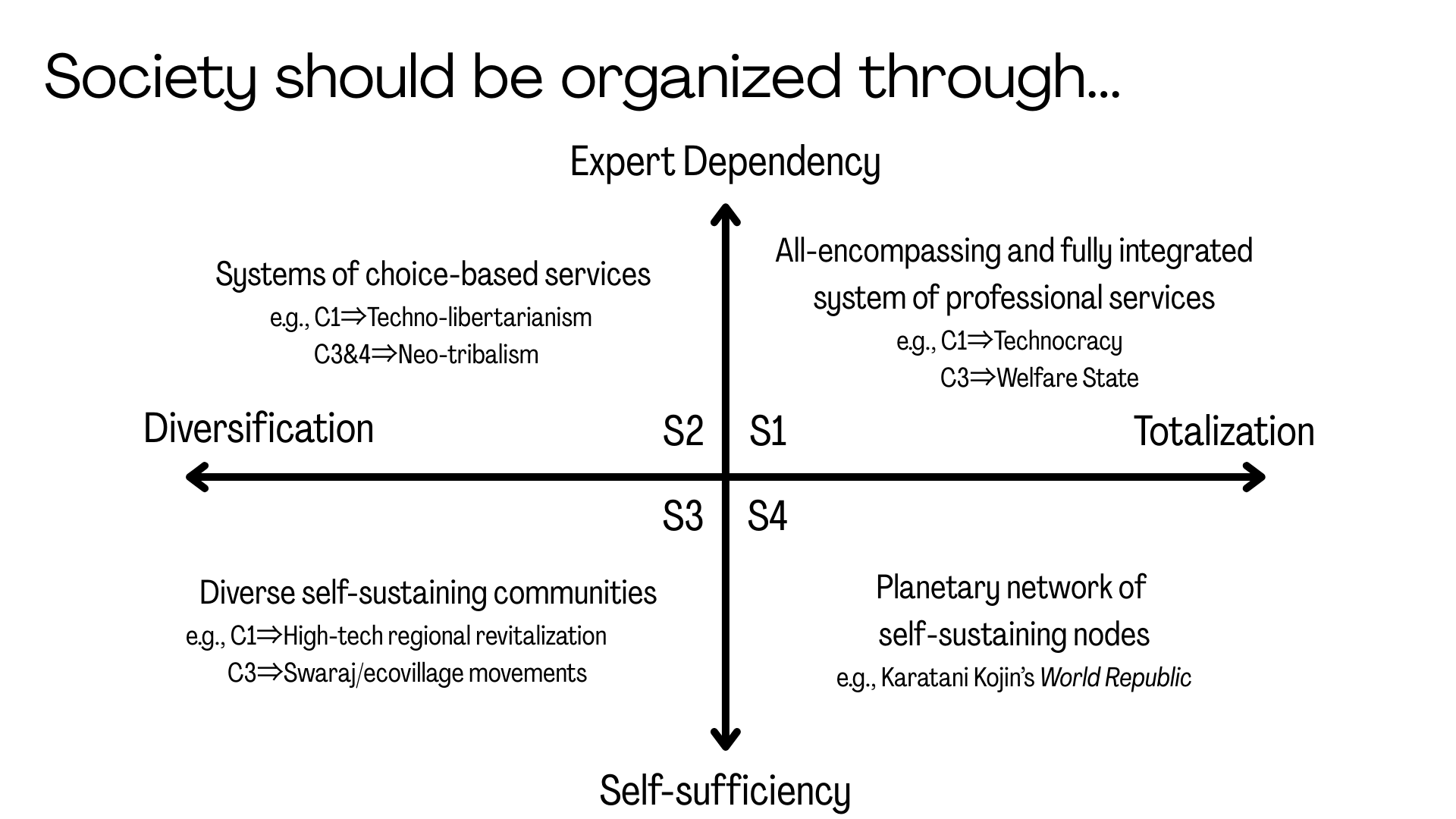
S1 (Expert-Dependent × Unified): Professional institutions coordinate a unified response. With C1 assumptions, this produces technocracy — one evidence-based system for all, staffed by the best specialists. With C3 assumptions, it produces the welfare state — a comprehensive apparatus that protects and resources plural ways of life through centrally administered redistribution and recognition [1]. The structural risk in both: Matsumoto’s fieldwork on Aogashima Island (one of the scholars whose work motivates this framework) shows how the medicalization of childbirth support — the “upgrade” of mutual-aid networks into hospital-dependent care — simultaneously eliminates the social fabric it claimed to improve [1].
S2 (Expert-Dependent × Diversified): Multiple expert-designed options compete within frameworks set by expertise. Techno-libertarianism (aligned with C1) concentrates competence in competing private entities accountable through market exit rather than democratic process [1]. The structural trap: platform ecosystems demonstrate how S2 pathways allow C1 forces to escape the normative constraints of S1 while recreating S1-scale dependency through commercial rather than governmental means — what Habermas calls “colonization of the life-world” through techno-commercial dependency [1].
S3 (Self-Sufficient × Diversified): Communities build embedded capacity and genuine self-determination while coordinating voluntarily. Gandhi’s Swaraj movement mobilizes C3 with S3 logic [1]; local food systems and bioregional networks build the redundancy that antifragility thinking demands — not systems designed to withstand known shocks, but systems that never became brittle to begin with. The structural limitation: even self-declared autonomous communities remain entangled in C matrix dynamics through resource and allocation dependence on the surrounding system [1].
S4 (Self-Sufficient × Unified): Communities practice genuine self-sufficiency rooted in place and tradition while choosing voluntary reciprocal coordination based on shared recognition of common condition — not imposed uniformity, but what Karatani Kōjin calls concrete universalism emerging through actual relationship. Karatani’s 世界共和国 (sekai kyōwakoku, World Republic) grounded in Exchange Mode D — a mode of pure reciprocity that has no stable historical instantiation but recurrently erupts in religious and utopian social movements — is the closest existing design concept [1]. The classical Chinese formulation 和而不同 (hé ér bù tóng, harmony amid distinction) captures the aspiration: each part maintains its particular nature while contributing to a whole achieved not by erasing difference but by holding it [1].
E Matrix: Horizons of Educational Change
The E Matrix maps how different change approaches answer the question: what is the relationship between knowledge, learner, and transformation? It is organized on two axes [1]:
- Knowledge-Centered vs. Learner-Centered: Does the educational approach center on transmitting or transforming a particular epistemic framework — treating the knowledge as primary? Or does it center on the growth, needs, and agency of the person learning — treating the learner as primary?
- Collective vs. Individual orientation: Does the approach prioritize collective formation (social coordination, shared competencies, intersubjective practice) or individual development (personal growth, autonomy, self-directed inquiry)?
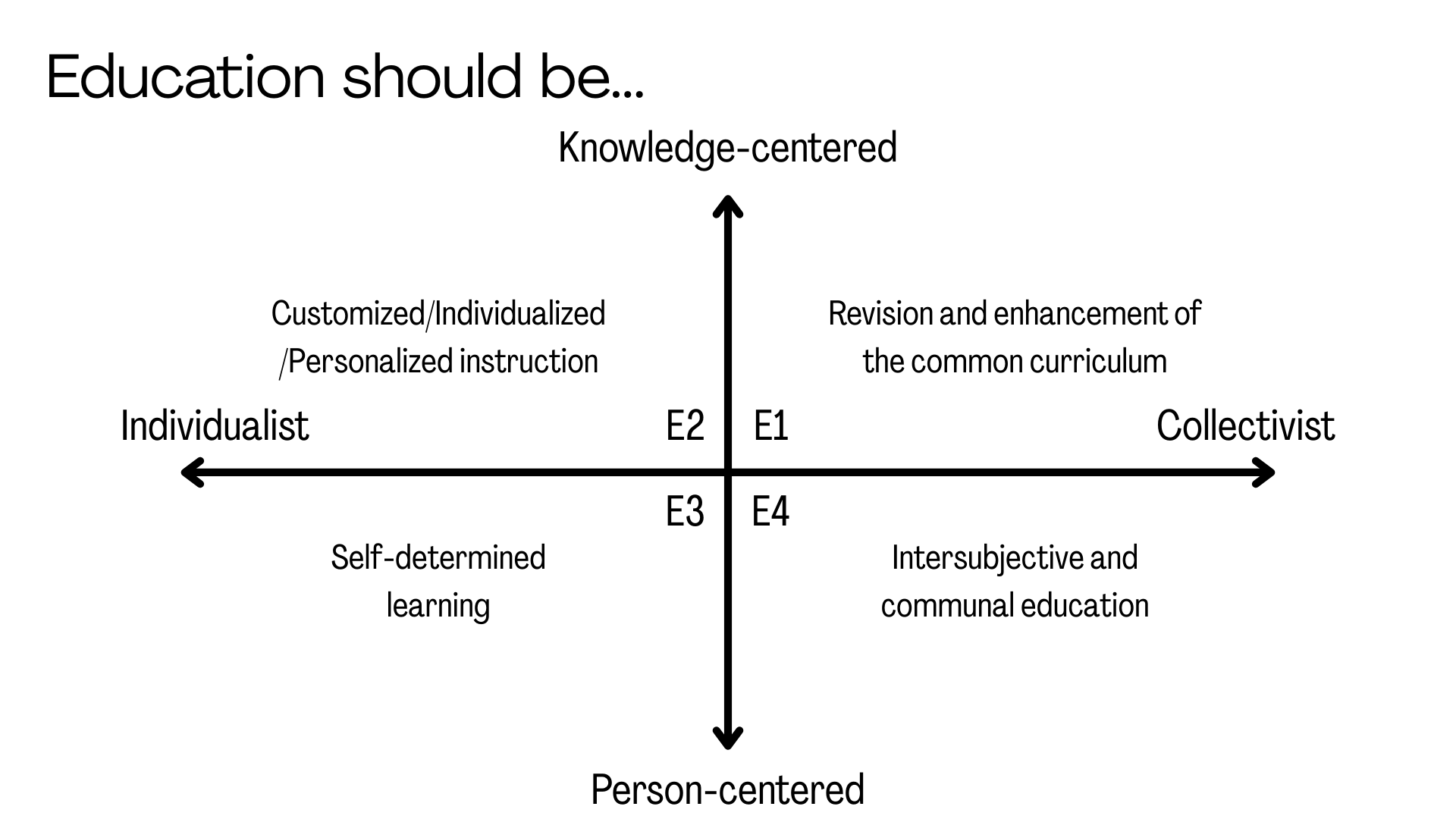
E1 (Knowledge-Centered × Collective): Transmitting or instilling a knowledge framework — whether scientific literacy, indigenous cosmology, critical consciousness, or integral theory — across a population through institutional channels. The curriculum wars are E1 battles: every C quadrant attempts to encode its knowledge horizon in national curricula, accreditation standards, and textbooks, typically using S1 or S2 pathways [1]. The recurring structural failure: the knowledge transmitted carries its C matrix positionality with it — critical pedagogy can become a new orthodoxy, decolonizing curricula can reproduce Western academic gatekeeping, STEM mandates can reinscribe instrumental rationality precisely through the institutions meant to challenge it [1].
E2 (Knowledge-Centered × Individual): A particular knowledge framework is not questioned, but the learner’s pace, style, and developmental readiness are honored. Personalized learning systems and curriculum-following homeschooling fall here [1]. The risk identified by education scholar Sanuki Hiroshi: the loss of shared experience of disagreement with people from different knowledge frameworks removes the conditions under which genuine dialogue can develop, contributing to post-truth incommunicability [1].
E3 (Learner-Centered × Individual): No specific knowledge framework is positioned as what the learner must acquire; instead, the learner’s own developmental needs, curiosities, and health are the anchor. Unschooling is the paradigmatic form [1]. The structural blind spot: without explicit engagement with the C and S matrices, learners may develop elaborate inner worlds while remaining structurally dependent on the surrounding system — unknown unknowns that never surface as questions, and a tendency toward self-enclosure rather than world-engagement [1].
E4 (Learner-Centered × Collective): The learner’s growth within and through community is central, but no specific C framework is pre-given. Democratic school communities and horizontally organized learning cooperatives approximate this horizon [1]. The structural vulnerability: even communities without explicit ideological frameworks are penetrated by C matrix dynamics through resource and allocation dependence — the absence of explicit C positioning does not protect against C influence, it only renders it invisible [1].
Cross-Matrix Dynamics
The matrices are not static — they interact, and their interaction is where the framework’s most important insights emerge. Several recurring dynamics are worth naming.
C3’s S1-ization: When C3 (multivocal, plural knowledge) achieves institutional authority through S1 (expert-dependent, unified) pathways — curriculum mandates, DEI policy, discursive norms — the normative content shifts while the totalizing structure remains intact. “Knowledge is plural and perspectival” becomes enforced as a single correct position, reproducing C1 dynamics through a C3 vocabulary [1]. The short film Alternative Math (Maddox 2017) illustrates this: a classroom defense of epistemological openness that becomes a new tribunal for orthodoxy, with the teacher who insists 2+2=4 denounced as a bigot [1].
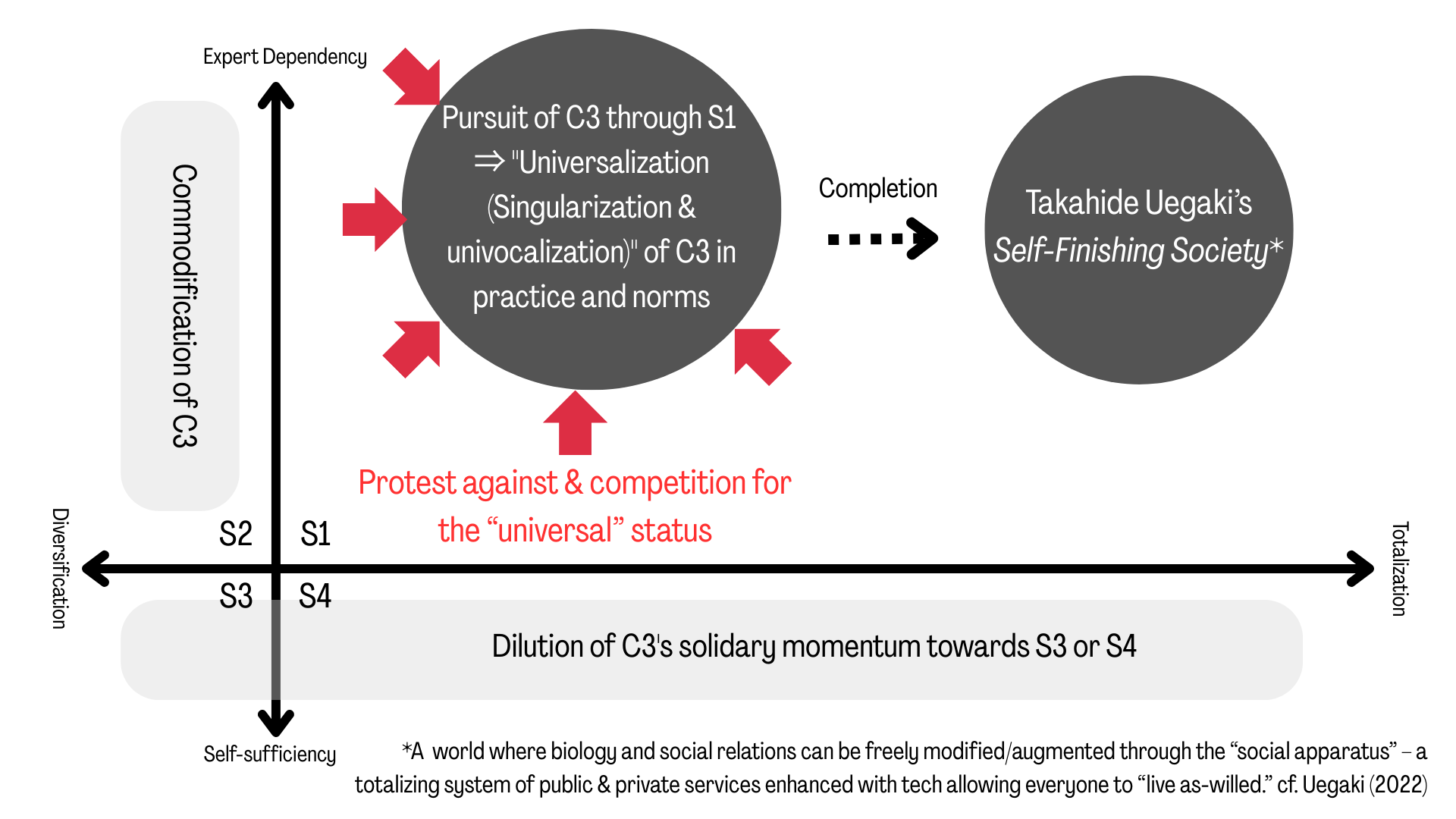
Possible secondary effects of C3’s social change approach through S1 (Similar dynamics may be observable in the conflicts surrounding “wokeism”)
C1’s S2-ization: When C1 forces (univocal knowledge, one-best-method expertise) face increased normative resistance within S1 institutions — democratic deliberation, regulatory constraint, DEI requirements — they migrate to S2 pathways (competing private platforms, corporate science, tech ecosystems). Big Tech’s platform ecology demonstrates this: C1 knowledge logic escaping S1 accountability while recreating S1-scale dependency through commercial rather than governmental means, bypassing the normative constraints that C3 and C2 had built within S1 arenas [1].
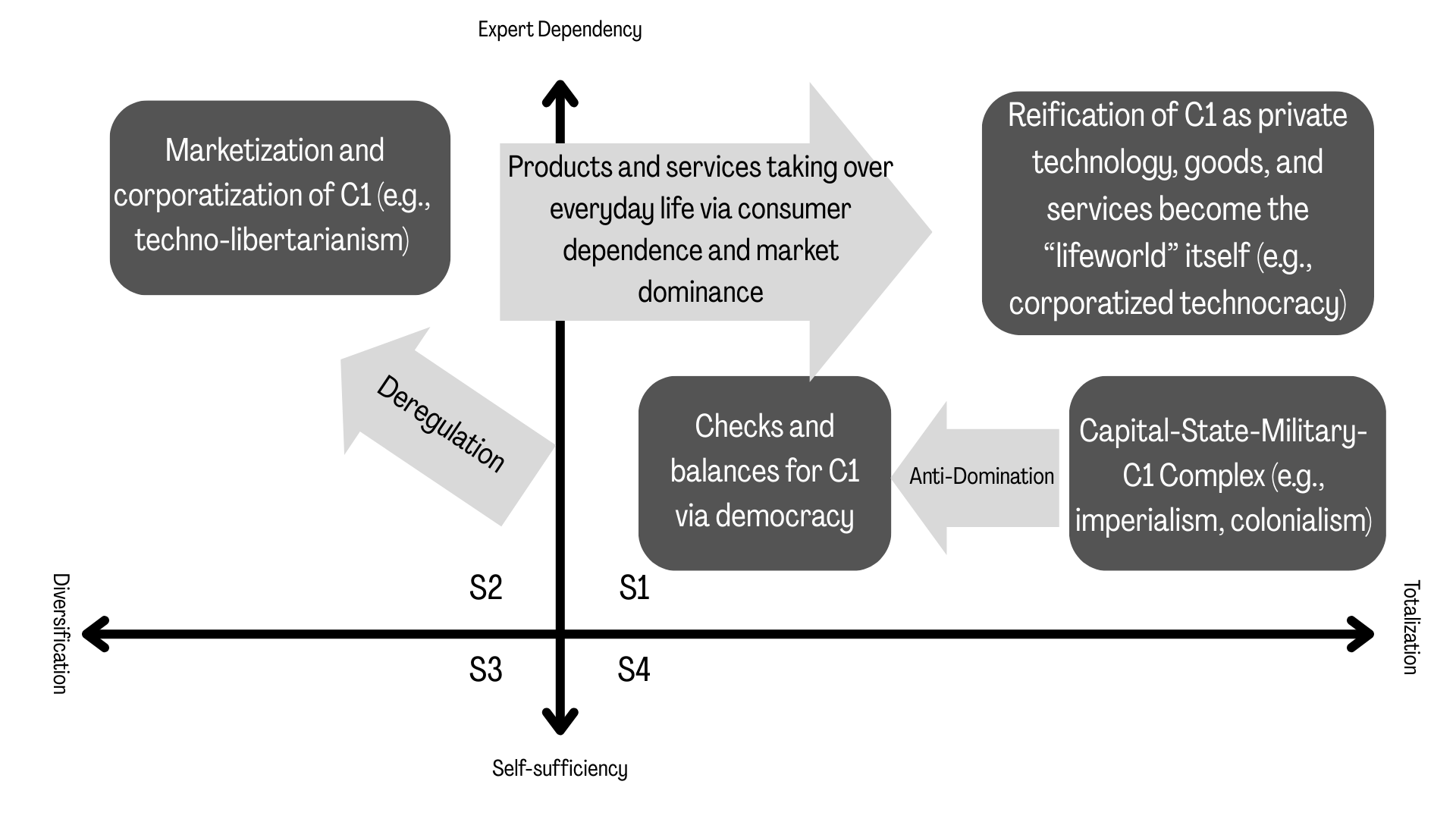
Possible secondary effects of restricting C1’s social change approach to S2(Similar dynamics may be observable in platform capitalism & the capitalism-populism convergences)
E matrix as the condensed battlefield: Because education reproduces both cultural systems and social structures, the E matrix is where C and S dynamics collide most intensely. Every C quadrant attempts to use S1 or S2 pathways to encode its epistemological horizon in the next generation (E1), while learner-centered approaches (E3, E4) that avoid this struggle may unknowingly reproduce surrounding C/S dynamics through structural dependency rather than explicit transmission [1].
These dynamics are not fixed sequences but emergent properties — each approach carries emergent properties that cannot be read off from its quadrant position alone, and the matrices themselves are subject to the kindai chi problem: as soon as any map of change horizons is drawn, it has become one particular perspective among others [1].
Using the Framework
The three matrices function as a positioning environment, not a prescription. They are most useful for:
- Diagnosing positionality: Map where your change strategy falls in each matrix — what it sees clearly, what it structurally cannot see, and which competing quadrants it is most likely to dismiss without understanding
- Anticipating unintended consequences: Each quadrant has characteristic failure modes (e.g., C1: epistemological imperialism; C2: absorption into C1; C3: new univocality via S1; C4: pseudoscientific marginalization; S1: dependency reproduction; S2: accountability evasion; S3: insularity and populational vulnerability; S4: idealization without material base)
- Reading cross-matrix dynamics: A strategy that looks coherent within one matrix often contains unresolved tensions when viewed through the others — all three matrices must be held simultaneously
- Facilitating cross-paradigm dialogue: Actors from different quadrants routinely talk past each other because they are answering different questions about what the problem even is; the matrices provide a shared meta-language for surfacing these differences without demanding pre-emptive consensus
- Expanding the option space: The most common strategic trap is binary collapse — reform vs. revolution, tradition vs. modernity, science vs. indigeneity; each matrix expands the option space to four, and their interaction expands it further
Theoretical Positioning
Post-Enlightenment Horizons is situated in the tradition of Synthetic Anthropology (総合人間学, sōgō ningen gaku) — a Japanese integrative intellectual tradition concerned with the whole human being across cultural, social, and biological dimensions, and explicitly resistant to the disciplinary fragmentation of modern academia. This framework was developed by Adler Yang as a contribution to the 2023 Symposium of the Association for Synthetic Anthropology (総合人間学会, Sōgō Ningen Gakkai), responding to four symposium reports — by Asakura, Matsumoto, Oka, and Noe — each diagnosing a different site of kindai chi’s dominance: schooling that teaches learners they have lost something without naming what; professional knowledge displacing village-embedded childcare wisdom; academic knowledge reducing Ainu culture to a specimen; and the imperative to unlearn as a response to all three [1].
It draws on Daoist philosophy as its primary critical resource against teleological and logocentric thinking. Where Western epistemology assumes the structure of language mirrors the structure of reality (genron chi → logos-centrism), Daoist thought holds that 道 (Dào) exceeds any conceptual or linguistic fixing — the most rigorous epistemic act is to remain aware of what one’s vantage point (shiza) cannot see, not to perfect the vantage point into omniscience [1].
It engages Roy Bhaskar’s Critical Realism as a potential navigation path across the C matrix without collapsing into any single quadrant: ontological realism (reality exists independent of our knowledge of it — C1’s valid insight) combined with epistemic relativism (all knowledge of it is perspectival and fallible — C3’s valid insight) combined with judgmental rationalism (we can still make provisional, revisable comparative judgments across frameworks — preventing C3’s slide into nihilism) combined with dialectical critical realism (resolving the theory-practice binary that runs through S and E matrices) and metaReality (addressing the unity-in-difference logic of C4 without the discursive self-contradiction that marginalizes it) [1].
This framework connects directly to other concepts in this research ecosystem: the dependency architecture mapped in Modes of Dependencies explains why S3 self-sufficiency is more difficult than prefigurative practice imagines; the incommunicability diagnosed in From “Incommunicability” to “Response-able Awareness” names what happens when E2 dynamics go unaddressed in a post-truth environment; and Karatani’s exchange mode theory grounds the S4 horizon with historical-materialist force.
The framework’s epistemological humility is deliberate. Its closing observation returns to the Daodejing: “The Dao that can be Dao-ed is not the constant Dao” — the moment any map of change horizons is drawn, it has already become one particular perspective among others, subject to the very dynamics it diagnoses [1]. The matrices are tools for orientation, not exits from the predicament they describe.
References
[1] Yang, Adler (楊逸帆). 「近代知の支配性とその変革地平: 総合人間学からの展望」(The Dominance of Modern Knowledge and Horizons of Change: A Synthetic Anthropological Analysis). 総合人間学 (Synthetic Anthropology), 2024.
[2] Bhaskar, Roy. Dialectic: The Pulse of Freedom. Verso, 1993; repr. Routledge, 2008.
[3] Bhaskar, Roy. Enlightened Common Sense: The Philosophy of Critical Realism. Ed. Mervyn Hartwig. Routledge, 2016.
[4] Cabrera, Derek et al. Systems Thinking Made Simple: New Hope for Solving Wicked Problems. Cabrera Research Lab, 2015.
[5] Derrida, Jacques. Dissemination. Trans. Barbara Johnson. University of Chicago Press, 1981.
[6] Elliott, F. (2009). Science, metaphoric meaning, and indigenous knowledge. Alberta Journal of Educational Research, 55(3).
[7] Feyerabend, Paul. Against Method. New Left Books, 1975.
[8] Foucault, Michel. Discipline and Punish. Trans. Alan Sheridan. Vintage Books, 1995.
[9] Gandhi, Mohandas K. Hind Swaraj and Other Writings. Ed. Anthony Parel. Cambridge University Press, 1997.
[10] Habermas, Jürgen. The Theory of Communicative Action. Trans. Thomas McCarthy. 2 vols. Beacon Press, 1984–1987.
[11] Karatani Kōjin (柄谷行人). 『世界共和国へ』(Sekai kyōwakoku e, Towards a World Republic). Iwanami Shoten, 2006.
[12] Laszlo, Ervin. Science and the Akashic Field: An Integral Theory of Everything. Inner Traditions, 2004; rev. ed. 2007.
[13] Lyotard, Jean-François. The Differend: Phrases in Dispute. Trans. Georges Van Den Abbeele. University of Minnesota Press, 1988.
[14] Maddox, David, dir. Alternative Math. Short film, 2017.
[15] Mignolo, Walter D. Local Histories/Global Designs: Coloniality, Subaltern Knowledges, and Border Thinking. Princeton University Press, 2000; repr. 2012.
[16] Mou Zongsan (牟宗三). 《現象與物自身》(Xiànxiàng yǔ wù zì shēn, Phenomenon and Thing-in-Itself). Student Book Company (學生書局), 1975; repr. 2003.
[17] Needham, Joseph et al. Science and Civilisation in China, Vol. 7. Cambridge University Press, 1995.
[18] Pomeranz, Kenneth. The Great Divergence: China, Europe, and the Making of the Modern World Economy. Princeton University Press, 2000.
[19] Popper, Karl. The Logic of Scientific Discovery. Routledge, 1959; repr. 2002.
[20] Smith, Linda Tuhiwai. Decolonizing Methodologies: Research and Indigenous Peoples. 3rd ed. Zed Books, 2021.
[21] Wilber, Ken. A Theory of Everything: An Integral Vision for Business, Politics, Science and Spirituality. Shambhala, 2000.
[22] Yacoubian, H. A. (2020). Is science a universal or a culture-specific endeavor? The benefits of having secondary students critically explore this question. Cultural Studies of Science Education, 15(4), 1097–1119.
[23] 楊逸帆(2021)「配分依存:全人的発達を抑制する生成メカニズム」『総合人間学研究』15、39–59 / (2023) 『分割された文明難局を複雑適応系のアプローチで繋げる:〈自己家畜化論〉と〈自己完結社会論〉を踏まえた〈配分依存論〉の試み』[プレプリント]ResearchGate https://doi.org/DOI: 10.13140/RG.2.2.32677.68322
See Also
- Modes of Dependencies — Analyzes the structural mechanisms through which communities and institutions become dependent on external resources, expertise, or recognition. Directly illuminates why S3 (self-sufficient × diversified) is more difficult to achieve and sustain than prefigurative practice often assumes, and why S1 and S2 dependency patterns tend to reassert themselves even within explicitly alternative arrangements.
- From “Incommunicability” to “Response-able Awareness” — Diagnoses the condition in which actors from different knowledge frameworks can no longer productively disagree — each perceiving the other as simply wrong rather than differently positioned. This is the E2 failure mode made explicit: when learners are never exposed to the experience of genuine disagreement across frameworks, post-truth incommunicability is not a cultural accident but a structural outcome.
- Prefigurative Academia — Explores what it means to enact alternative knowledge and institutional forms within existing academic structures rather than waiting for systemic transformation. In matrix terms, prefigurative academia occupies a C3/C4 × S3/S4 × E4 orientation — and carries precisely the unintended consequence risks those quadrant intersections entail.
- Allocation Dependence — Focuses specifically on how the distribution of resources shapes whose knowledge, whose institutions, and whose educational practices are viable. Provides the material-structural underpinning for why C quadrant positions are never purely epistemic choices — they are always already embedded in S and E matrix conditions that constrain which horizons are accessible in practice.
See this framework in action with this AI-simulated debate:
(Produced as my personal pre-meeting exercise for the 2025/26 Inaugural TIAL fellowship)
Read more
Publication [in Japanese] The Dominance of Modern Knowledge and Horizons of Change: A Synthetic Anthropological Analysis
Paper [in Japanese] “Exploring Integral Knowledge” Workshop 1: The Dominance of Modern Knowledge and Horizons of Change
Where this came from
- The dominance of modern knowledge and horizons of change
Source
This framework was developed by Adler Yang as a contribution to the 2023 Symposium of the Association for Synthetic Anthropology (総合人間学会, Sōgō Ningen Gakkai), responding to four symposium reports
How this connects
The centre is this page. Each mark is a page or a person that the site’s records link to it; a line between two marks means those two are linked as well.