Modes of Dependencies
Contents
- What Is This Framework?
- ① Cosmic-Terrestrial Dependence 天地依存
- ② Allocation Dependence 配分依存
- ③ Money Dependence 貨幣依存
- ④ Artificiality Dependence 人工性依存 (Meta-Mode)
- ⑤ Controllability Dependence 制御性依存 (Meta-Mode)
- The Inverted Pyramid and the Squeeze
- Empirical and Theoretical Foundations
- Where These Modes Show Up
- A Map of Intervention Points
- Toward Regenerative Dependency Architectures
- Impact
- Theoretical Positioning
- Read More
- Formats
- See Also
How do the interfaces we rely on for survival self-organize into the very structures that constrain us?
Most critiques of power picture domination as something imposed from the outside. Yet in practice, people also participate in and sustain the systems that constrain them — not because they are naive or powerless, but because survival itself depends on those systems. Modes of Dependencies is a conceptual framework that maps the historically self-organized ways humans gain access to the resources necessary for life — and shows how the current layering of these modes has inverted against the very foundations that make life possible.
What Is This Framework?
A dependency mode is a historically stable pattern through which a society secures what life requires: food, shelter, energy, opportunity, care, and meaning. Resources do not flow directly from the environment to human beings; they are always accessed through something. That something is a dependency mediator — the concrete interface between people and the conditions of their survival, whether it takes the form of a watershed, an examination, a wage, a logistics network, or an algorithm.
Five ideal-typical dependency modes have emerged historically. Three are direct modes — cosmic-terrestrial, allocative, and monetary — through which mediators connect people to resources in a relatively immediate way. Two are meta-modes — artificiality and controllability — which underpin and shape how the direct modes operate, rather than delivering resources directly.
The “core question” column below names the operative logic each mode imposes on participants: the implicit question that a person, institution, or species must answer in order to obtain resources through that mode. These are not questions anyone consciously asks — they are the survival logic that each mode instills through repeated adaptation. Understanding them is key to seeing how modes silently shape what people practice, value, and suppress in themselves: the cosmic-terrestrial mode trains ecological attentiveness; the allocative mode trains criteria-fitting; the monetary mode trains the capacity to generate and reproduce purchasing exchanges. When one mode becomes dominant, its core question begins to feel like the question of survival — and the logics of other modes fade from perception or come to seem impractical, naïve, or irrelevant.
| Mode | Type | Primary Mediators | Core Question |
|---|---|---|---|
| Cosmic-Terrestrial (天地依存) | Direct | Climate, soil, water, seasonal cycles, living ecosystems | Can I sustain life from this place and its rhythms? |
| Allocation (配分依存) | Direct | Exams, hiring gates, grants, rankings, welfare criteria, trade conditions | Do I qualify under the criteria this apparatus has set? |
| Money (貨幣依存) | Direct | Wages, prices, credit, markets | Are there always enough people whose desires remain unsatisfied — and who can pay, or borrow to pay? |
| Artificiality (人工性依存) | Meta | Tools, infrastructures, knowledge systems, institutions, built environments | What human-built supports exist — and can I access and rely on them? |
| Controllability (制御性依存) | Meta | Automation, algorithms, risk systems, code-as-law, predictive infrastructure | How much of the unpredictable can be brought under designed control? |
① Cosmic-Terrestrial Dependence 天地依存
Cosmic-terrestrial dependence is the most foundational mode: people securing survival by directly metabolizing local physical-biological conditions — through farming, fishing, herding, foraging, or inhabiting a place in attunement with its rhythms.
Cosmic-terrestrial mediators include rainfall and seasonal patterns, soil fertility and watershed health, biodiversity, and ecological cycles that neither belong to anyone nor can be fully priced. What makes this mode distinctive is direct metabolic feedback: farmers and fishers historically felt the consequences of depleting their soils or overfishing their waters in the same generation. This feedback loop — which modern supply chains and monetary mediation systematically sever — is what makes cosmic-terrestrial dependence generative rather than merely extractive when it functions well.
This is not a romantic condition. Cosmic-terrestrial dependence also entails seasonal vulnerability, unpredictable weather, ecological constraints on population, and the constant possibility of scarcity. What it does offer that later modes do not is redundancy: multiple, diverse pathways to survival that make communities resilient to single-point failures.
Even today, beneath every global food system, energy network, and pharmaceutical supply chain, the cosmic-terrestrial layer remains the ultimate material substratum. Climate disruption, resource depletion, and biodiversity collapse are its way of reasserting primacy when the higher-order modes forget it is there.
Why "Cosmic-Terrestrial"? (Not "Land" or "Nature")
The most foundational mode is deliberately not called “nature dependence” or “land dependence,” because both terms carry philosophical baggage that distorts the analysis.
“Land” inherits an economic tradition — from Malthus and Ricardo to contemporary resource policy — where the physical world appears primarily as a visible, quantifiable, ownable surface: measured in hectares, priced per acre, contested as territory. This Platonic bias toward what is measurable backgrounds the harder-to-quantify dimensions that are equally decisive: atmospheric moisture, hydrological rhythms, soil microbiology, pollinator networks, seasonal timing. It is precisely these invisible dimensions that modern extraction most systematically destroys, and that “land” as a category cannot even name.
“Nature” fails for two related reasons. First, it reproduces a human/non-human binary that is itself a product of the dominant cosmotechnics this framework critiques. Naming our dependence on ecosystems as dependence on “nature” implicitly confirms that humans are outside nature — that there is a “them” (nature) and an “us” (society) interacting across a boundary. East Asian 天地 (tian-di) does not work this way: it names the generative, dynamic ordering of Heaven and Earth as the field within which human life is always already situated, not an external realm we periodically visit or extract from.
Second, “nature dependence” generates an infinite regress problem. As Japanese evolutionary ecologist Hideo Obara showed through his self-domestication theory, humans have always reshaped their own environments and biological tendencies through tools and institutions — there is no human history without artificiality. Any attempt to specify what “nature” means before human intervention therefore collapses into an endless regress: natural before which intervention? And before that? The concept either becomes vacuous or arbitrarily privileges one historical moment as the baseline. This is why the framework deliberately avoids “nature dependence” even while drawing directly on Obara’s ecological and self-domestication insights.
Cosmic-terrestrial names the local interface where two dimensions meet: cosmic processes — solar cycles, atmospheric dynamics, geochemical flows — that precede and exceed human design; and terrestrial conditions — this soil, this watershed, this microclimate — where those processes become locally specific and humanly livable. Together they name what 天地 names: the localized instantiation of cosmic order that conditions all human life before institutional or monetary mediation begins — without requiring a fixed definition of “nature” or a nostalgic return to any prior state.
② Allocation Dependence 配分依存
Allocation dependence arises when access to resources and life chances is mediated primarily by allocation apparatuses — systems that decide who gets what — rather than by direct cosmic-terrestrial conditions or unconstrained market exchange.
Allocation mediators include: entrance examinations and school admissions; hiring procedures, professional licensing, and tenure review; grant committees, scholarship quotas, and funding criteria; welfare eligibility rules; platform rankings, algorithmic visibility, and content moderation; and any other institutional frame through which limited resources are distributed to selected claimants.
The mechanism that makes this mode significant is not external coercion but voluntary internalization. When people perceive that crucial life chances — education, income, social standing, security — are only accessible through allocation gates, they begin reshaping themselves to fit whatever criteria those gates apply. They develop rewarded skills and suppress unrewarded ones; they present identities calibrated to evaluators; they trim away interests, values, and capacities that do not “count.” This process — assimilation and trimming — proceeds even when pressure is mild, even in settings that explicitly reject competition.
Crucially, allocation dependence is not a meritocracy problem. Merit — the idea that allocation should track individual ability or achievement — is just one type of allocative logic among many. The underlying mechanism operates across radically different ideological framings:
- Imperial and competitive-academic systems (Chinese imperial examinations, modern university admissions, professional certification) allocate through standardized performance criteria, asking “who scored highest?”
- Redistributive and bureaucratic systems (Soviet work-unit assignments, welfare eligibility schemes) allocate through ideological conformity or need classification, asking “who qualifies categorically?”
- Domestication as allocation: in the biological history of human–animal relationships, animals that were tame and useful to human settlement were allocated resources (food, protection, breeding rights); those that were neither were displaced or driven to extinction. The allocative apparatus was not meritocratic — it was organized around human utility — but the structural consequence for those allocated against (exclusion, elimination) was no less absolute.
What all of these share is not “merit” but the concentration of life chances in an apparatus that defines and enforces its own criteria for who qualifies — and the resulting self-organization of participants around fitting those criteria, regardless of whether those criteria are fair, rational, or even legible. This is why the core question of allocation dependence — Do I qualify under the criteria this apparatus has set? — has a transfactual grip: it recurs wherever a gate controls a resource, regardless of what the gate claims to measure.
③ Money Dependence 貨幣依存
Money dependence predominates when the primary route to basic needs is monetary mediation — having sufficient purchasing power — rather than direct ecological access or institutional allocation.
Money functions as a generalized claim on society: rather than depending on a specific place, a specific institution, or a specific relationship, money-dependent survival requires only possessing the token. This generates a distinctive kind of freedom — geographic mobility, personal anonymity, the ability to acquire from strangers — that cosmic-terrestrial and allocative routes cannot offer. That is part of why it spread.
But money dependence also introduces a structural self-reproducing tension. The operative logic of the monetary mode — Are there always enough people whose desires remain unsatisfied and who can pay, or borrow to pay? — is not just a question any individual asks; it is the systemic condition that money dependence imposes on all participants at once. A doctor, a merchant, a platform, and a state all depend on there being a continuous supply of people with unmet needs who can access means of exchange, whether through wages, assets, or debt. A society in which everyone’s deepest needs were met through non-monetary channels, or in which the population’s capacity to transact had dried up, would face diminished monetary circulation. Money dependence, therefore, has a systematic stake in reproducing desire and maintaining the population’s capacity to keep transacting — a dynamic that resonates with Buddhist analyses of craving (愛), clinging (取), and the reproduction of the existence-mode (有) as a self-sustaining loop that no single actor chose to create.
When monetary mediation becomes singularized — when there is no viable cosmic-terrestrial or communal fallback — its fragility becomes existential. De-platforming, bank exclusion, or sudden unemployment can produce destitution in environments of material abundance. The person is not short of food or energy in any absolute sense; they simply cannot access them because the monetary interface has denied entry.
④ Artificiality Dependence 人工性依存 (Meta-Mode)
Artificiality dependence is the dependence on artificiality as such — on the cumulative totality of human-made supports through which our species has always survived: tools, built environments, knowledge systems, institutions, legal codes, symbolic orders, and digital infrastructures.
Humans are biologically incomplete animals. Unlike most species, we cannot survive from our bodies alone in most environments; we require externalized organs — clothing, shelter, fire, agriculture, medicine, infrastructure — to buffer us against the Universe’s indifference. This dependency on human-built supports is not a modern failure; it is what Homo sapiens has always been. The hand-plow, the irrigation canal, the writing system, the national currency, the freight network: each is a specific crystallization of artificiality that makes a particular dependency architecture possible.
What makes artificiality a meta-mode is that it is the medium within which the three direct modes take their specific historical forms. The form of cosmic-terrestrial dependence in a rice-farming paddy civilization differs from that in a wheat-growing steppe society because the artificiality through which each mediates its relationship to local conditions is different. Allocation systems and monetary systems are themselves forms of artificiality.
Crucially, artificiality is not culturally uniform. Different civilizations have built different artificial worlds with different cosmotechnics — different embedded assumptions about the relationship between the human, the cosmic, and the technical. This plurality means there are multiple possible architectures of dependency, not one inevitable trajectory. When artificiality is treated as a universal, neutral substrate, this diversity — and the futures it opens — disappears from view.
⑤ Controllability Dependence 制御性依存 (Meta-Mode)
Controllability dependence is not simply dependence on technology; it is dependence on a specific directional tendency within artificiality: the drive to minimize unpredictability and make more of life available “as-willed.”
Controllability mediators include: risk management and forecasting systems; standardization regimes and bureaucratic procedures; automation and cyber-physical systems; algorithms, AI, and code-based governance (“code is law”). Each reduces a dimension of contingency — crop failure, transit delay, hiring bias, medical error — by routing it through a designed system that produces more predictable outcomes.
This mode begins as a protective enhancement: early warning systems, food storage, vaccination, supply chain logistics. The problem diagnosed here is not technology or planning per se, but what happens when controllability becomes the organizing principle of entire societies. As more and more human functions are delegated to control systems:
- Decision-making migrates from human judgment to algorithmic rules that are opaque, rapidly shifting, and not open to negotiation.
- People lose the embodied capacities to cope with uncontrollability itself — the improvisational, relational, and ecological skills that sustained survival in less mediated environments.
- The systems built to reduce uncertainty begin generating new uncertainties of their own: platform algorithm changes, AI-assisted hiring collapses, autonomous supply chain failures.
Controllability dependence is a meta-mode because it operates at the level of how artificiality is built and oriented, not just which specific tools exist. As it intensifies into cybernetic loops — IoT → big data → AI → code-as-law — the artificial environment begins to function as a quasi-autonomous background system, governed by its own opaque dynamics. This is what the companion framework (Between the Universe and the Metaverse) calls the Metaverse: not a virtual reality headset but a self-governing artificial background environment that operates with the same indifference to human biological needs as the Universe it was built to tame.
The Inverted Pyramid and the Squeeze
These modes do not replace each other as history progresses — they layer. Each new mode is built on top of the earlier ones, mediating them, obscuring them, and eventually creating the illusion that they don’t exist.
The relationship between the modes is nested, not parallel. The Universe is the total outer container. Within it, cosmic-terrestrial conditions and the World (= Artificiality) co-exist in a partially overlapping relationship: some cosmic-terrestrial conditions have been incorporated into or reshaped by artificiality (managed forests, agricultural landscapes, urban microclimates), while others remain largely pre-human in character. Within the World of Artificiality, the direct modes — Allocation and Money — are the primary resource channels through which most people navigate daily. Controllability is not a parallel channel but rather a meta-directional tendency that gives modern Artificiality its dominant shape and trajectory, tending toward self-completion as an autonomous artificial environment.
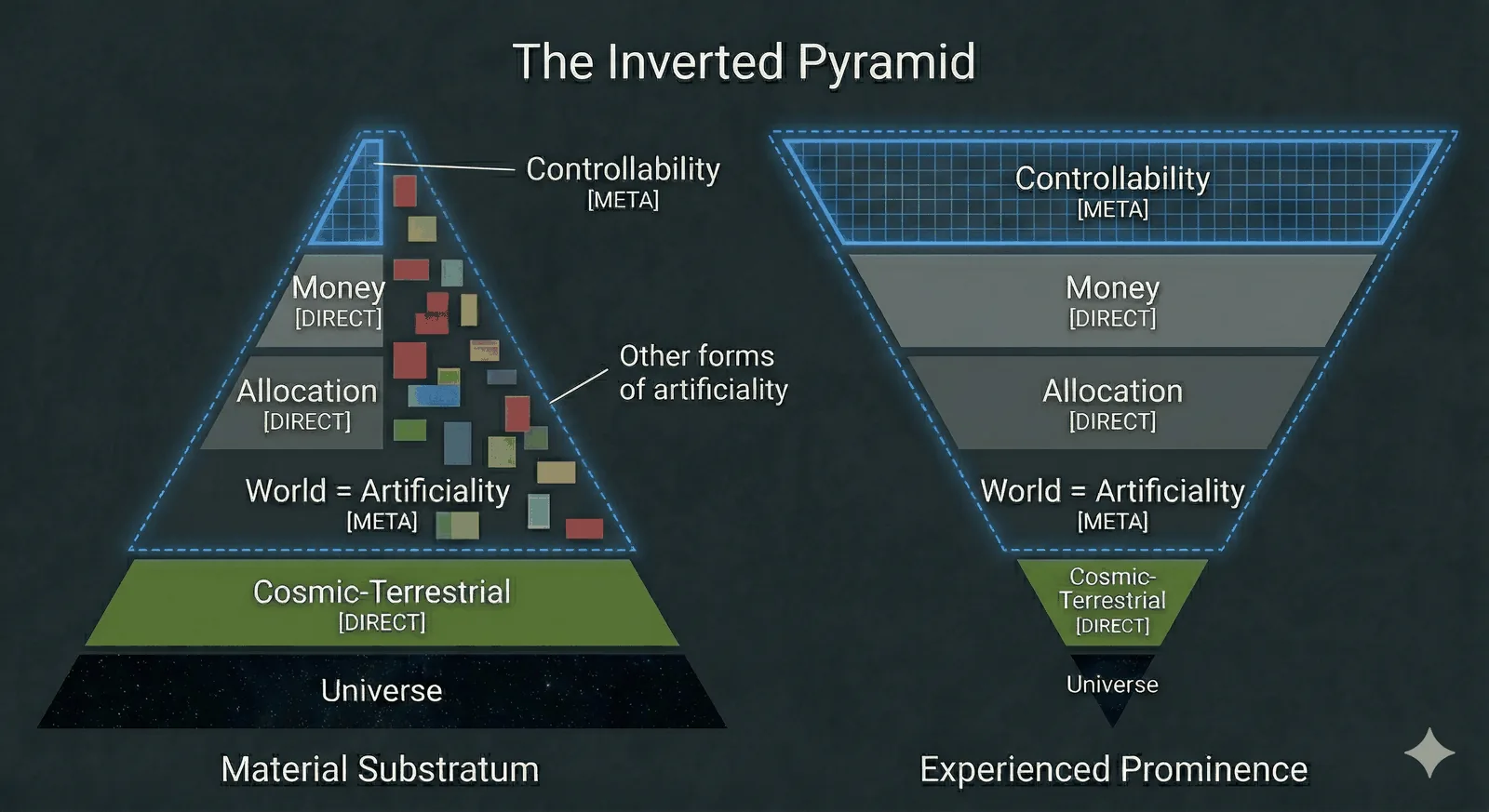
Material Substratum — what actually conditions and sustains life (larger = more foundational):
textUNIVERSE  [largest — the total physical-biological precondition]
│
├── COSMIC-TERRESTRIAL  [large — the immediate local substratum of life]
│       ↕ [partial overlap: some CT has been incorporated into Artificiality]
└── WORLD = ARTIFICIALITY  [large — human-built nested within Universe]
        │
        ├── Allocation ──┐
        │                ├── [medium — direct resource channels within Artificiality]
        └── Money ───────┘
        │
        └── Controllability  [medium — the direction that shapes Artificiality's growth]
Experienced Hierarchy — what modern life feels most dependent on (same structure; magnitudes inverted):
textUNIVERSE  [barely perceptible — invisible until catastrophe]
│
├── COSMIC-TERRESTRIAL  [small in felt experience — noticed mainly in crisis]
│       ↕ [partial overlap: the CT inside Artificiality is still mostly unfelt]
└── WORLD = ARTIFICIALITY  [dominant — the taken-for-granted environment of daily life]
        │
        ├── Allocation ──┐
        │                ├── [large — constantly navigated; felt as the primary path to opportunity]
        └── Money ───────┘
        │
        └── Controllability  [largest in felt experience — platforms, connectivity, automation
                               feel like the infrastructure of existence itself]
This inversion is not merely perceptual — it has structural consequences:
- Self-domestication deepens. As dependence shifts from cosmic-terrestrial conditions toward allocative, monetary, and controllability systems, people adapt to artificial selection pressures — evaluation criteria, market incentives, algorithmic rules — rather than to the rhythms of the living world. Capacities that don’t “count” in the dominant frames — ecological attentiveness, relational care, embodied craftsmanship, local knowledge — atrophy as if useless.
- Systemic fragility rises. Replacing diverse, redundant resource pathways (commons, subsistence, local exchange, ecological fallback) with singularized mediators (platforms, credit scores, supply chains) removes resilience buffers. When a single mediator fails — a platform bans, a bank denies, a supply chain breaks — there is no fallback. Artificial destitution in material abundance becomes possible.
- The squeeze intensifies. As controllability dependence self-completes into a quasi-autonomous artificial environment, humans face survival pressures from two uncontrollable totalities simultaneously: a destabilized Universe (ecological crisis, pandemic, climate disruption) pressing from without, and a self-governing Metaverse (opaque algorithms, platform law, AI rules) pressing from within. The same controllability infrastructure built to protect us from the Universe’s indifference now generates a second indifferent background.
Empirical and Theoretical Foundations
This framework synthesizes multiple research traditions with concrete fieldwork:
- Self-domestication theory (Obara) and dual-ecosystem anthropology trace how humans create artificial ecosystems nested within natural ones — and how, over time, humans adapt to their own creations rather than the wider Universe.
- Environmental Marxism’s metabolism concept is extended beyond labor-centrism through Bhaskar’s laminated ontology: physical-biological substrata undergird social and cultural layers without being reducible to them. The result is a multi-level analysis that can simultaneously address ecological foundations and social dynamics without collapsing one into the other.
- Karatani’s Modes of Exchange and Polanyi’s integrative forms are re-read as operating within a deeper dependency architecture. Both frameworks describe how resources circulate among humans; dependency modes describe what makes that circulation materially possible — and how circulation forms can rupture the cosmic-terrestrial conditions on which they ultimately depend.
In Dialogue With Karatani and Polanyi
Two of the most powerful structural critiques of capitalism in contemporary critical theory — Kojin Karatani’s modes of exchange and Karl Polanyi’s integrative forms — share core ambitions with this framework: to show that the market economy is neither natural nor inevitable, and that history offers genuine alternatives. Modes of Dependencies engages both directly, not to displace them but to add the layer their analyses presuppose without examining.
What Karatani Offers — and Where It Stops
Karatani’s framework organizes how resources circulate in human societies into three modes: Exchange Mode A (reciprocity and gift), Mode B (plunder and redistribution by the state), and Mode C (commodity exchange via the market). Modes B and C correspond closely to what this framework calls Allocation Dependence and Money Dependence respectively. The structural diagnosis — that state power and capital dominate modern social life — is sharp and well-supported.
What drops from view is the premise that makes all three modes of exchange possible in the first place: the metabolic relationship between human life and cosmic-terrestrial conditions — the actual acquisition of food, water, energy, and materials from the living world. When this foundational layer is left unexamined, the framework can diagnose domination clearly but cannot fully specify the recovery conditions when dependency mediators collapse. If allocation and monetary systems fail, what circuits need to be reconnected? Karatani’s analysis doesn’t reach that question, because the answer lies beneath the exchange layer.
The Gift Is Not the Foundation — It Is Already a Supplement
This matters for how we understand Mode A — reciprocity, pure gift, what Karatani identifies with original nomadism — and its relationship to the hoped-for Mode D. The precondition for gift and reciprocity operating in small-scale communities without heavy domination is precisely that cosmic-terrestrial metabolic access was already functioning: people could provision themselves from local ecological conditions without requiring an elaborate institutional apparatus. Gift exchange and mutual aid, in this light, are supplementary adaptive responses to challenges that cosmic-terrestrial metabolism alone cannot resolve — not the foundation itself.
Two further complications follow. First, gift and reciprocity have historically coexisted with violence — war, human sacrifice, raiding — which were also forms of “world-metabolism” in pre-modern societies, and were often experienced as sacred rather than evil by participants. Modern normative sensibilities cannot be applied straightforwardly here. Second, and more consequentially: if the cosmic-terrestrial metabolic foundation is left unaddressed, Mode D — the hoped-for return to reciprocity and free association at a higher, universalized level — cannot secure the dependency mediators that Modes B and C currently provide. It opposes allocation and money without being able to replace what those modes actually deliver to people who have no other fallback. This is why, historically, universal religions and modern associationist movements have tended to revert in practice to allocation and monetary dependence (Weber), however much they aspired to transcend them. Karatani himself acknowledges this dynamic, which is part of why Mode D tends to migrate toward the normative and ideational — a horizon rather than a program.
Ecovillage movements are instructive here. They can genuinely embody Mode D aspirations through direct community practice rooted in cosmic-terrestrial conditions — growing food, managing water, building local economies of care. But their continuation and expansion are constrained precisely by geographic fixation: they work where they can root into a specific place, and that rootedness is simultaneously their strength and their limit. Mode D, to be more than an island, needs an account of how cosmic-terrestrial metabolism can be re-anchored at scale — which requires working within the dependency architecture, not only within the exchange layer.
Polanyi’s Same Blind Spot
The same gap appears in Polanyi. His three integrative forms — reciprocity, redistribution, and market exchange — are all types of resource circulation among people. The prior question of how people acquire resources from the world, and what metabolic circuits sustain that acquisition, retreats into the background. Even in his most ecologically adjacent argument — the critique of land as a “fictitious commodity” that cannot be treated as a genuine market good without social damage — land tends to appear as an economic resource, a property relation to be protected. The weather, the watershed, the soil biology, the local climate system: the full cosmic-terrestrial reality that “land” names is still backgrounded.
As a result, Polanyi’s central remedy — re-embedding markets in social relations — tends in practice toward securing more stable forms of reciprocity and redistribution rather than recovering the metabolic circuits of cosmic-terrestrial dependence itself. Re-embedding in social relations is necessary; it is not sufficient if those social relations are themselves severed from the ecological conditions that make them viable.
An Anthropological Complement, Not a Replacement
Dependency mode theory is not a negation of exchange analysis. It is an anthropological complement that reconnects the circulation layer — how resources move among people — to its foundational condition: the metabolic relationship with the cosmos from which those resources ultimately come. In this reading, principles of agriculture, ecological commoning, and human-nature symbiosis — long discussed in this intellectual tradition — are not simply nice additions to Mode D or to market re-embedding. They are the foundational conditions without which those proposals remain aspirational rather than practicable: the metabolic circuits that need to be re-anchored before exchange reforms can hold.
| Karatani | Polanyi | Dependency Modes | |
|---|---|---|---|
| Allocation-mediated resource distribution | Mode B: plunder & redistribution | Redistribution | Allocation Dependence |
| Money-mediated resource access | Mode C: commodity exchange | Market exchange | Money Dependence |
| Community-based mutual aid | Mode A: reciprocity/gift | Reciprocity | Supplement to Cosmic-Terrestrial |
| Self-provisioning from place | — | Householding (partial) | Cosmic-Terrestrial Dependence |
| Human-built enabling infrastructure | — | — | Artificiality Dependence |
| Drive toward predictability and control | — | — | Controllability Dependence |
| Aspirational transcendence | Mode D: free association | Re-embedding | Requires dependency re-architecture |
- Allocation Dependence fieldwork in Taiwan showed that exam-oriented self-adaptation persisted even in alternative schools, even when formal competitive pressure was relaxed. This demonstrated that allocation dependence is a self-organizing survival logic, not simply a top-down imposition — which became the empirical anchor for the broader framework.
- East Asian philosophy is engaged not as cultural backdrop but as structural analysis: Daoist yǒu suǒ dài (有所待 — “always depending on something”) and Buddhist dependent origination (十二因縁) are read as early accounts of self-organizing dependency chains that can be traced and potentially reconfigured.
Where These Modes Show Up
The modes are transfactual: they appear across sectors, scales, and historical periods, even when surface institutions differ.
- In education and research: allocation and controllability dependence fuse when universities govern themselves through rankings, metric-based funding, and AI-assisted assessment. Scholars and students adapt to evaluation frames even when research questions and human development suffer. The problem is not competition as such; it is the singularization of intellectual life chances through a specific set of mediators.
- In labor and welfare: where direct cosmic-terrestrial access has been enclosed, people must obtain survival through employment (allocation) or market exchange (money). Disruptions — job automation, de-platforming, benefit eligibility failures — expose how fully singularized these routes have become, with no genuine fallback to cosmic-terrestrial or communal alternatives.
- In urban everyday life: urban populations experience cosmic-terrestrial conditions primarily through disruption — blackouts, droughts, floods, supply collapses — when the mediating infrastructures of artificiality and controllability fail. The rest of the time, the foundational layer is functionally invisible, which generates a chronic epistemic gap between what people feel dependent on and what actually keeps them alive.
- In digital and platform economies: allocation dependence and controllability dependence increasingly merge. Visibility, income, and social standing are distributed by opaque, self-modifying systems; governance migrates from negotiable human rules toward automated and shifting algorithmic law. Users adapt their behavior to systems they cannot read, vote on, or meaningfully contest.
- In global ecological governance: the competition for critical resources — water, grain, rare earths, biodiversity corridors — continuously reveals the underlying cosmic-terrestrial layer that monetary and allocation-based governance papers over. International climate negotiations, food sovereignty movements, and biodiversity frameworks can all be read as attempts to make cosmic-terrestrial dependence legible within policy systems that have structurally forgotten it.
A Map of Intervention Points
Most policy and reform efforts work inside a single dependency mode, treating symptoms without touching the architecture that generates them:
- Fairer admissions criteria, competency-based frameworks, or holistic evaluation improve conditions within allocation dependence — but rarely ask whether life chances should depend on competitive gatekeeping at all.
- Universal basic income, progressive redistribution, and market re-embedding improve conditions within money dependence — but maintain money as the primary route to basic survival.
- Responsible AI governance, algorithmic transparency mandates, and human-in-the-loop requirements tame specific control systems within controllability dependence — without questioning how far life should be organized around controllability as such.
- Sustainable technology design and digital sovereignty initiatives engage within artificiality dependence — but rarely address the dominant directional tendency of that dependence toward self-completing control systems.
Modes of Dependencies reframes intervention as a question of re-composing dependency architecture:
- Which modes are structurally over-dominant relative to material survival conditions (controllability, money)?
- Which are structurally under-supported (cosmic-terrestrial, convivial forms of artificiality)?
- Where do existing practices already re-compose dependency routes — alternative schools that partially exit allocation while reconnecting learning to ecological and community conditions; commons-based resource systems that diversify away from monetary singularization; community energy projects that rebuild direct cosmic-terrestrial ties?
- How do we distinguish compensatory reforms (making existing dependencies less harmful) from transformative interventions (changing what we depend on, through what, and at what scale)?
Toward Regenerative Dependency Architectures
The core conceptual shift this framework proposes is what it calls the dependency turn (依存転回): moving from asking only “who is dominating whom?” to asking “through what dependencies are we co-producing this structure — and how might we reorganize them?”
Daoist yǒu suǒ dài (有所待) names an infinite chain: the cook depends on the knife, the knife on the smith, the smith on the ore, the ore on the mountain, the mountain on Heaven-and-Earth. There is no final independence, only different configurations of dependence. Buddhist dependent origination (十二因縁) shows that these chains can be traced, understood, and interrupted at specific links — not eliminated, but reconfigured through awareness of their structure.
A regenerative dependency architecture would aim to:
- Re-anchor more of life in cosmic-terrestrial conditions — not through romantic primitivism, but through deliberate, just, and ecologically accountable reconnection: food sovereignty, community water stewardship, distributed renewable energy, and ecological design that treats local conditions as partners rather than substrates.
- Re-diversify artificiality, drawing on cosmotechnics insights to build artificial systems that enhance rather than replace cosmic-terrestrial metabolism — and supporting plural technological trajectories rather than universal convergence on the controllability-maximizing path.
- Re-situate allocation and money as constrained instruments, bounded by and answerable to the deeper modes, rather than as the primary arbiters of who may live, learn, and matter.
- Re-design controllability so that the reduction of uncertainty does not come at the cost of the capacity to live with uncontrollability — with seasonal change, ecological variability, human unpredictability, and the inherent openness of futures.
In knowledge production, this orientation grounds the proposal of Prefigurative Academia: experimental institutional forms that partially exit mainstream allocation dependence, reconnect learning to real ecologies and communities, and aim at being education as sustainable development rather than merely education for it.
Impact
Modes of Dependencies is a theoretical and diagnostic framework whose impact is currently emerging at three levels:
- Conceptual integration: It provides shared vocabulary that connects Allocation Dependence, Money Dependence, and Controllability Dependence to their common anthropological and ecological roots, showing them as different expressions of a single inverted architecture rather than separately parallel “wicked problems.”
- Diagnostic re-framing: It enables contemporary crises — academic precarity, youth alienation, gig economy vulnerability, ecological overshoot, digital destitution, AI displacement anxiety — to be read as different symptoms of the same structural inversion: maximum experienced dependence on the mediators that are materially least foundational.
- Design orientation: It is informing emerging practices in alternative education, livelihood experiments, commons-based resource management, and institutional design that grapple concretely with how to diversify and re-compose dependency mediators rather than optimizing within existing apparatuses.
Theoretical Positioning
Modes of Dependencies positions itself as a human-ecological complement to existing critical frameworks:
- It supplements Karatani and Polanyi by pulling into view the cosmic-terrestrial precondition of all exchange and integration forms. Karatani’s hoped-for Exchange Mode D and Polanyi’s “re-embedding of markets” both remain insufficient as long as they do not address which dependency mediators reconnect social life back to the Universe’s foundational conditions.
- It extends environmental Marxism beyond labor-centrism, using Bhaskar’s laminated ontology to integrate ecological, biological, social, and cultural analysis without reducing one to the other.
- It translates Heidegger’s Enframing (Gestell) and Uegaki’s self-completion tendency into the concrete vocabulary of dependency modes: instead of “technology in general,” it names the specific mediating routes through which these civilizational tendencies are lived, reproduced, and potentially interrupted.
- It bridges East Asian philosophy and modern social science through the dependency turn: Daoist and Buddhist dependency analyses are not exotic supplements but structurally precise early accounts of self-organizing chains — accounts that gain new precision when read through complex adaptive systems theory.
Read More
- Publication YANG, Adler (2026). “Beneath Modes of Exchange: From the Self-Organization of Dependency Modes to Prefigurative Academia.” Synthetic Anthropology (Japanese original).
- Publication Yang, A. (2021). “Allocation Dependence: The Generative Mechanism that Inhibits Holistic Development.” Synthetic Anthropology 15, pp. 39–59.
- Paper Yang, A. (2023). “Connecting the Compartmentalized Civilizational Predicaments: A Complex Adaptive Systems-Based Approach Through the Allocation Dependence Theory.” ResearchGate preprint.
- Video Yang, A. (2023). “Seeing ‘Allocation Dependence’ Underlying Diplomaism — A Critical Realist Approach.” IACR Annual Meeting talk.
- Publication Yang, A. (2026). Between the Universe and the Metaverse: Surviving the Squeeze in Between. Master’s thesis, Soochow University (Taipei).
- Paper Yang, A. (2025). “An Invitation to Prefigurative Academia.” Association of Cultural Typhoon Annual Meeting, Kaohsiung.
Formats
- Publication Journal articles
- Paper Conference papers and preprints
See Also
- Allocation Dependence — examines how individuals, institutions, and nations voluntarily reshape themselves to fit gatekeeping criteria they didn’t set, and why this self-organizing assimilation-and-trimming logic recurs across ideological settings — meritocratic, bureaucratic, or otherwise — including explicitly progressive or non-competitive ones.
- Learning by Caring — a practice-oriented counterpart: how regenerative, reciprocal care can partially loosen the grip of allocative mediators and open alternative routes to learning and livelihood.
- Money Dependence — analyzes how monetary mediation organizes desire, reproduces dissatisfaction, and creates artificial destitution in materially abundant environments.
- Controllability Dependence — examines how the drive to reduce uncertainty self-organizes into a dominant directional tendency within artificiality, progressively delegating human judgment to opaque automated systems and generating new vulnerabilities in place of the old ones.
- Redefining “Metaverse” — examines how controllability dependence, when self-completing, produces a quasi-autonomous artificial background environment — the Metaverse — that squeezes human life between two indifferent totalities: a destabilized Universe and an ungovernable artificial world.
- Prefigurative Academia — proposes experimental institutional forms that re-compose dependency modes by reconnecting knowledge production with cosmic-terrestrial conditions and pluriversal forms of artificiality, partially exiting dominant allocation and controllability mediators.
- Critical-Realist Agent-Based Approach — the methodological framework underlying the empirical study of dependency modes: how layered causal mechanisms and adaptive agent behavior interact to produce and reproduce dependency architectures.
How this connects
The centre is this page. Each mark is a page or a person that the site’s records link to it; a line between two marks means those two are linked as well.