From "Incommunicability" to "Response-able Awareness
Contents
Can rational judgment ever solve disagreements — or does it push us further apart?
When people seem unable to reach each other across deep epistemic divides, the standard reflex is to prescribe more facts and sharper critical thinking. But my research into post-truth polarization reveals that this reflex is itself part of the problem. From Incommunicability to Response-able Awareness examines the structural limits of rational judgment as a tool for navigating genuine disagreement, and it proposes a Daoist-informed, critically realist alternative: a mode of engagement oriented not toward winning arguments, but toward becoming attuned enough to be changed by the encounter.
What Is This Framework?
Incommunicability (不可溝通性, bù kě gōu tōng xìng) names a specific social condition: not mere miscommunication due to missing information, but the deeper breakdown that occurs when people inhabit incommensurable frameworks (different ontologies, values, ways of knowing) and every attempt to reason across the gap ends up reinforcing it.
This framework traces the persistence of incommunicability to two interlocking structural mechanisms:
- Logo-(non)capacity: All logocentric activities (language, reason, judgment) carry irreducible non-capacities alongside their capacities. Any articulation foregrounds some aspects of reality at the expense of others, and any judgment criterion presupposes a pre-judgment that cannot be justified on purely neutral grounds.
- Aspective reality: All views and perspectives are real — not all equally correct, but each genuinely manifesting some aspect of a multi-layered reality. Disagreement is often not between truth and error, but between different partial truths that cannot easily be made to face each other directly.
Applied to conflicts rooted in genuine worldview differences, rational judgment tends to escalate rather than resolve them — not because people are irrational, but because the tool is structurally ill-suited to the task.
The Incommunicability Trap
The limits of fact-checking
The failure of fact-checking to reduce polarization is one of the most striking developments in contemporary information governance. Fact-checking presupposes that disagreement is primarily about what happened, and that supplying missing information will change minds. But in deep polarization, what one side presents as a “fact,” the other receives as an expression of the opposing framework’s pre-judgment — in other words, as opinion, bias, or conspiracy. The attempt to correct others’ facts often leads to further polarization, because within the dynamics of incommunicability, correction is experienced as an attack on one’s lived reality.
The Thomas Theorem — critically reread
The sociologist W.I. Thomas famously argued: “If men define situations as real, they are real in their consequences”. This is usually read as a warning about the power of false belief. But a critical realist reading inverts the emphasis: if people define situations as real, not only are they real in their consequences, they are also real in their conditions. The experiences, exclusions, and suffering that generate a belief are real causal conditions, not mere errors to be debunked. Correcting the propositional content of a belief while leaving its generative conditions untouched does not dislodge it; it only demonstrates to the believer that the opposing side refuses to engage with what actually matters.
How Language Itself Generates the Divide
To understand why rational judgment fails, we must look at the structural limits of language and systems of meaning. The Zhuangzi and Daodejing, read alongside contemporary systems thinking (specifically DSRP theory), offer a precise account of why logocentric exchange structurally fails.
Categories are generative and eliminative at once
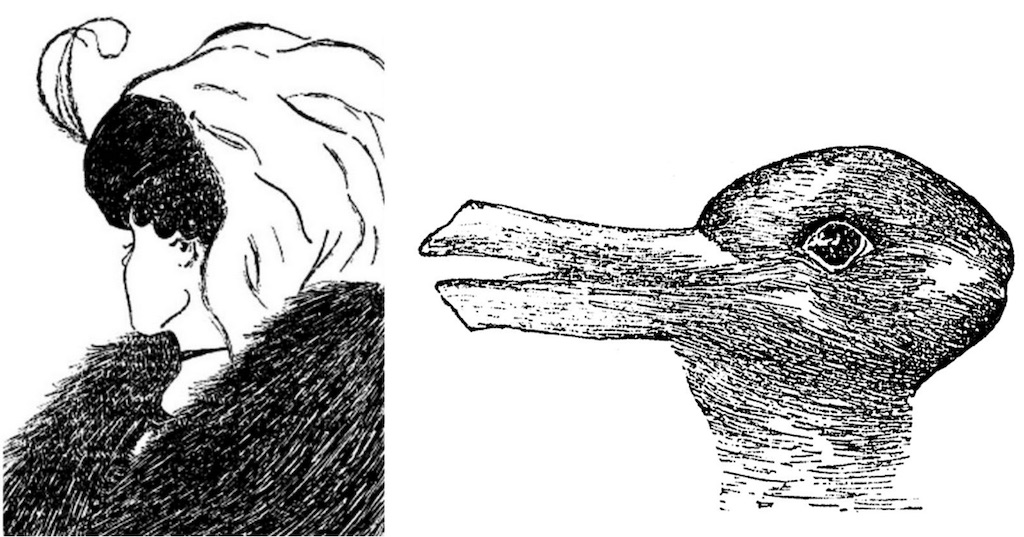
The Zhuangzi describes the mechanism of the simultaneous generation of ‘this-that’ distinctions (彼是方生之說, bǐ shì fāng shēng zhī shuō): one knows a view based on the specific point they occupy. Drawing a distinction generates one identity (“this” / the action) while simultaneously demising another (“that” / the reaction). Every category we inhabit shapes what can appear at all, constructing a reality for the user while actively occluding alternative ways of seeing.
Naming essentializes what is inexhaustible
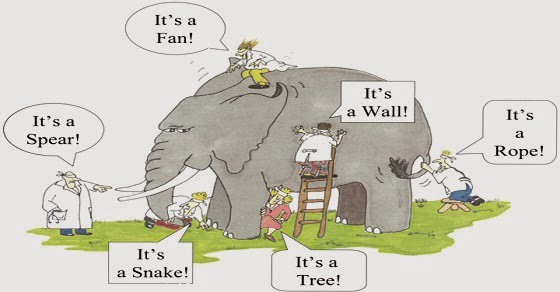
The Daodejing opens with a fundamental insight about systems and parts: “The name that can be named is not the constant name” (名可名,非常名, míng kě míng, fēi cháng míng). Naming takes one part or aspect of an inexhaustible whole and elevates it as the defining essence. The more refined our arguments become, the more effectively they foreclose what they exclude.
What is said is always partly unsaid
Because of this logo-(non)capacity, there are always structural gaps between what I mean (my action), what I say (reaction to my intention/my action upon the other), and what the other hears (their reaction shaped by their own point and view). The Zhuangzi notes that what speech discourses about is characteristically indeterminate (所言者特未定也, suǒ yán zhě tè wèi dìng yě). Language operates as 糟魄 (zāo pò, dregs and sediment) — the lossy residue left behind after a living encounter has passed into articulation. Sophisticated argumentation only exchanges these sediments, multiplying the surfaces on which misreading can occur.


Judgment always depends on pre-judgment
Any judgment of “right” or “wrong” requires a community that already shares pre-judgments about what counts as evidence or validity. When applied across genuine framework differences, rational judgment cannot adjudicate neutrally. It can only carry the pre-judgments of whichever framework the adjudicator inhabits, imposing them as universal standards.
Aspective Reality: Why Every View Is Genuinely Real
Critical realism distinguishes between the intransitive domain (reality as it is, independent of our knowledge) and the transitive domain (our situated, historically bounded knowledge of it). Daoist philosophy arrives at the exact same ontological position: “The Dao that can be Dao-ed is not the constant Dao” (道可道,非常道, dào kě dào, fēi cháng dào). The constant Dao is an inexhaustible reality, while the Dao that can be articulated is real but inherently partial.
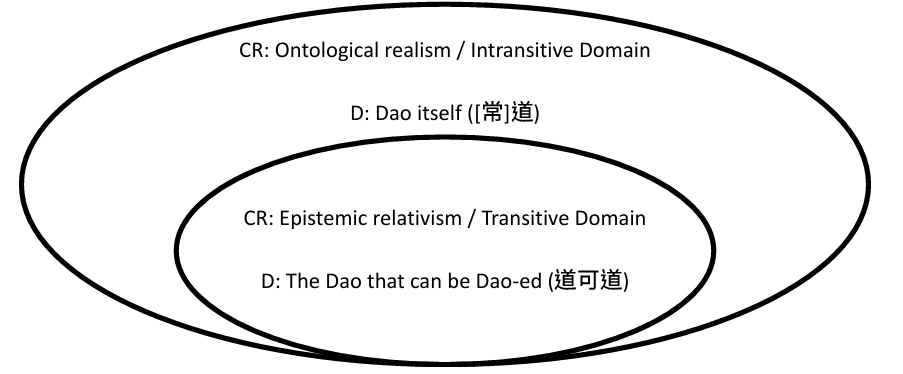
This requires a frank acknowledgment of finitude. Every knower inhabits specific capacities, positionalities, and temporalities. The epistemic performances of every knower — what they see, articulate, judge, feel — are genuine manifestations of the Dao/reality, not free inventions. They arise from real conditions (a body, a history, a position, a trained attention) that are themselves real. And the content they produce — the knowledge, the claim, the narrative, the feeling — is a real crystallization of what those conditions can access of the world.
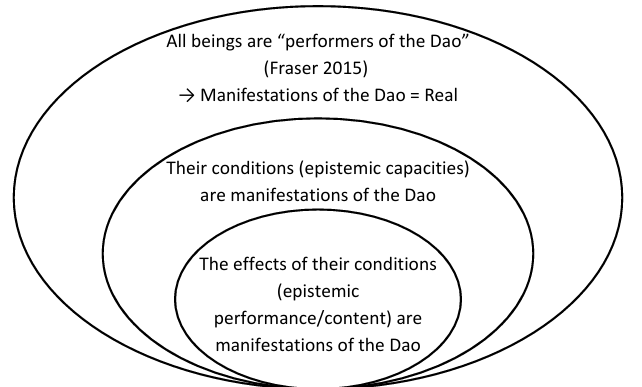
From this follows the concept’s defining claim: our epistemic performances are aspective — they genuinely represent some aspects of reality while necessarily leaving others inaccessible. “Aspective” does not mean “distorted” or “biased” in a pejorative sense; it means partial in the specific way that every finite, situated knower is partial. This is not relativism: the aspects that are tracked are genuinely real, not fabricated. But neither is it absolutism: no finite knower tracks all aspects, and the claim to do so is always an aspective move that has forgotten its own conditions.

The practical consequence is significant. When two parties hold apparently contradictory positions, the most productive first question is not “which one is right?” but “what aspect of a shared, inexhaustible reality is each tracking from its specific epistemic position?” The goal of cross-framework encounter is not the elimination of one view by the other — it is the possibility of a more comprehensive, multi-aspective grasp of the situation: one that both sides could not have achieved alone, and that requires genuine encounter rather than victorious argument to reach.
Map of Intervention Points: Why Standard Fixes Fail
When faced with incommunicability, standard systemic responses almost always fall into compensatory traps rather than transformative ones.
- Debunking and Fact-checking: This approach aims to correct the propositional content of a belief. It is compensatory because it treats the symptom (the “false” claim) while ignoring the real causal conditions (the lived experiences and systemic injuries) that make the narrative adhesive.
- Strategic Bridge-Building / “Finding Common Ground”: This approach attempts to build shared policy or diplomatic architecture while ignoring underlying ontological divides. It is compensatory because it treats incommunicability as a mere lack of coordination rather than a clash of genuinely real, historically grounded conditions.
- Transformative Intervention (Engaging Conditions): Response-able Awareness shifts intervention from defeating beliefs to engaging their generative conditions. Rather than asking “How do I change this person?”, the transformative approach asks “What is the information environment and causal structure that makes this belief feel true and necessary?” This redirect moves from interpersonal confrontation to structural care.
Response-able Awareness
Response-able Awareness is the generative alternative this framework proposes. The compound is deliberate: it names both the capacity to respond (to be genuinely moved and changed by what one encounters) and the responsibility toward the other (the ethical bearing and care required to hold space for their lived reality).
It is grounded in the Daoist practice of 心齋 (xīn zhāi, fasting of the heart-mind): a practice of gradually emptying the heart-mind of its accumulated pre-judgments and defensive formations to become genuinely receptive. It moves away from fixing one’s own categorical framework as the universal measure, and instead cultivates flowing cognition — attuning to the situation before imposing a frame on it.
Because all language is zāo pò (sediment), genuine communication requires cultivating the capacity to sense what the sediment is pointing toward, before and beyond its propositional content. This parallels Eugene Gendlin’s focusing (attending to the pre-articulate felt sense) and Virginia Satir’s congruent communication (attending to the whole person rather than engaging in surface-level language and behaviors). Response-able Awareness does not aim primarily at consensus; it aims at resonance.
Transfactual Manifestations
The incommunicability trap operates at scale wherever people holding genuinely different frameworks must act together.
- Policy and governance: Technical expertise regularly fails to persuade the public because what counts as relevant evidence or legitimate authority is itself aspective. Rational argument addressed to the propositional surface fails to reach real causal conditions.
- Science communication: Debunking campaigns frequently strengthen conviction among those committed to opposing frameworks. The structural reason is not irrationality, but that correction within one framework is received as a pre-judgment by another.
- Institutional and organizational change: Resistance to change almost always carries real information about aspects of the situation that the dominant frame cannot access. Treating resistance as ignorance reliably produces entrenchment; treating it as aspective input cultivates adaptation.
Theoretical Positioning
This framework positions itself at the intersection of several traditions:
- It extends Bhaskar’s Critical Realism into epistemological practice: aspective reality is not just a theoretical claim about stratification, but a call for a specific kind of relational practice.
- It operationalizes Zhuangzi and Laozi’s epistemology for contemporary cross-paradigm conflict, showing that flowing cognition and the sediment-nature of language are structurally precise accounts of logo-(non)capacity.
- It maps seamlessly onto Systems Thinking (DSRP Theory, Cabrera & Cabrera), identifying how the simultaneous generation of distinctions, part-whole essentializing, and action-reaction gaps structurally manufacture polarization.
- It complements Habermasian communicative rationality while deepening its critique, addressing what happens when distortions in communication are not procedural, but epistemic-ontological.
References
Yang, Adler. “Daoist Wisdom in Post-Truth Times: Rethinking Rational Judgment.” Submitted and under revision. DOI: 10.13140/RG.2.2.27950.32323.
Yang, Adler. “Can Rational Judgment Ever Solve the Post-Truth Condition, or Does It Polarize Society Even Further? Insights from Daoism & Critical Realism.”
Yang, Adler. “The Limits of ‘Fact-Checking’: Embracing Plurality Might Be the Only Way to Achieve Universality.” LinkedIn Pulse.
Thomas, W.I., and Thomas, D.S. (1928). The Child in America: Behavior Problems and Programs. Knopf.
Bhaskar, Roy (2008). Dialectic: The Pulse of Freedom. Routledge.
Zhuangzi. The Complete Works of Zhuangzi. Trans. Burton Watson (2003). Columbia University Press.
Laozi. Daodejing. Trans. D. C. Lau (1963). Penguin Classics.
Bhaskar, Roy (1975). A Realist Theory of Science. Leeds Books.
Yang, Adler. “On ‘Incommunicability’: Mourning Shinzo Abe through Attack on Titan.” Matters (Traditional Chinese).
Satir, Virginia (1988). The New Peoplemaking. Science and Behavior Books.
Gendlin, Eugene T. (1978). Focusing. Everest House.
⑫ See Also
- Allocation Dependence — examines how institutional gatekeeping produces voluntary self-trimming; shares with this framework the analysis of how structural logics operate through participants’ own adaptive responses rather than only through external coercion.
- Modes of Dependencies — the broader framework that situates incommunicability in the context of artificiality and controllability dependence, demonstrating how opaque environments multiply aspective divides.
- Prefigurative Academia — proposes experimental knowledge-production practices that partially exit the logocentric, elimination-oriented epistemic norms of mainstream academia, creating space for resonance-oriented inquiry.
Read more
Paper Daoist Wisdom in Post-Truth Times: Rethinking Rational Judgment
Column [in Traditional Chinese] “One Abe with respective interpretations:” a “champion” or a “destroyer” of democratic peace?
How this connects
The centre is this page. Each mark is a page or a person that the site’s records link to it; a line between two marks means those two are linked as well.