演講報告:楊逸帆〈看見文憑主義底下的「分配依賴」:批判實在論取徑〉(2023)
本報告介紹楊逸帆的「分配依賴」理論,說明資源取得標準如何促成同化、能力剔除、不平等、異化與耗竭。
- 日期
- 2023-08-08
- 作者
- 智庫報告(機器草稿,未校閱)
- 原發表處
- Recording on YouTube
- 存檔日期
- 2026-11-21
- 日期
- 2023-08-08
- 作者
- 智庫報告(機器草稿,未校閱)
- 原發表處
- Recording on YouTube
- 存檔日期
- 2026-11-21
目錄
Adler Yang (楊逸帆) presented “Seeing ‘Allocation Dependence’ Underlying Diplomaism — A Critical Realist Approach” in a conference session at an event not identified in the recording; the video was uploaded on 8 August 2023. Yang argued that the persistence of diplomaism despite repeated educational reforms can be explained through “allocation dependence”: when people believe that access to necessary resources depends on satisfying allocation criteria, they reshape themselves around those criteria, producing recurring social harms.
From practical problems to underlying mechanisms
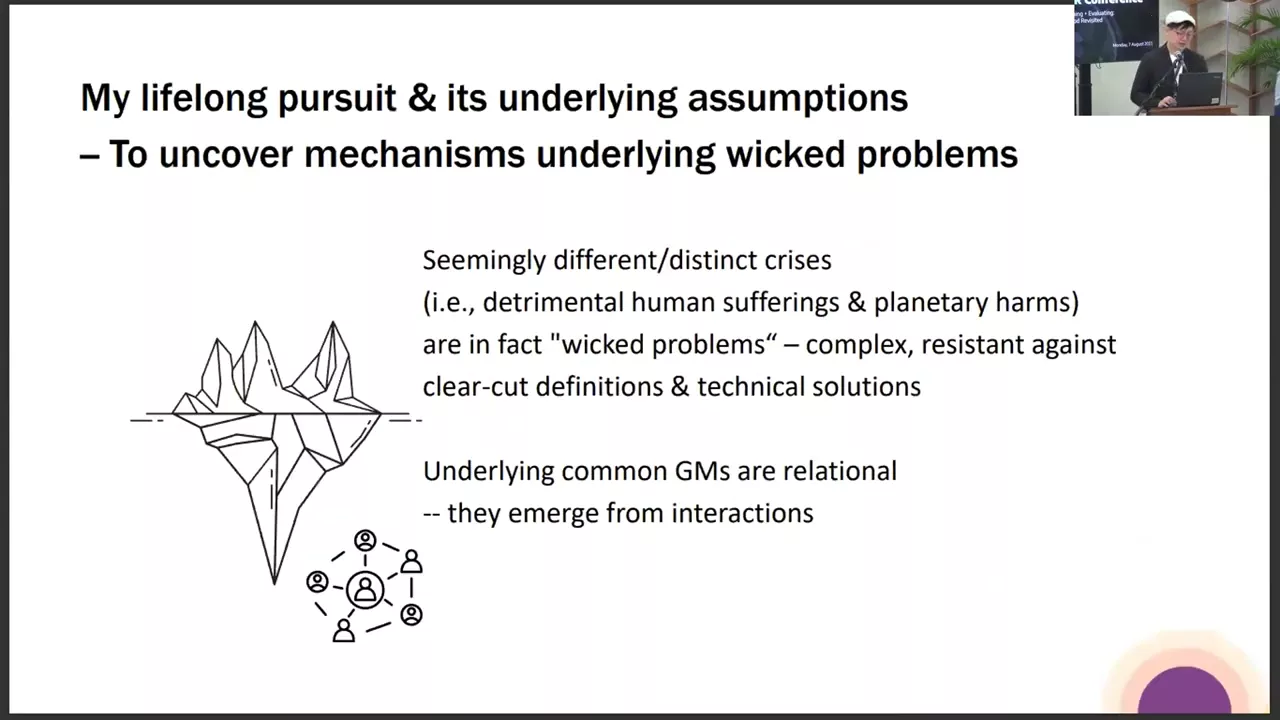
Yang situated the research in fourteen years of involvement in education reform and social innovation. He said that positivistic, reductionistic, mechanistic and anthropocentric approaches often lead reformers to address visible symptoms while leaving the mechanisms that reproduce problems intact. The same problems consequently return in different forms.
His independent research was guided initially by complex systems theory. He later found critical realism compatible with the work and useful for communicating it. Both approaches, he said, share an open-system, stratified and emergentist account of causality. He also stressed that the causes of wicked problems should not be expected to follow disciplinary boundaries.
Yang chose education as his initial field because it was accessible to him as a teenager and because education, understood broadly, forms people’s modes of relationship. He believed that this made the formation of generative mechanisms comparatively observable. Looking back, he associated this reasoning with Archer’s morphogenetic approach. He asked the audience for advice on improving the rigor of the research, dividing it into academically suitable publications and navigating academia. (0:01:31–0:04:10)
Diplomaism after educational reform
Yang selected diplomaism as a wicked problem because practices oriented toward educational credentials persisted even after admissions reforms. Roughly thirty years earlier, students concentrated on achieving high marks in entrance examinations. Later reforms sought to encourage holistic development and reduce cramming and teaching to the test. Yet competition shifted toward new admissions criteria: Yang showed an example of people waiting overnight for limited hospital volunteering places so that students could improve their admissions portfolios.
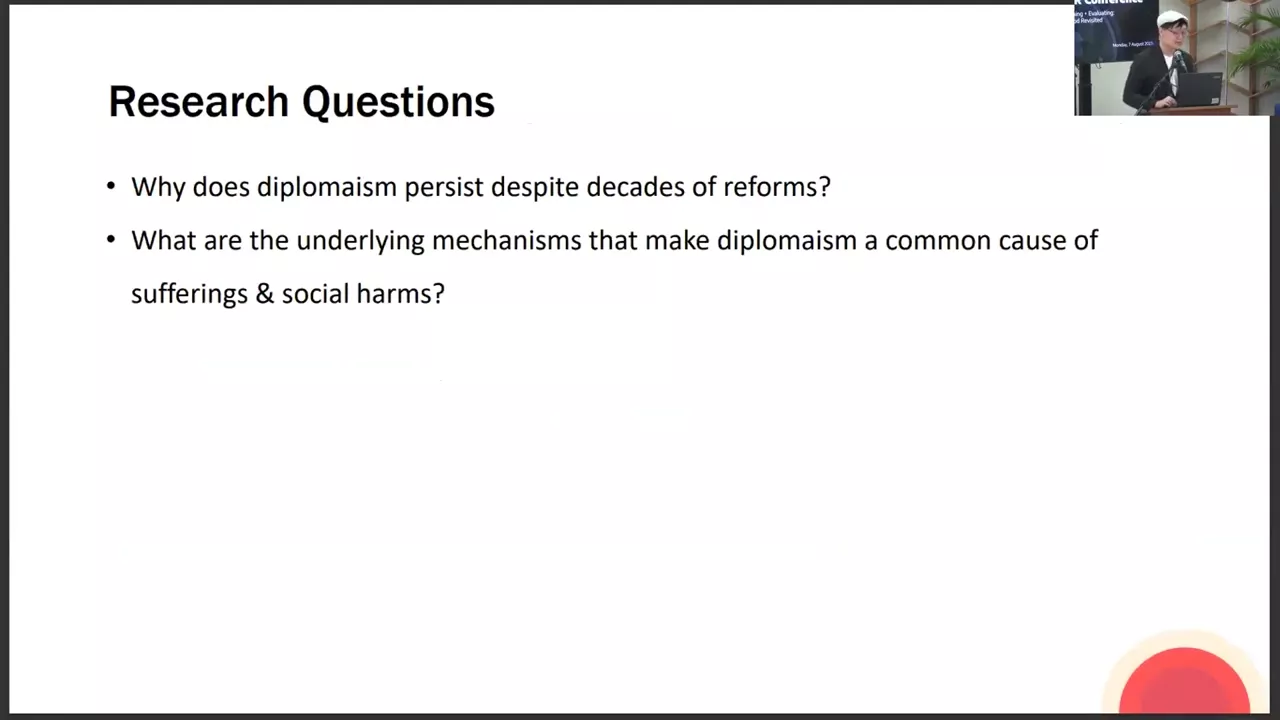
His research asked why diplomaism had persisted through decades of reform and which mechanisms made it a source of suffering and social harm. He identified two commonly accepted explanations: an ideology driven by what he called an imperial version of Confucianism, and competition caused by the scarcity and economic returns of desirable higher education.
To examine these explanations, Yang documented an alternative school whose teachers, parents and students had consciously rejected the relevant ideology and practices during a period when higher education was no longer scarce and its economic returns were not regarded as strong. His material included video ethnography, later used in a documentary, and interviews tracing students from elementary school through university graduation. He also considered their families’ socioeconomic and educational backgrounds.
At the surface level, the study appeared to support learning-centered or self-regulated education over traditional pedagogy. Qualitative observations, however, showed students voluntarily concluding that their interests, abilities and other learning mattered less than examination requirements, even though the school and their parents did not compel them to take that path.
Yang illustrated the process through a childhood friend who rode a unicycle, improvised jazz, taught himself 3D animation before Wikipedia existed and developed theoretical models of the universe. The student initially dismissed examination achievement, comparing it to diet cola: filling but nutritionally empty. He later abandoned these activities to prepare for tests, believing that a desirable education would help him realize his potential.
The student entered a selective traditional high school but did not gain admission to his preferred university subject. When he prepared to transfer, a family financial crisis required him to earn money. Yang reasoned that continued work in 3D animation might have given him eight years of experience by age eighteen. Having suspended those pursuits, however, he lacked employable skills and joined the military as a professional soldier to reduce his family’s burden. (0:04:11–0:10:29)
The structure and effects of allocation dependence
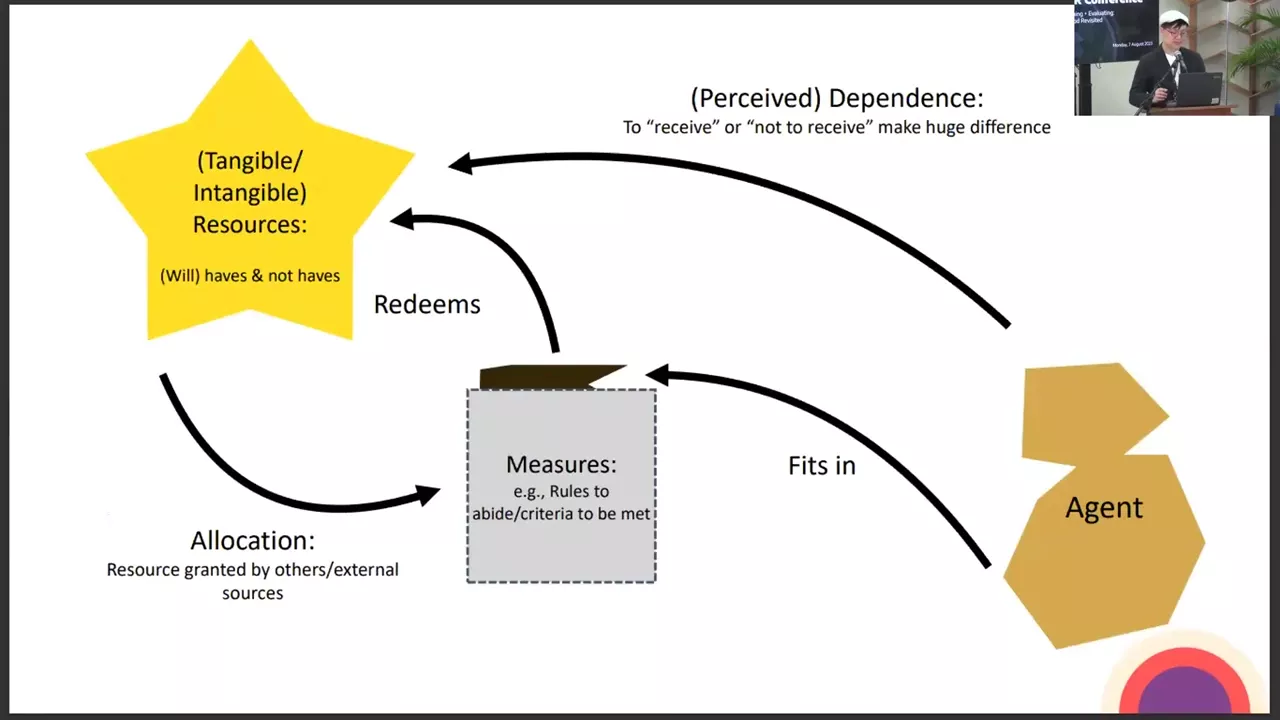

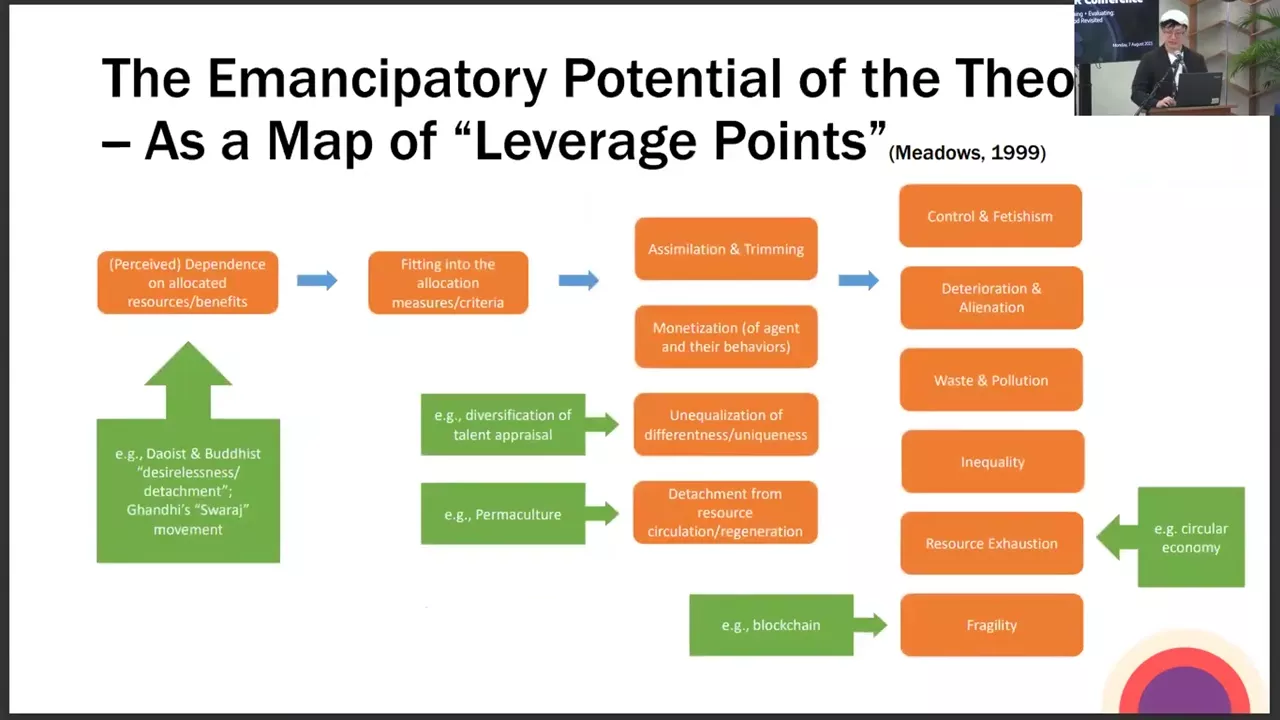
From such cases, Yang developed the concept of allocation dependence. The mechanism arises when an agent perceives—accurately or otherwise—that access to a resource depends on an allocation process. The agent therefore tries to satisfy its measures in order to redeem the resource.
Yang described four immediate features. “Assimilation” is the acquisition of qualities demanded by the allocation measures, while “trimming” removes qualities that do not fit them. Monetization makes agents less attentive to the intrinsic value of either the acquired or discarded qualities: conformity to the measures functions like money by determining the amount or quality of resources obtainable. Unequalization follows because agents differ in their initial affinity with the measures. Finally, attention shifts away from circulating or regenerating resources and toward securing them through allocation.
He associated allocation dependence with several causal effects. It enables control through the formation of agents and the resources that permit particular forms of life, while fetishism influences thought and conduct. Assimilation, trimming, misallocation and neglect of intrinsic value can also produce alienation, which Yang compared to the social counterpart of deteriorating health.
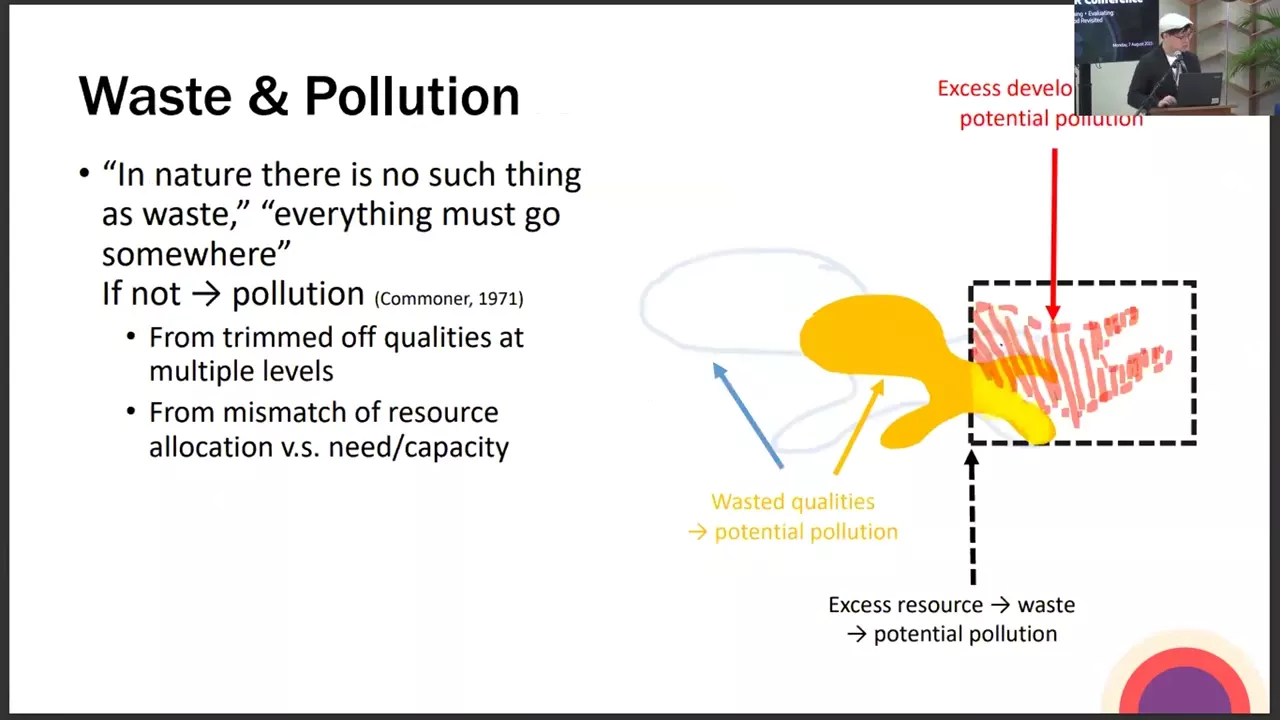
Using the ecological proposition that everything must go somewhere, Yang treated discarded qualities as waste that can become pollution. At a broader scale, people excluded from schools or labor markets may become risks to themselves and society. Inequality grows because initial differences in fit compound over time, even if agents begin with equal resources. Resource exhaustion also follows when regeneration and recirculation are externalized from the allocation-and-redemption process. (0:10:30–0:14:44)
Applications, fragility and possible intervention
Yang argued that allocation-dependent structures are fragile: larger and more sophisticated networks become vulnerable when dependence increases and redundancy, diversity and alternatives decline. Failure in one part may disrupt the whole structure, as occurred when the educational system did not fulfill the expectations of the student in his example.
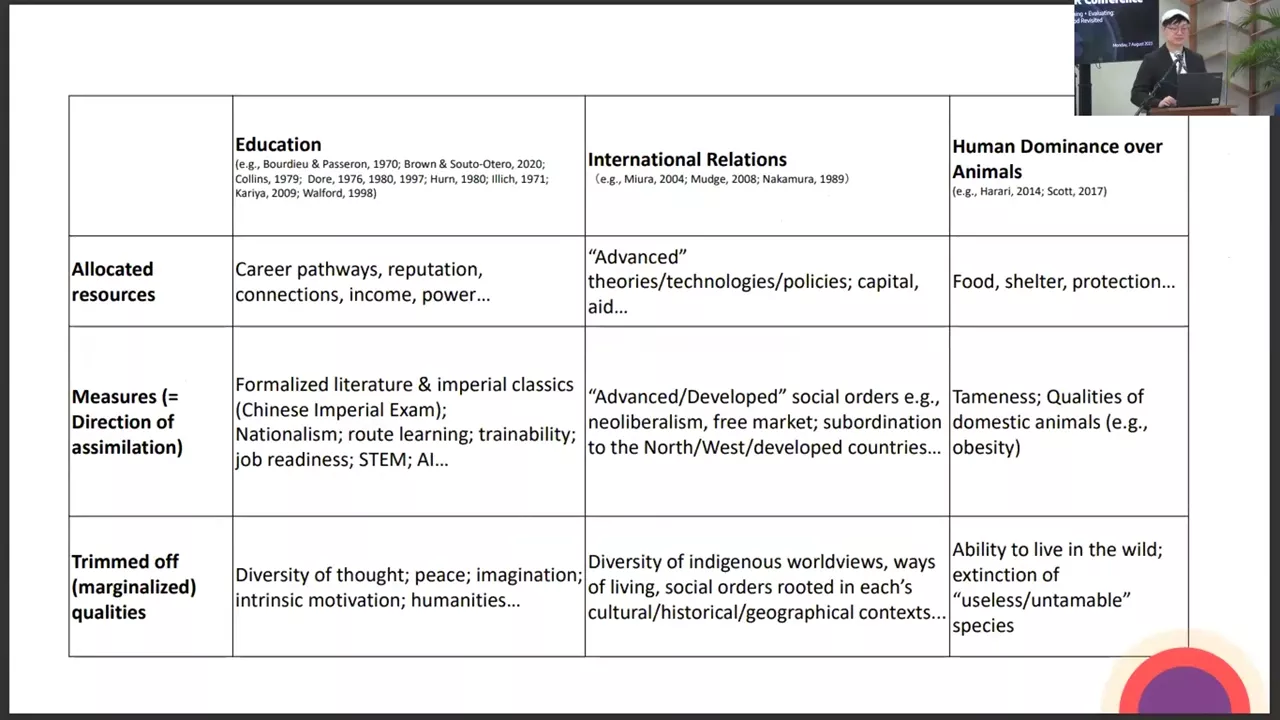
He then traced the mechanism across domains. In imperial China, candidates recited formalized literature and imperial classics to obtain bureaucratic posts, with diversity of thought among the qualities trimmed away. Under a neoliberal regime, criteria such as trainability, job readiness and STEM capacity can marginalize the social sciences and humanities. In international relations, countries categorized as underdeveloped may adapt to measures imposed by developed countries to obtain resources, losing Indigenous worldviews and ways of living. Animals dependent on human food, shelter and protection similarly conform to human criteria for domesticity while losing capacities for life in the wild; at the species level, those that do not fit may become extinct.
Yang maintained that the causal powers associated with allocation dependence remain available wherever the structure exists, although they do not always generate wicked problems. A leverage-points map could evaluate interventions: the circular economy, for example, addresses resource exhaustion but not the deeper processes of assimilation and trimming. He closed by identifying further questions about practices that might reduce allocation dependence and other mechanisms that enable or sustain it. (0:14:45–0:18:58)
Discussion
An unnamed respondent advised Yang to review literature on meritocracy and examination culture, distinguish realistic allocation constraints from perceptions, connect the proposed mechanism more explicitly to critical realism and separate agent-centered mechanisms from external conditions with causal powers.
Rina questioned whether “dependence” placed too much responsibility on students who might instead be forced into industrialized educational systems. Citing the Philippines, she noted that credentials could be required even for dishwashing work. She suggested examining structure, agency and culture, as well as an imperial and exploitative mode of living. Yang replied that his Taiwanese natural experiment showed similar conduct even without some commonly proposed external forces. From a complex adaptive systems perspective, he said, dependence could operate whether externally enforced or internally driven.
Another respondent recommended separating the material into different articles, including complexity-oriented and critical-realist treatments. Karen questioned whether the educational system was dysfunctional or effectively disciplining students by suppressing their passions. Yang answered that Taiwan’s Ministry of Education had repeatedly sought more holistic and creative education, yet cramming persisted after admissions reforms. He proposed that accounts based on hidden curricula or governmental agendas explained some cases but not every recurrence of the pattern. (0:18:59–0:31:58)