演講報告:柳靜(유정 Jeong Ryu)〈自強不息的成員,共創堅韌的學習社群〉
本講演記錄Jeong Ryu的合作高等教育模式,說明多元參與者如何流通知識、表述社會問題並重新理解大學。
- 活動
- 反脆弱的教育新典範:一場從雙E(效益、效率)到雙R(穩健、韌性)的典範轉移 (TIES 2020)
- 日期
- 2020-11-22
- 作者
- 智庫報告(機器草稿,未校閱)
- 原發表處
- Recording on YouTube
- 存檔日期
- 2026-11-22
- 活動
- 反脆弱的教育新典範:一場從雙E(效益、效率)到雙R(穩健、韌性)的典範轉移 (TIES 2020)
- 日期
- 2020-11-22
- 作者
- 智庫報告(機器草稿,未校閱)
- 原發表處
- Recording on YouTube
- 存檔日期
- 2026-11-22
目錄
Jeong Ryu, Professor at Knowledge Circulation Cooperative University (KCCU), spoke in Session 2, “Universities as the soil for Resilient and Robust Societies,” at the online 2020 Taiwan International Education Summit on 22 November 2020. Introduced by summit curator and session host Adler Yang, Ryu argued that universities can move from competitive education toward cooperative knowledge production by enabling people with different forms of expertise to research, teach, learn, and articulate social problems together.
Communities of Learning and Research
Ryu introduced herself as a cognitive scientist and cognitive psychologist interested in psychological trauma, human cognition, and the relationship between values and human development. She also described her interest in handicrafts, showing clothing and a bag she had made.
She situated her work within several communities. One was a community of professors concerned about the future of Korean universities and the possibility of recreating higher education in a better form. Another supported independent researchers, including people without graduate-school training. Its premise was that curiosity and the capacity to conduct research are not confined to formally credentialed academics.
Ryu then described an open cognitive science meeting that had continued since [unclear in recording, 0:46:23]. Participants with an interest in cognitive science could join, teach, and learn from one another. The meeting brought together people from fields including psychology, politics, and neuroscience. Its interdisciplinary character was intended to help participants examine human life and the mind from multiple perspectives.
Using an image of overlapping circles, Ryu explained that each discipline or individual sees the world through a limited viewpoint. The areas between those viewpoints could produce misunderstanding, but participants could also explain their concepts and methods to one another. Over approximately ten years, the community addressed annual themes including embodied mind, technology, and virtual reality. Ryu estimated that more than 3,000 people had participated through meetings and online communication. Membership was open across distinctions such as professor and student, young and old. (0:37:43–0:54:33)
From Competitive Education to Cooperative Knowledge
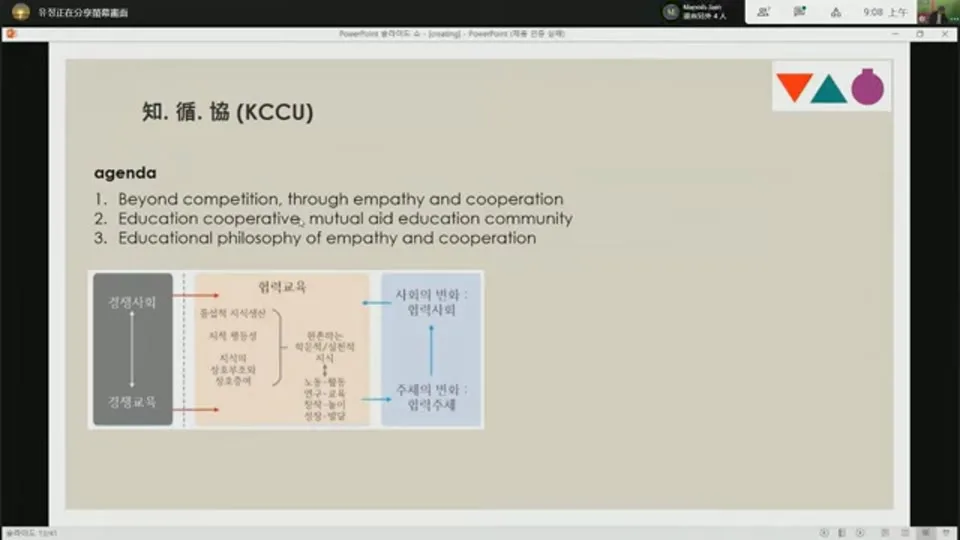
Turning to KCCU, Ryu described knowledge as something that should move among people rather than remain fixed or treated as a commodity. Members therefore formed a cooperative community, developed a curriculum, and took the roles of both teachers and students. Teaching and learning were treated as equal and reciprocal processes through which participants could grow.
With Ryu’s confirmation, Yang interpreted one of her diagrams as a movement from a competitive society and competitive education toward cooperative education. Three principles organized this alternative: interdisciplinary knowledge production, equality of knowledge, and mutual aid in knowledge. The intended direction was from cooperative educational practices to peaceful cooperative organizations and, through them, a peaceful cooperative society.
Ryu emphasized that KCCU’s curriculum, rules, and communication systems were made by its members. The university also had to communicate its purpose beyond the cooperative: a strong concept alone would not sustain KCCU if people did not understand it or wish to participate. (0:55:46–1:02:18)
Non-College Youth and the Circulation of Knowledge
More than 50 percent of KCCU’s entrants, Ryu said, were young people who did not attend conventional universities, including some who had attended college only part-time. They wanted to research, learn, and participate in knowledge creation but could not find an adequate place within Korea’s normal educational system.
These students also faced the problem of explaining their identities. Unlike people who could describe themselves through recognized roles such as professor or teacher, they repeatedly had to tell families and others why they had not entered a conventional university, why they continued to study, and why they wanted to become better human beings. Ryu said that many initially felt confused, but participation in KCCU helped them develop pride and undertake forms of social action. Their activities included making films and plays and writing for journals.
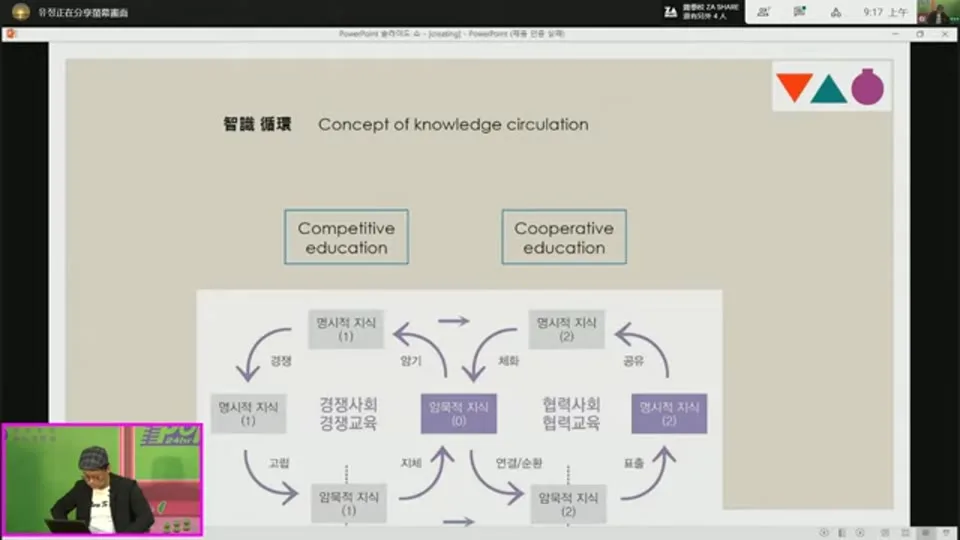
A second diagram contrasted two cycles of knowledge. Competitive education began with cramming or “spoon-feeding” and led toward competition and isolation. The cooperative cycle began with exploring, followed by explaining and sharing. Through repeated circulation, implicit knowledge became increasingly explicit and embodied. Ryu presented this process as the means by which education could change direction from competition to cooperation. (1:02:18–1:09:58)
Curriculum, Publication, and the Meaning of a University
KCCU organized its curriculum around three principles represented in Ryu’s slides by different colors, although part of her explanation was [unclear in recording, 1:09:58]. Each semester, students presented the concepts and knowledge they had developed. Presentations could take conventional academic forms or include performances.
For graduation, students completed a substantial project, described as a planning paper or related written work. Some later submitted their research to Korean journals. Ryu said their subjects arose from problems in Korean society, including disability and the experiences of young adults, which affected people directly but were often difficult for them to explain or assert publicly. Through essays and presentations, KCCU students learned to articulate these experiences. Graduates also maintained their own journal and an alumni organization.
Ryu concluded by returning to the small-group research process: participants formed questions, developed research concepts, and produced articles. This work reopened basic questions—“What is learning? What is teaching? Also, what is the university?” (1:16:55). Although a university contains members, curricula, hardware, and software, she asked which of these mattered most. Her answer emphasized senior and junior members empathizing with one another rather than treating curriculum alone as the institution’s defining element. (1:09:58–1:18:01)
Discussion
Yang summarized Ryu’s account as a response to two problems: a highly competitive university system that excludes or disadvantages many students, and the isolation of researchers from one another. He highlighted the cognitive science meetings as an example of collaborative work in which participants compare partial or distorted viewpoints and develop more mature knowledge through interaction.
He also restated KCCU’s movement from competitive education toward cooperation through interdisciplinarity, equality of knowledge, and mutual aid. In his account, students progressed from semester presentations to graduation projects and journal articles, enabling them to describe Korean social problems in their own words while retaining academic rigor.
Ryu confirmed Yang’s summary. Yang then referred to his earlier visit to KCCU, where he had encountered discussion of the Anthropocene as a large interdisciplinary problem. He contrasted this with conventional introductory courses divided by discipline and said that KCCU allowed students and professors to collaborate in the production of knowledge. (1:19:13–1:24:35)
關聯
中央是本頁。每個記號代表網站紀錄中與本頁相連的頁面或人物;兩個記號之間的線,表示這兩者彼此也有關聯。